


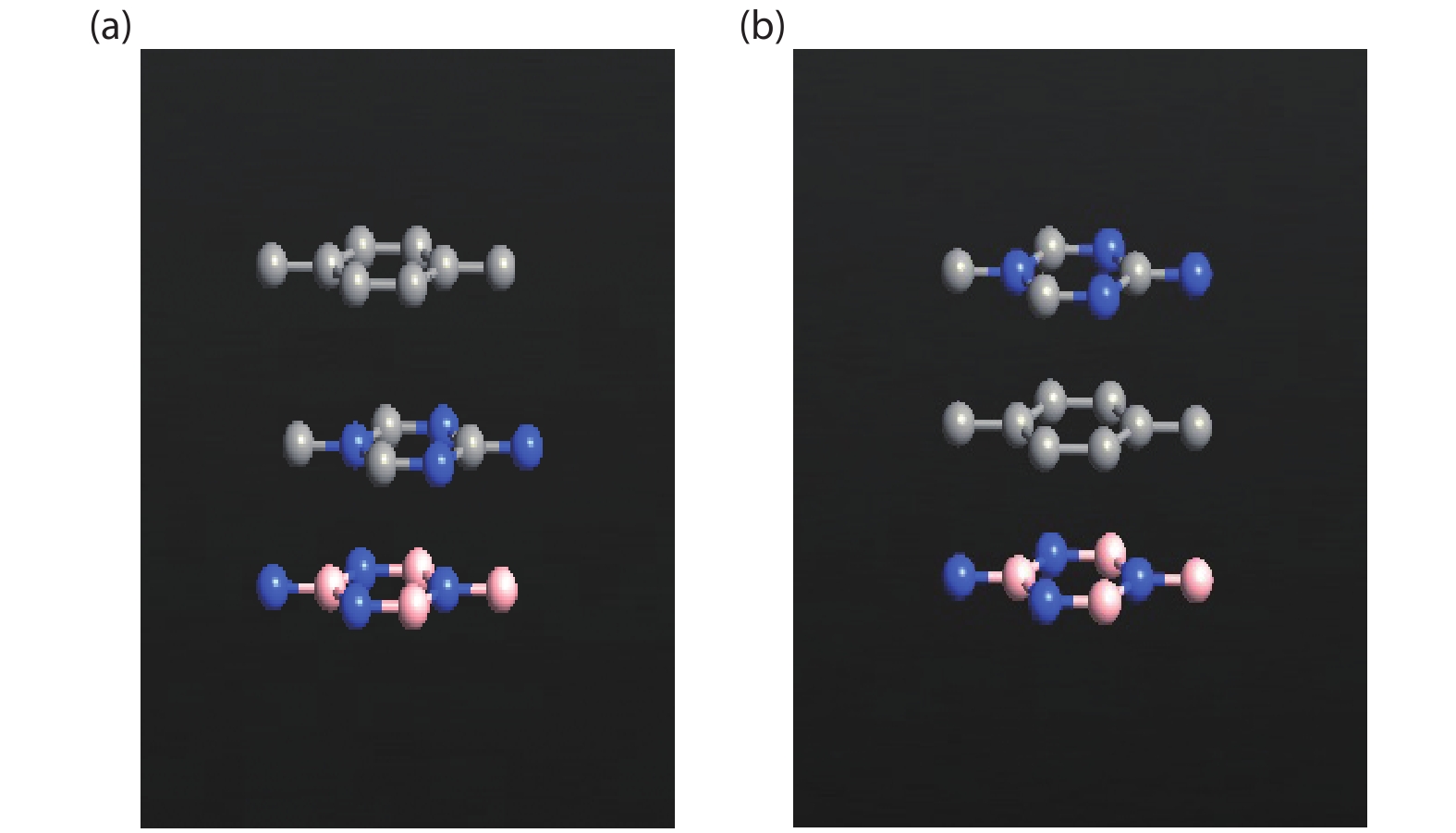
Fig. 1.
(Color online) Proposed heterostructures (a) G/g-C3N4/h-BN in ABA stack and (b) g-C3N4/G/h-BN in AAA stack.
ARTICLES
Santosh Kumar Gupta1, and Rupesh Shukla2,
Corresponding author: Santosh Kumar Gupta, E-mail: skg@mnnit.ac.in,; Rupesh Shukla, ritarupeshshukla@gmail.com
Abstract: The effect of an external electric field on the bandgap is observed for two proposed heterostructures graphitic carbon nitride-graphene-hexagonal boron nitride (g-C3N4/G/h-BN) in hexagonal stack (AAA) and graphene-graphitic carbon nitride-hexagonal boron nitride (G/g-C3N4/h-BN) in Bernal stack (ABA). Their inter-layer distance, binding energy and effective mass has also been calculated. The structure optimization has been done by density functional theory (DFT) with van der Waals corrections. The inter-layer distance, bandgap, binding energy and effective mass has been listed for these heterostructures and compared with that of bilayer graphene (BLG), graphene-hexagonal boron nitride (G/h-BN) hetero-bilayer, graphene-graphitic carbon nitride (G/g-C3N4) hetero-bilayer and graphitic carbon nitride-graphene- graphitic carbon nitride (g-C3N4/G/g-C3N4) heterostructure in Bernal and hexagonal stack. g-C3N4/G/h-BN is found to offer lower effective mass and larger bandgap opening among the considered heterostructures.
Key words: bandgap, graphene, h-BN, g-C3N4, binding energy, DFT
| [1] |
Geim A K, Novoselov K S. The rise of graphene. Nat Mater, 2007, 6: 183 doi: 10.1038/nmat1849
|
| [2] |
Gupta M, Gaur N, Kumar P, et al. Tailoring the electronic properties of a Z-shaped graphene field effect transistor via B/N doping. Phys Lett A, 2015, 379: 710 doi: 10.1016/j.physleta.2014.12.046
|
| [3] |
Novoselov K S, Geim A K, Morozov S. Electric field effect in atomically thin carbon films. Science, 2004, 306: 666 doi: 10.1126/science.1102896
|
| [4] |
Wang X R, Ouyang Y J, Li X L, et al. Room-temperature all semiconducting sub-10-nm Graphene nanoribbon field-effect transistors. Phys Rev Lett, 2008, 100: 206803 doi: 10.1103/PhysRevLett.100.206803
|
| [5] |
Giovannetti G, Khomyakov P A, Brocks G, et al. Substrate induced band gap in Graphene on hexagonal boron nitride: Ab initio density functional calculations. Phys Rev B, 2007, 76: 073103 doi: 10.1103/PhysRevB.76.073103
|
| [6] |
Ao Z M, Peeters F M. electric field activated hydrogen dissociative adsorption to nitrogen-doped graphene. J Phys Chem C, 2010, 114(34): 14503 doi: 10.1021/jp103835k
|
| [7] |
Zhou J, Wu M M, Zhou X, et al. Tuning electronic and magnetic properties of Graphene by surface modification. Appl Phys Lett, 2009, 95: 103108 doi: 10.1063/1.3225154
|
| [8] |
Choi S M, Jhi S H, Son Y W. Effects of strain on electronic properties of Graphene. Phys Rev B, 2010, 81: 081407 doi: 10.1103/PhysRevB.81.081407
|
| [9] |
Zhang Y, Tang T T, Girit C, et al. Direct observation of a widely tunable bandgap in bilayer graphene. Nature, 2009, 459: 820 doi: 10.1038/nature08105
|
| [10] |
Tao W, Qing G, Yan L, et al. A comparative investigation of an AB- and AA-stacked bilayer Graphene sheet under an applied electric field: A density functional theory study. Chin Phys B, 2012, 21(6): 067301 doi: 10.1088/1674-1056/21/6/067301
|
| [11] |
Avetisyan A A, Partoens B, Peeters F M. Stacking order dependent electric field tuning of the band gap in Graphene multilayers. Phys Rev B, 2010, 81: 115432 doi: 10.1103/PhysRevB.81.115432
|
| [12] |
Zhu J, Xiao P, Li H, et al. Graphitic Carbon Nitride: Synthesis, Properties, and Applications in Catalysis. ACS Appl Mater Interf, 2014, 6: 16449 doi: 10.1021/am502925j
|
| [13] |
Li X R, Dai Y, Ma Y D, et al. Graphene/g-C3N4 bilayer: considerable band gap opening and effective band structure engineering. Phys Chem Chem Phys, 2014, 16: 4230 doi: 10.1039/c3cp54592j
|
| [14] |
Dong M M, He C, Zhang W X, et al. Tunable and sizable bandgap of g-C3N4/Graphene/g-C3N4 sandwich heterostructure: a Van Der Waals density functional study. J Mater Chem C, 2017, 5: 3830 doi: 10.1039/C7TC00386B
|
| [15] |
Hu Wei, Li Zhenyu, Yang Jinlong. Structural, electronic, and optical properties of hybrid silicene and graphene nanocomposite. J Chem Phys, 2013, 139: 154704 doi: 10.1063/1.4824887
|
| [16] |
Atomistix Toolkit version 2017.1, Synopsys Quantum Wise A/S (www.quantumwise.com)
|
| [17] |
Smidstrup S, et al. First-principles Green's-function method for surface calculations: A pseudopotential localized basis set approach. Phys Rev B, 2017, 96: 195309 doi: 10.1103/PhysRevB.96.195309
|
| [18] |
Schlipf M, Gygi F. Optimization algorithm for the generation of ONCV pseudopotentials. Comp Phys Commun, 2015, 196: 36 doi: 10.1016/j.cpc.2015.05.011
|
| [19] |
Setten M J van, et al. The PseudoDojo: Training and grading a 85 element optimized norm-conserving pseudopotential table. Comp Phys Comm, 2018, 226: 39-54 doi: 10.1016/j.cpc.2018.01.012
|
| [20] |
Stokbro K, et al. Semiempirical model for nanoscale device simulations, Phys Rev B, 2010, 82: 075420 doi: 10.1103/PhysRevB.82.075420
|
| [21] |
Pulay P. Convergence acceleration of iterative sequences, The case of SCF iteration. Chem Phys Lett, 1980, 73(2): 393 doi: 10.1016/0009-2614(80)80396-4
|
| [22] |
Wang J, Ma F, Sun M. Graphene, hexagonal boron nitride, and their heterostructures: properties and applications. RSC Adv, 2017, 7, 16801 doi: 10.1039/C7RA00260B
|
| [23] |
Ghosh R K, Mahapatra S. Proposal for Graphene-Boron Nitride Heterobilayer Based Tunnel FET. IEEE Trans Nanotechnol, 2013, 12(5): 665 doi: 10.1109/TNANO.2013.2272739
|
| [24] |
Ramasubramaniam A, Naveh D, Towe E. Tunable band gaps in bilayer Graphene/h-BN heterostructures. Nano Lett, 2011, 11: 1070 doi: 10.1021/nl1039499
|
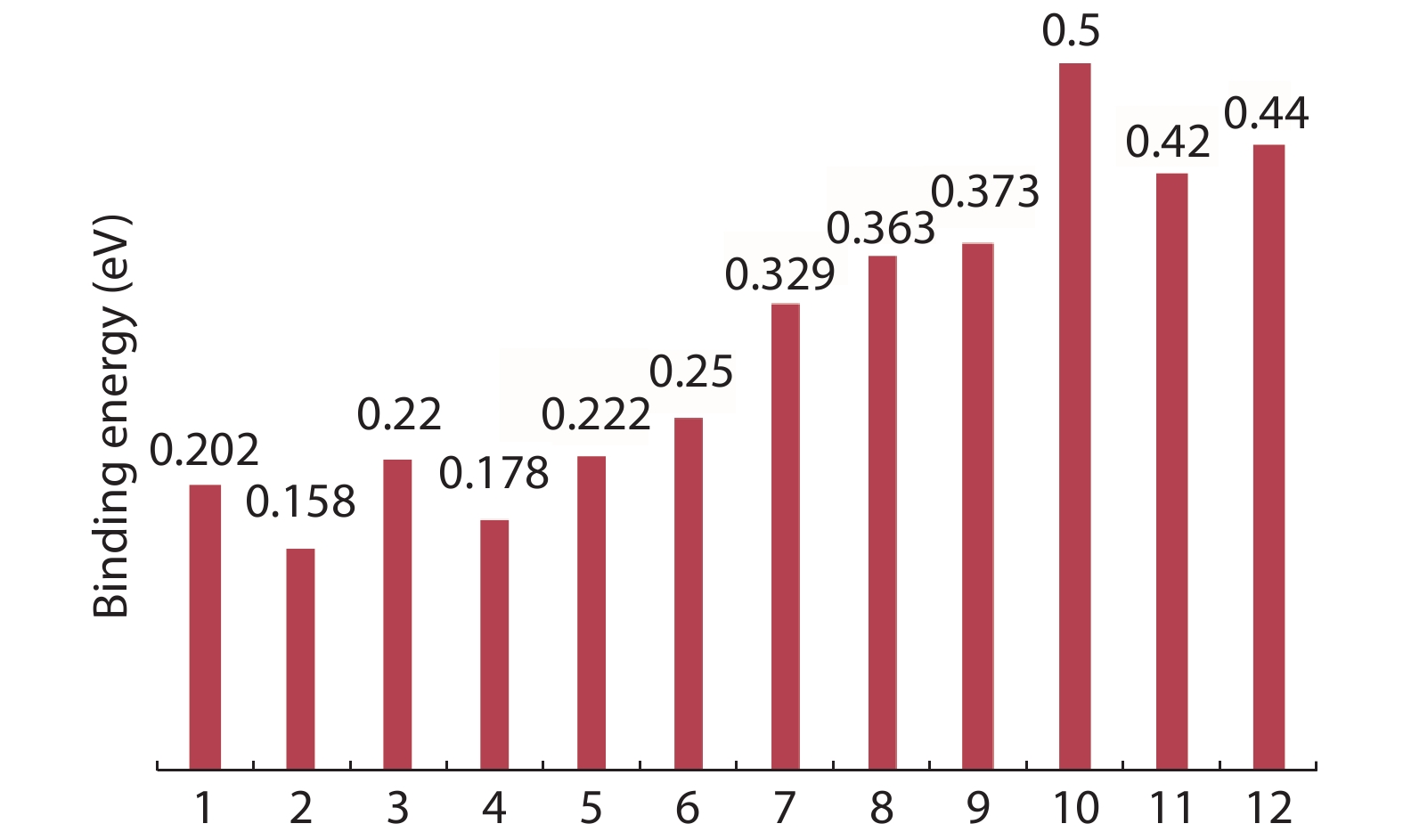
Table 3. Binding energies (Eb) for different heterostructures.
| Graphene structure | Binding energies (Eb) |
| BLG |


|
| G/BN |


|
| G/C3N4 |


|
| BN/G/BN |


|
| C3N4/G/C3N4 |


|
| G/C3N4/BN |


|
| C3N4/G/BN |


|
 DownLoad: CSV
Table 4. Effective mass at 6 V/nm field with interlayer distance (both d1 and d2) fixed at 2.8 ?.
| Graphene structure | Bernal stack | Hexagonal stack | |||
| Electron | Hole | Electron | Hole | ||
| BLG | 0.300 | 0.335 | 0.436 | 0.527 | |
| G/BN | 0.315 | 0.366 | 0.294 | 0.372 | |
| G/C3N4 | 0.286 | 0.324 | 0.268 | 0.349 | |
| BN/G/BN | 0.316 | 0.471 | 0.360 | 0.390 | |
| C3N4/G/C3N4 | 0.335 | 0.347 | 0.345 | 0.371 | |
| G/C3N4/BN | 0.354 | 0.415 | – | – | |
| C3N4/G/BN | – | – | 0.274 | 0.346 | |
DownLoad: CSV
| [1] |
Geim A K, Novoselov K S. The rise of graphene. Nat Mater, 2007, 6: 183 doi: 10.1038/nmat1849
|
| [2] |
Gupta M, Gaur N, Kumar P, et al. Tailoring the electronic properties of a Z-shaped graphene field effect transistor via B/N doping. Phys Lett A, 2015, 379: 710 doi: 10.1016/j.physleta.2014.12.046
|
| [3] |
Novoselov K S, Geim A K, Morozov S. Electric field effect in atomically thin carbon films. Science, 2004, 306: 666 doi: 10.1126/science.1102896
|
| [4] |
Wang X R, Ouyang Y J, Li X L, et al. Room-temperature all semiconducting sub-10-nm Graphene nanoribbon field-effect transistors. Phys Rev Lett, 2008, 100: 206803 doi: 10.1103/PhysRevLett.100.206803
|
| [5] |
Giovannetti G, Khomyakov P A, Brocks G, et al. Substrate induced band gap in Graphene on hexagonal boron nitride: Ab initio density functional calculations. Phys Rev B, 2007, 76: 073103 doi: 10.1103/PhysRevB.76.073103
|
| [6] |
Ao Z M, Peeters F M. electric field activated hydrogen dissociative adsorption to nitrogen-doped graphene. J Phys Chem C, 2010, 114(34): 14503 doi: 10.1021/jp103835k
|
| [7] |
Zhou J, Wu M M, Zhou X, et al. Tuning electronic and magnetic properties of Graphene by surface modification. Appl Phys Lett, 2009, 95: 103108 doi: 10.1063/1.3225154
|
| [8] |
Choi S M, Jhi S H, Son Y W. Effects of strain on electronic properties of Graphene. Phys Rev B, 2010, 81: 081407 doi: 10.1103/PhysRevB.81.081407
|
| [9] |
Zhang Y, Tang T T, Girit C, et al. Direct observation of a widely tunable bandgap in bilayer graphene. Nature, 2009, 459: 820 doi: 10.1038/nature08105
|
| [10] |
Tao W, Qing G, Yan L, et al. A comparative investigation of an AB- and AA-stacked bilayer Graphene sheet under an applied electric field: A density functional theory study. Chin Phys B, 2012, 21(6): 067301 doi: 10.1088/1674-1056/21/6/067301
|
| [11] |
Avetisyan A A, Partoens B, Peeters F M. Stacking order dependent electric field tuning of the band gap in Graphene multilayers. Phys Rev B, 2010, 81: 115432 doi: 10.1103/PhysRevB.81.115432
|
| [12] |
Zhu J, Xiao P, Li H, et al. Graphitic Carbon Nitride: Synthesis, Properties, and Applications in Catalysis. ACS Appl Mater Interf, 2014, 6: 16449 doi: 10.1021/am502925j
|
| [13] |
Li X R, Dai Y, Ma Y D, et al. Graphene/g-C3N4 bilayer: considerable band gap opening and effective band structure engineering. Phys Chem Chem Phys, 2014, 16: 4230 doi: 10.1039/c3cp54592j
|
| [14] |
Dong M M, He C, Zhang W X, et al. Tunable and sizable bandgap of g-C3N4/Graphene/g-C3N4 sandwich heterostructure: a Van Der Waals density functional study. J Mater Chem C, 2017, 5: 3830 doi: 10.1039/C7TC00386B
|
| [15] |
Hu Wei, Li Zhenyu, Yang Jinlong. Structural, electronic, and optical properties of hybrid silicene and graphene nanocomposite. J Chem Phys, 2013, 139: 154704 doi: 10.1063/1.4824887
|
| [16] |
Atomistix Toolkit version 2017.1, Synopsys Quantum Wise A/S (www.quantumwise.com)
|
| [17] |
Smidstrup S, et al. First-principles Green's-function method for surface calculations: A pseudopotential localized basis set approach. Phys Rev B, 2017, 96: 195309 doi: 10.1103/PhysRevB.96.195309
|
| [18] |
Schlipf M, Gygi F. Optimization algorithm for the generation of ONCV pseudopotentials. Comp Phys Commun, 2015, 196: 36 doi: 10.1016/j.cpc.2015.05.011
|
| [19] |
Setten M J van, et al. The PseudoDojo: Training and grading a 85 element optimized norm-conserving pseudopotential table. Comp Phys Comm, 2018, 226: 39-54 doi: 10.1016/j.cpc.2018.01.012
|
| [20] |
Stokbro K, et al. Semiempirical model for nanoscale device simulations, Phys Rev B, 2010, 82: 075420 doi: 10.1103/PhysRevB.82.075420
|
| [21] |
Pulay P. Convergence acceleration of iterative sequences, The case of SCF iteration. Chem Phys Lett, 1980, 73(2): 393 doi: 10.1016/0009-2614(80)80396-4
|
| [22] |
Wang J, Ma F, Sun M. Graphene, hexagonal boron nitride, and their heterostructures: properties and applications. RSC Adv, 2017, 7, 16801 doi: 10.1039/C7RA00260B
|
| [23] |
Ghosh R K, Mahapatra S. Proposal for Graphene-Boron Nitride Heterobilayer Based Tunnel FET. IEEE Trans Nanotechnol, 2013, 12(5): 665 doi: 10.1109/TNANO.2013.2272739
|
| [24] |
Ramasubramaniam A, Naveh D, Towe E. Tunable band gaps in bilayer Graphene/h-BN heterostructures. Nano Lett, 2011, 11: 1070 doi: 10.1021/nl1039499
|









Article views: 4628 Times PDF downloads: 76 Times Cited by: 0 Times
Received: 25 March 2018 Revised: 06 August 2018 Online: Accepted Manuscript: 05 January 2019Uncorrected proof: 09 January 2019Published: 01 March 2019
| Citation: |
Santosh Kumar Gupta, Rupesh Shukla. Bandgap engineered novel g-C3N4/G/h-BN heterostructure for electronic applications[J]. Journal of Semiconductors, 2019, 40(3): 032801. doi: 10.1088/1674-4926/40/3/032801
****
S K Gupta, R Shukla, Bandgap engineered novel g-C3N4/G/h-BN heterostructure for electronic applications[J]. J. Semicond., 2019, 40(3): 032801. doi: 10.1088/1674-4926/40/3/032801.

|
| [1] |
Geim A K, Novoselov K S. The rise of graphene. Nat Mater, 2007, 6: 183 doi: 10.1038/nmat1849
|
| [2] |
Gupta M, Gaur N, Kumar P, et al. Tailoring the electronic properties of a Z-shaped graphene field effect transistor via B/N doping. Phys Lett A, 2015, 379: 710 doi: 10.1016/j.physleta.2014.12.046
|
| [3] |
Novoselov K S, Geim A K, Morozov S. Electric field effect in atomically thin carbon films. Science, 2004, 306: 666 doi: 10.1126/science.1102896
|
| [4] |
Wang X R, Ouyang Y J, Li X L, et al. Room-temperature all semiconducting sub-10-nm Graphene nanoribbon field-effect transistors. Phys Rev Lett, 2008, 100: 206803 doi: 10.1103/PhysRevLett.100.206803
|
| [5] |
Giovannetti G, Khomyakov P A, Brocks G, et al. Substrate induced band gap in Graphene on hexagonal boron nitride: Ab initio density functional calculations. Phys Rev B, 2007, 76: 073103 doi: 10.1103/PhysRevB.76.073103
|
| [6] |
Ao Z M, Peeters F M. electric field activated hydrogen dissociative adsorption to nitrogen-doped graphene. J Phys Chem C, 2010, 114(34): 14503 doi: 10.1021/jp103835k
|
| [7] |
Zhou J, Wu M M, Zhou X, et al. Tuning electronic and magnetic properties of Graphene by surface modification. Appl Phys Lett, 2009, 95: 103108 doi: 10.1063/1.3225154
|
| [8] |
Choi S M, Jhi S H, Son Y W. Effects of strain on electronic properties of Graphene. Phys Rev B, 2010, 81: 081407 doi: 10.1103/PhysRevB.81.081407
|
| [9] |
Zhang Y, Tang T T, Girit C, et al. Direct observation of a widely tunable bandgap in bilayer graphene. Nature, 2009, 459: 820 doi: 10.1038/nature08105
|
| [10] |
Tao W, Qing G, Yan L, et al. A comparative investigation of an AB- and AA-stacked bilayer Graphene sheet under an applied electric field: A density functional theory study. Chin Phys B, 2012, 21(6): 067301 doi: 10.1088/1674-1056/21/6/067301
|
| [11] |
Avetisyan A A, Partoens B, Peeters F M. Stacking order dependent electric field tuning of the band gap in Graphene multilayers. Phys Rev B, 2010, 81: 115432 doi: 10.1103/PhysRevB.81.115432
|
| [12] |
Zhu J, Xiao P, Li H, et al. Graphitic Carbon Nitride: Synthesis, Properties, and Applications in Catalysis. ACS Appl Mater Interf, 2014, 6: 16449 doi: 10.1021/am502925j
|
| [13] |
Li X R, Dai Y, Ma Y D, et al. Graphene/g-C3N4 bilayer: considerable band gap opening and effective band structure engineering. Phys Chem Chem Phys, 2014, 16: 4230 doi: 10.1039/c3cp54592j
|
| [14] |
Dong M M, He C, Zhang W X, et al. Tunable and sizable bandgap of g-C3N4/Graphene/g-C3N4 sandwich heterostructure: a Van Der Waals density functional study. J Mater Chem C, 2017, 5: 3830 doi: 10.1039/C7TC00386B
|
| [15] |
Hu Wei, Li Zhenyu, Yang Jinlong. Structural, electronic, and optical properties of hybrid silicene and graphene nanocomposite. J Chem Phys, 2013, 139: 154704 doi: 10.1063/1.4824887
|
| [16] |
Atomistix Toolkit version 2017.1, Synopsys Quantum Wise A/S (www.quantumwise.com)
|
| [17] |
Smidstrup S, et al. First-principles Green's-function method for surface calculations: A pseudopotential localized basis set approach. Phys Rev B, 2017, 96: 195309 doi: 10.1103/PhysRevB.96.195309
|
| [18] |
Schlipf M, Gygi F. Optimization algorithm for the generation of ONCV pseudopotentials. Comp Phys Commun, 2015, 196: 36 doi: 10.1016/j.cpc.2015.05.011
|
| [19] |
Setten M J van, et al. The PseudoDojo: Training and grading a 85 element optimized norm-conserving pseudopotential table. Comp Phys Comm, 2018, 226: 39-54 doi: 10.1016/j.cpc.2018.01.012
|
| [20] |
Stokbro K, et al. Semiempirical model for nanoscale device simulations, Phys Rev B, 2010, 82: 075420 doi: 10.1103/PhysRevB.82.075420
|
| [21] |
Pulay P. Convergence acceleration of iterative sequences, The case of SCF iteration. Chem Phys Lett, 1980, 73(2): 393 doi: 10.1016/0009-2614(80)80396-4
|
| [22] |
Wang J, Ma F, Sun M. Graphene, hexagonal boron nitride, and their heterostructures: properties and applications. RSC Adv, 2017, 7, 16801 doi: 10.1039/C7RA00260B
|
| [23] |
Ghosh R K, Mahapatra S. Proposal for Graphene-Boron Nitride Heterobilayer Based Tunnel FET. IEEE Trans Nanotechnol, 2013, 12(5): 665 doi: 10.1109/TNANO.2013.2272739
|
| [24] |
Ramasubramaniam A, Naveh D, Towe E. Tunable band gaps in bilayer Graphene/h-BN heterostructures. Nano Lett, 2011, 11: 1070 doi: 10.1021/nl1039499
|

 WeChat ID
Journal of Semiconductors © 2017 All Rights Reserved 京ICP備05085259號-2