


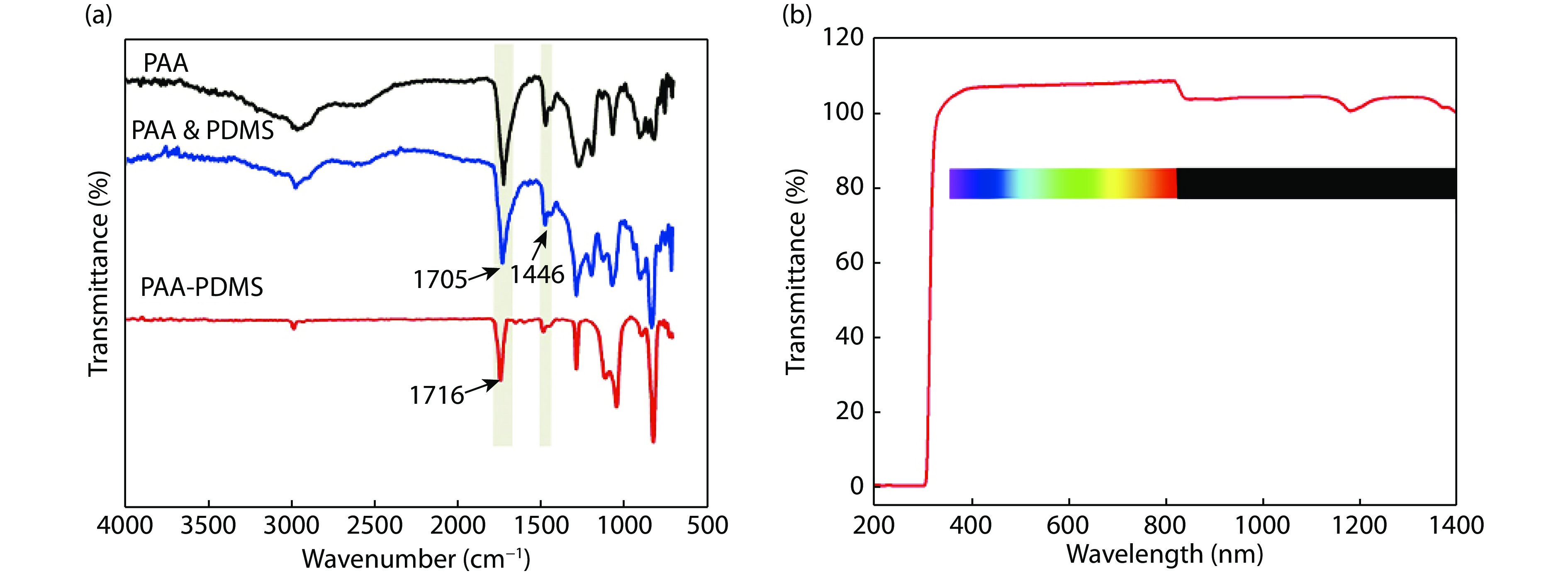
Fig. 1.
(Color online) (a) ATR-FTIR and (b) UV spectra of neat PAA, PAA & PDMS and PAA-PDMS materials.
ARTICLES
Yujin Yao1, Huiling Tai1, , Dongsheng Wang1, 2, , Yadong Jiang1, Zhen Yuan1 and Yonghao Zheng1
Corresponding author: Huiling Tai, taitai1980@uestc.edu.cn; Dongsheng Wang, wangds@uestc.edu.cn
Abstract: A new family of transparent, biocompatible, self-adhesive, and self-healing elastomer has been developed by a convenient and efficient one-pot reaction between poly(acrylic acid) (PAA) and hydroxyl-terminated polydimethylsiloxane (PDMS-OH). The condensation reaction between PAA and PDMS-OH has been confirmed by attenuated total reflection Fourier transform infrared (ATR-FTIR) spectra. The prepared PAA-PDMS elastomers possess robust mechanical strength and strong adhesiveness to human skin, and they have fast self-healing ability at room temperature (in ~10 s with the efficiency of 98%). Specifically, strain sensors were fabricated by assembling PAA-PDMS as packaging layers and polyetherimide-reduced graphene oxide (PEI-rGO) as strain-sensing layers. The PAA-PDMS/PEI-rGO sensors are stably and reliably responsive to slight physical deformations, and they can be attached onto skin directly to monitor the body’s motions. Meanwhile, strain sensors can self-heal quickly and completely, and they can be reused for the motion detecting after shallowly scratching the surface. This work provides new opportunities to manufacture high performance self-adhesive and self-healing materials.
Key words: self-healing, PDMS elastomer, self-adhesiveness, condensation reaction
| [1] |
Hager M D, P Greil P, C Leyens C, et al. Self-healing materials. Adv Mater, 2010, 22, 5424 doi: 10.1002/adma.201003036
|
| [2] |
Wool R P. Self-healing materials: a review. Soft Matter, 2008, 4(3), 400 doi: 10.1039/b711716g
|
| [3] |
White S R, N Sottos N, P Geubelle P, et al. Autonomic healing of polymer composites. Nature, 2001, 409(6822), 794 doi: 10.1038/35057232
|
| [4] |
Cho S H, White S R, Braun P V. Self-healing polymer coatings. Adv Mater, 2009, 21(6), 645 doi: 10.1002/adma.200802008
|
| [5] |
Zwaag S. Self-healing materials: An alternative approach to 20 centuries of materials science. The Netherlands: Springer Science Business Media BV, 2008, 30
|
| [6] |
Han Y, Wu X, Zhang X, et al. Self-healing, highly sensitive electronic sensors enabled by metal–ligand coordination and hierarchical structure design. ACS Appl Mater Interfaces, 2017, 9(23), 20106 doi: 10.1021/acsami.7b05204
|
| [7] |
Yamada T, Hayamizu Y, Yamamoto Y, et al. A stretchable carbon nanotube strain sensor for human-motion detection. Nanotech, 2011, 6(5), 296 doi: 10.1038/nnano.2011.36
|
| [8] |
Yang Y, Zhu B, Yin D, et al. Flexible self-healing nanocomposites for recoverable motion sensor. Nano Energy, 2015, 17, 1 doi: 10.1016/j.nanoen.2015.07.023
|
| [9] |
Hu Y, Zhao T, Zhu P, et al. A low-cost, printable, and stretchable strain sensor based on highly conductive elastic composites with tunable sensitivity for human motion monitoring. Nano Res, 2018, 11(4), 1938 doi: 10.1007/s12274-017-1811-0
|
| [10] |
Liao M, Wan P, Wen J, et al. Wearable, healable, and adhesive epidermal sensors assembled from mussel-inspired conductive hybrid hydrogel framework. Adv Funct Mater, 2017, 27(48), 1703852 doi: 10.1002/adfm.201703852
|
| [11] |
Chen P, Li Q, Grindy S, et al. White-light-emitting lanthanide metallogels with tunable luminescence and reversible stimuli-responsive properties. Chem Soc, 2015, 137(36), 11590 doi: 10.1021/jacs.5b07394
|
| [12] |
Wang C, Wu H, Chen Z, et al. Self-healing chemistry enables the stable operation of silicon microparticle anodes for high-energy lithium-ion batteries. Nat Chem, 2013, 5(12), 1042 doi: 10.1038/nchem.1802
|
| [13] |
Jin H, Huynh T P, Haick H. Self-healable sensors based nanoparticles for detecting physiological markers via skin and breath: toward disease prevention via wearable devices. Nano Lett, 2016, 16(7), 4194 doi: 10.1021/acs.nanolett.6b01066
|
| [14] |
Pantelopoulos A, Bourbakis N G. A survey on wearable sensor-based systems for health monitoring and prognosis. IEEE Trans Syst Man Cy C, 2010, 40(1), 1 doi: 10.1109/TSMCC.2009.2032660
|
| [15] |
Wang D Y, Tao L Q, Y Liu Y, et al. High performance flexible strain sensor based on self-locked overlapping graphene sheets. Nanoscale, 2016, 8(48), 20090 doi: 10.1039/C6NR07620C
|
| [16] |
Pang C, Lee C, Suh K Y. Recent advances in flexible sensors for wearable and implantable devices. J Appl Polym Sci, 2013, 130(3), 1429 doi: 10.1002/app.39461
|
| [17] |
Choi S, Lee H, Ghaffari R, et al. Recent advances in flexible and stretchable bio-electronic devices integrated with nanomaterials. Adv Mater, 2016, 28(22), 4203 doi: 10.1002/adma.201504150
|
| [18] |
Chen D, Wang D, Yang Y, et al. Self-healing materials for next-generation energy harvesting and storage devices. Adv Energy Mater, 2017, 7(23), 1700890 doi: 10.1002/aenm.201700890
|
| [19] |
Gao N, Fang X. Synthesis and development of graphene–inorganic semiconductor nanocomposites. Chem Rev, 2015, 115(16), 8294 doi: 10.1021/cr400607y
|
| [20] |
Ning Y, Zhang Z, Teng F, et al. Novel transparent and self-powered UV photodetector based on crossed ZnO nanofiber array homojunction. Small, 2018, 14(13), 1703754 doi: 10.1002/smll.201703754
|
| [21] |
Darabi M A, A Khosrozadeh A, R Mbeleck R, et al. Skin-inspired multifunctional autonomic-intrinsic conductive self-healing hydrogels with pressure sensitivity, stretchability, and 3D printability. Adv Mater, 2017, 29(31), 1700533 doi: 10.1002/adma.201700533
|
| [22] |
Li J, Geng L, Wang G, et al. Self-healable gels for use in wearable devices. Chem Mater, 2017, 29(21), 8932 doi: 10.1021/acs.chemmater.7b02895
|
| [23] |
Cai G, Wang J, Qian K, et al. Extremely stretchable strain sensors based on conductive self-healing dynamic cross-links hydrogels for human-motion detection. Adv Sci, 2017, 4(2), 1600190 doi: 10.1002/advs.201600190
|
| [24] |
Liu Y J, Cao W T, Ma M G, et al. Ultrasensitive wearable soft strain sensors of conductive, self-healing, and elastic hydrogels with synergistic " soft and hard” hybrid networks. ACS Appl Mater Interfaces, 2017, 9(30), 25559 doi: 10.1021/acsami.7b07639
|
| [25] |
Liu S, Zheng R, Chen S, et al. A compliant, self-adhesive and self-healing wearable hydrogel as epidermal strain sensor. J Mater Chem C, 2018, 6(15), 4183 doi: 10.1039/C8TC00157J
|
| [26] |
Liu X, Lu C, Wu X, et al. Self-healing strain sensors based on nanostructured supramolecular conductive elastomers. J Mater Chem A, 2017, 5(20), 9824 doi: 10.1039/C7TA02416A
|
| [27] |
Keller M W, White S R, Sottos N R. A self-healing poly (dimethyl siloxane) elastomer. Adv Funct Mater, 2007, 17(14), 2399 doi: 10.1002/adfm.200700086
|
| [28] |
Zhang D D, Ruan Y B, Zhang B Q, et al. A self-healing PDMS elastomer based on acylhydrazone groups and the role of hydrogen bonds. Polymer, 2017, 120, 189 doi: 10.1016/j.polymer.2017.05.060
|
| [29] |
Zhang A, Yang L, Lin Y, et al. Self-healing supramolecular elastomers based on the multi-hydrogen bonding of low-molecular polydimethylsiloxanes: Synthesis and characterization. J Appl Polym Sci, 2013, 129(5), 2435 doi: 10.1002/app.38832
|
| [30] |
Zhao J, Xu R, Luo G, et al. A self-healing, re-moldable and biocompatible crosslinked polysiloxane elastomer. J Mater Chem B, 2016, 4(5), 982 doi: 10.1039/C5TB02036K
|
| [31] |
Zhang B, Zhang P, Zhang H, et al. A transparent, highly stretchable, autonomous self-healing poly(dimethyl siloxane) elastomer. Macromol Rapid Commun, 2017, 38(15), 1700110 doi: 10.1002/marc.201700110
|
| [32] |
Mei J F, Jia X Y, Lai J C, et al. A highly stretchable and autonomous self-healing polymer based on combination of pt·pt and π–π interactions. Macromol Rapid Comm, 2016, 37(20), 1667 doi: 10.1002/marc.201600428
|
| [33] |
Jia X Y, Mei J F, Lai J C, et al. A self-healing PDMS polymer with solvatochromic properties. Chem Commun, 2015, 51(43), 8928 doi: 10.1039/C5CC01956G
|
| [34] |
Jia X Y, Mei J F, Lai J C, et al. A highly stretchable polymer that can be thermally healed at mild temperature. Macromol Rapid Commun, 2016, 37(12), 952 doi: 10.1002/marc.201600142
|
| [35] |
Rao Y L, Chortos A, Pfattner R, et al. Stretchable self-healing polymeric dielectrics cross-linked through metal–ligand coordination. J Am Chem Soc, 2016, 138(18), 6020 doi: 10.1021/jacs.6b02428
|
| [36] |
Cao J, Zhang X, Lu C, et al. Self-healing sensorsbased ondual noncovalent network elastomer for human motion monitoring. Macromol Rapid Commun, 2017, 38(23), 1700406 doi: 10.1002/marc.201700406
|
| [37] |
Ye X, Yuan Z, Tai H, et al. A wearable and highly sensitive strain sensor based on a polyethylenimine–rGO layered nanocomposite thin film. J Mater Chem C, 2017, 5(31), 7746 doi: 10.1039/C7TC01872J
|
| [38] |
Shobhana E. X-Ray diffraction and UV-visible studies of PMMA thin films. Int J Modern Eng Res, 2012, 2(3), 1092
|
| [39] |
Wang T, Isimjan T T, Chen J, et al. Transparent nanostructured coatings with UV-shielding and superhydrophobicity properties. Nanotechnology, 2011, 22(26), 265708 doi: 10.1088/0957-4484/22/26/265708
|
| [40] |
De Giglio E, Cometa S, Cioffi N, et al. Analytical investigations of poly (acrylic acid) coatings electrodeposited on titanium-based implants: a versatile approach to biocompatibility enhancement. Anal Bioanal Chem, 2007, 389(7/8), 2055 doi: 10.1007/s00216-007-1299-7
|
| [41] |
Yu H, Fu G, He B. Preparation and adsorption properties of PAA-grafted cellulose adsorbent for low-density lipoprotein from human plasma. Cellulose, 2006, 14(2), 99 doi: 10.1007/s10570-006-9080-1
|
| [42] |
Dai J, Bao Z, Sun L, et al. High-capacity binding of proteins by poly (acrylic acid) brushes and their derivatives. Langmuir, 2006, 22(9), 4274 doi: 10.1021/la0600550
|
| [43] |
Drotlef D M, Amjadi M, Yunusa M, et al. Bioinspired composite microfibers for skin adhesion and signal amplification of wearable sensors. Adv Mater, 2017, 29(28), 1701353 doi: 10.1002/adma.201701353
|
| [44] |
Liu Y, Pharr M, Salvatoreg G A. Lab-on-skin: a review of flexible and stretchable electronics for wearable health monitoring. ACS Nano, 2017, 11(10), 9614 doi: 10.1021/acsnano.7b04898
|
| [45] |
Song Y K, Jo Y H, Lim Y J, et al. Sunlight-induced self-healing of a microcapsule-type protective coating. ACS Appl Mater Interfaces, 2013, 5(4), 1378 doi: 10.1021/am302728m
|
| [46] |
Mangun C L, Mader A C, Sottos N R, et al. Self-healing of a high temperature cured epoxy using poly (dimethylsiloxane) chemistry. Polymer, 2010, 51(18), 4063 doi: 10.1016/j.polymer.2010.06.050
|
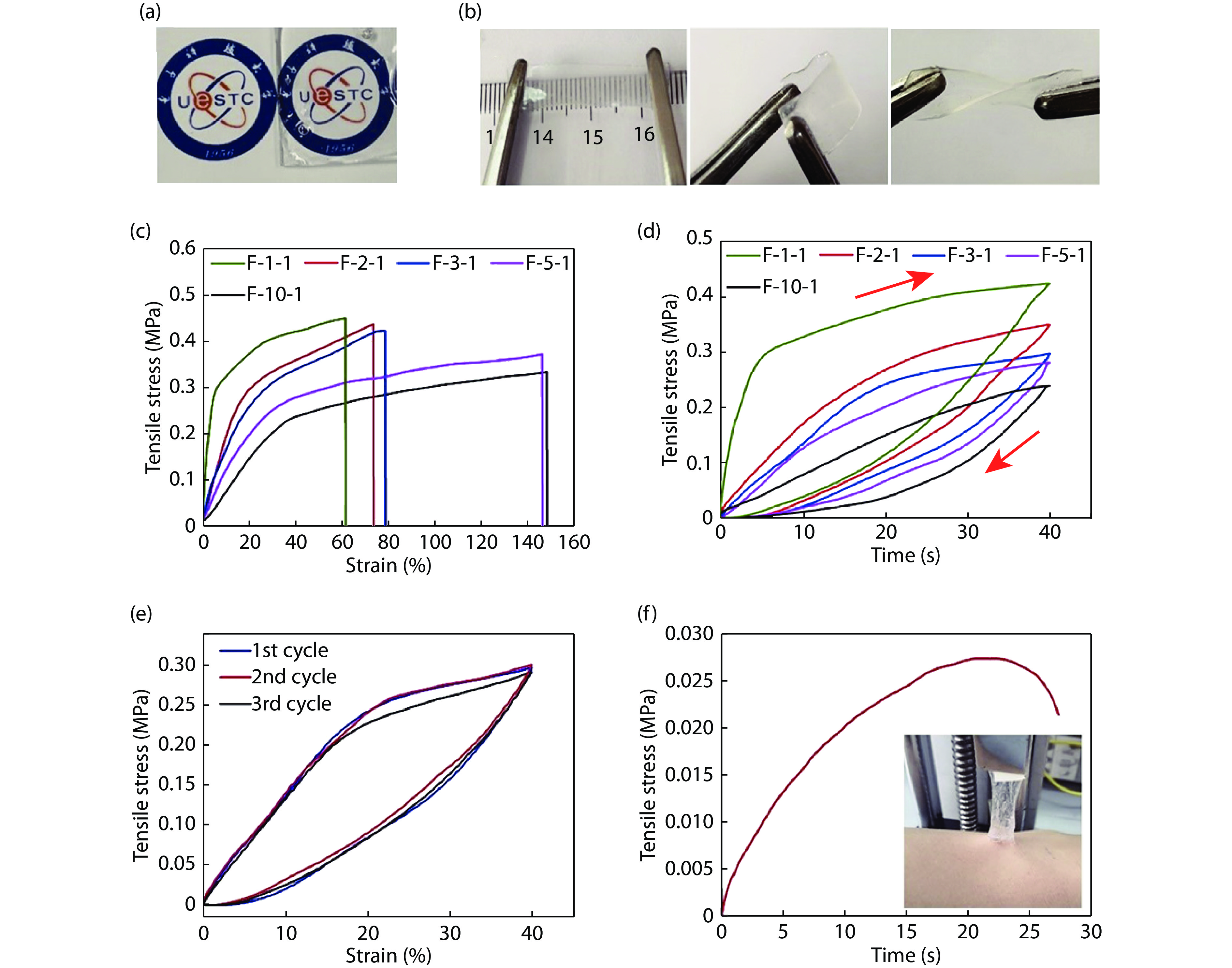
Table 1. Mechanical properties of elastomer with different ratios of PAA and PDMS-OH.
| Sample | PAA:PDMS-OH (wt.%) | Breaking strength (MPa) | Breaking elongation (%) |
| F-1-1 | 1 : 1 | 0.4832 | 76.7 |
| F-2-1 | 2 : 1 | 0.4426 | 91.3 |
| F-3-1 | 3 : 1 | 0.3829 | 94.5 |
| F-5-1 | 5 : 1 | 0.3749 | 146.4 |
| F-10-1 | 10 : 1 | 0.3365 | 148.6 |
 DownLoad: CSV
| [1] |
Hager M D, P Greil P, C Leyens C, et al. Self-healing materials. Adv Mater, 2010, 22, 5424 doi: 10.1002/adma.201003036
|
| [2] |
Wool R P. Self-healing materials: a review. Soft Matter, 2008, 4(3), 400 doi: 10.1039/b711716g
|
| [3] |
White S R, N Sottos N, P Geubelle P, et al. Autonomic healing of polymer composites. Nature, 2001, 409(6822), 794 doi: 10.1038/35057232
|
| [4] |
Cho S H, White S R, Braun P V. Self-healing polymer coatings. Adv Mater, 2009, 21(6), 645 doi: 10.1002/adma.200802008
|
| [5] |
Zwaag S. Self-healing materials: An alternative approach to 20 centuries of materials science. The Netherlands: Springer Science Business Media BV, 2008, 30
|
| [6] |
Han Y, Wu X, Zhang X, et al. Self-healing, highly sensitive electronic sensors enabled by metal–ligand coordination and hierarchical structure design. ACS Appl Mater Interfaces, 2017, 9(23), 20106 doi: 10.1021/acsami.7b05204
|
| [7] |
Yamada T, Hayamizu Y, Yamamoto Y, et al. A stretchable carbon nanotube strain sensor for human-motion detection. Nanotech, 2011, 6(5), 296 doi: 10.1038/nnano.2011.36
|
| [8] |
Yang Y, Zhu B, Yin D, et al. Flexible self-healing nanocomposites for recoverable motion sensor. Nano Energy, 2015, 17, 1 doi: 10.1016/j.nanoen.2015.07.023
|
| [9] |
Hu Y, Zhao T, Zhu P, et al. A low-cost, printable, and stretchable strain sensor based on highly conductive elastic composites with tunable sensitivity for human motion monitoring. Nano Res, 2018, 11(4), 1938 doi: 10.1007/s12274-017-1811-0
|
| [10] |
Liao M, Wan P, Wen J, et al. Wearable, healable, and adhesive epidermal sensors assembled from mussel-inspired conductive hybrid hydrogel framework. Adv Funct Mater, 2017, 27(48), 1703852 doi: 10.1002/adfm.201703852
|
| [11] |
Chen P, Li Q, Grindy S, et al. White-light-emitting lanthanide metallogels with tunable luminescence and reversible stimuli-responsive properties. Chem Soc, 2015, 137(36), 11590 doi: 10.1021/jacs.5b07394
|
| [12] |
Wang C, Wu H, Chen Z, et al. Self-healing chemistry enables the stable operation of silicon microparticle anodes for high-energy lithium-ion batteries. Nat Chem, 2013, 5(12), 1042 doi: 10.1038/nchem.1802
|
| [13] |
Jin H, Huynh T P, Haick H. Self-healable sensors based nanoparticles for detecting physiological markers via skin and breath: toward disease prevention via wearable devices. Nano Lett, 2016, 16(7), 4194 doi: 10.1021/acs.nanolett.6b01066
|
| [14] |
Pantelopoulos A, Bourbakis N G. A survey on wearable sensor-based systems for health monitoring and prognosis. IEEE Trans Syst Man Cy C, 2010, 40(1), 1 doi: 10.1109/TSMCC.2009.2032660
|
| [15] |
Wang D Y, Tao L Q, Y Liu Y, et al. High performance flexible strain sensor based on self-locked overlapping graphene sheets. Nanoscale, 2016, 8(48), 20090 doi: 10.1039/C6NR07620C
|
| [16] |
Pang C, Lee C, Suh K Y. Recent advances in flexible sensors for wearable and implantable devices. J Appl Polym Sci, 2013, 130(3), 1429 doi: 10.1002/app.39461
|
| [17] |
Choi S, Lee H, Ghaffari R, et al. Recent advances in flexible and stretchable bio-electronic devices integrated with nanomaterials. Adv Mater, 2016, 28(22), 4203 doi: 10.1002/adma.201504150
|
| [18] |
Chen D, Wang D, Yang Y, et al. Self-healing materials for next-generation energy harvesting and storage devices. Adv Energy Mater, 2017, 7(23), 1700890 doi: 10.1002/aenm.201700890
|
| [19] |
Gao N, Fang X. Synthesis and development of graphene–inorganic semiconductor nanocomposites. Chem Rev, 2015, 115(16), 8294 doi: 10.1021/cr400607y
|
| [20] |
Ning Y, Zhang Z, Teng F, et al. Novel transparent and self-powered UV photodetector based on crossed ZnO nanofiber array homojunction. Small, 2018, 14(13), 1703754 doi: 10.1002/smll.201703754
|
| [21] |
Darabi M A, A Khosrozadeh A, R Mbeleck R, et al. Skin-inspired multifunctional autonomic-intrinsic conductive self-healing hydrogels with pressure sensitivity, stretchability, and 3D printability. Adv Mater, 2017, 29(31), 1700533 doi: 10.1002/adma.201700533
|
| [22] |
Li J, Geng L, Wang G, et al. Self-healable gels for use in wearable devices. Chem Mater, 2017, 29(21), 8932 doi: 10.1021/acs.chemmater.7b02895
|
| [23] |
Cai G, Wang J, Qian K, et al. Extremely stretchable strain sensors based on conductive self-healing dynamic cross-links hydrogels for human-motion detection. Adv Sci, 2017, 4(2), 1600190 doi: 10.1002/advs.201600190
|
| [24] |
Liu Y J, Cao W T, Ma M G, et al. Ultrasensitive wearable soft strain sensors of conductive, self-healing, and elastic hydrogels with synergistic " soft and hard” hybrid networks. ACS Appl Mater Interfaces, 2017, 9(30), 25559 doi: 10.1021/acsami.7b07639
|
| [25] |
Liu S, Zheng R, Chen S, et al. A compliant, self-adhesive and self-healing wearable hydrogel as epidermal strain sensor. J Mater Chem C, 2018, 6(15), 4183 doi: 10.1039/C8TC00157J
|
| [26] |
Liu X, Lu C, Wu X, et al. Self-healing strain sensors based on nanostructured supramolecular conductive elastomers. J Mater Chem A, 2017, 5(20), 9824 doi: 10.1039/C7TA02416A
|
| [27] |
Keller M W, White S R, Sottos N R. A self-healing poly (dimethyl siloxane) elastomer. Adv Funct Mater, 2007, 17(14), 2399 doi: 10.1002/adfm.200700086
|
| [28] |
Zhang D D, Ruan Y B, Zhang B Q, et al. A self-healing PDMS elastomer based on acylhydrazone groups and the role of hydrogen bonds. Polymer, 2017, 120, 189 doi: 10.1016/j.polymer.2017.05.060
|
| [29] |
Zhang A, Yang L, Lin Y, et al. Self-healing supramolecular elastomers based on the multi-hydrogen bonding of low-molecular polydimethylsiloxanes: Synthesis and characterization. J Appl Polym Sci, 2013, 129(5), 2435 doi: 10.1002/app.38832
|
| [30] |
Zhao J, Xu R, Luo G, et al. A self-healing, re-moldable and biocompatible crosslinked polysiloxane elastomer. J Mater Chem B, 2016, 4(5), 982 doi: 10.1039/C5TB02036K
|
| [31] |
Zhang B, Zhang P, Zhang H, et al. A transparent, highly stretchable, autonomous self-healing poly(dimethyl siloxane) elastomer. Macromol Rapid Commun, 2017, 38(15), 1700110 doi: 10.1002/marc.201700110
|
| [32] |
Mei J F, Jia X Y, Lai J C, et al. A highly stretchable and autonomous self-healing polymer based on combination of pt·pt and π–π interactions. Macromol Rapid Comm, 2016, 37(20), 1667 doi: 10.1002/marc.201600428
|
| [33] |
Jia X Y, Mei J F, Lai J C, et al. A self-healing PDMS polymer with solvatochromic properties. Chem Commun, 2015, 51(43), 8928 doi: 10.1039/C5CC01956G
|
| [34] |
Jia X Y, Mei J F, Lai J C, et al. A highly stretchable polymer that can be thermally healed at mild temperature. Macromol Rapid Commun, 2016, 37(12), 952 doi: 10.1002/marc.201600142
|
| [35] |
Rao Y L, Chortos A, Pfattner R, et al. Stretchable self-healing polymeric dielectrics cross-linked through metal–ligand coordination. J Am Chem Soc, 2016, 138(18), 6020 doi: 10.1021/jacs.6b02428
|
| [36] |
Cao J, Zhang X, Lu C, et al. Self-healing sensorsbased ondual noncovalent network elastomer for human motion monitoring. Macromol Rapid Commun, 2017, 38(23), 1700406 doi: 10.1002/marc.201700406
|
| [37] |
Ye X, Yuan Z, Tai H, et al. A wearable and highly sensitive strain sensor based on a polyethylenimine–rGO layered nanocomposite thin film. J Mater Chem C, 2017, 5(31), 7746 doi: 10.1039/C7TC01872J
|
| [38] |
Shobhana E. X-Ray diffraction and UV-visible studies of PMMA thin films. Int J Modern Eng Res, 2012, 2(3), 1092
|
| [39] |
Wang T, Isimjan T T, Chen J, et al. Transparent nanostructured coatings with UV-shielding and superhydrophobicity properties. Nanotechnology, 2011, 22(26), 265708 doi: 10.1088/0957-4484/22/26/265708
|
| [40] |
De Giglio E, Cometa S, Cioffi N, et al. Analytical investigations of poly (acrylic acid) coatings electrodeposited on titanium-based implants: a versatile approach to biocompatibility enhancement. Anal Bioanal Chem, 2007, 389(7/8), 2055 doi: 10.1007/s00216-007-1299-7
|
| [41] |
Yu H, Fu G, He B. Preparation and adsorption properties of PAA-grafted cellulose adsorbent for low-density lipoprotein from human plasma. Cellulose, 2006, 14(2), 99 doi: 10.1007/s10570-006-9080-1
|
| [42] |
Dai J, Bao Z, Sun L, et al. High-capacity binding of proteins by poly (acrylic acid) brushes and their derivatives. Langmuir, 2006, 22(9), 4274 doi: 10.1021/la0600550
|
| [43] |
Drotlef D M, Amjadi M, Yunusa M, et al. Bioinspired composite microfibers for skin adhesion and signal amplification of wearable sensors. Adv Mater, 2017, 29(28), 1701353 doi: 10.1002/adma.201701353
|
| [44] |
Liu Y, Pharr M, Salvatoreg G A. Lab-on-skin: a review of flexible and stretchable electronics for wearable health monitoring. ACS Nano, 2017, 11(10), 9614 doi: 10.1021/acsnano.7b04898
|
| [45] |
Song Y K, Jo Y H, Lim Y J, et al. Sunlight-induced self-healing of a microcapsule-type protective coating. ACS Appl Mater Interfaces, 2013, 5(4), 1378 doi: 10.1021/am302728m
|
| [46] |
Mangun C L, Mader A C, Sottos N R, et al. Self-healing of a high temperature cured epoxy using poly (dimethylsiloxane) chemistry. Polymer, 2010, 51(18), 4063 doi: 10.1016/j.polymer.2010.06.050
|









Article views: 5534 Times PDF downloads: 101 Times Cited by: 0 Times
Received: 16 April 2019 Revised: 27 May 2019 Online: Accepted Manuscript: 07 September 2019Uncorrected proof: 09 September 2019Published: 08 November 2019
| Citation: |
Yujin Yao, Huiling Tai, Dongsheng Wang, Yadong Jiang, Zhen Yuan, Yonghao Zheng. One-pot preparation and applications of self-healing, self-adhesive PAA-PDMS elastomers[J]. Journal of Semiconductors, 2019, 40(11): 112602. doi: 10.1088/1674-4926/40/11/112602
****
Y J Yao, H L Tai, D S Wang, Y D Jiang, Z Yuan, Y H Zheng, One-pot preparation and applications of self-healing, self-adhesive PAA-PDMS elastomers[J]. J. Semicond., 2019, 40(11): 112602. doi: 10.1088/1674-4926/40/11/112602.

|
| [1] |
Hager M D, P Greil P, C Leyens C, et al. Self-healing materials. Adv Mater, 2010, 22, 5424 doi: 10.1002/adma.201003036
|
| [2] |
Wool R P. Self-healing materials: a review. Soft Matter, 2008, 4(3), 400 doi: 10.1039/b711716g
|
| [3] |
White S R, N Sottos N, P Geubelle P, et al. Autonomic healing of polymer composites. Nature, 2001, 409(6822), 794 doi: 10.1038/35057232
|
| [4] |
Cho S H, White S R, Braun P V. Self-healing polymer coatings. Adv Mater, 2009, 21(6), 645 doi: 10.1002/adma.200802008
|
| [5] |
Zwaag S. Self-healing materials: An alternative approach to 20 centuries of materials science. The Netherlands: Springer Science Business Media BV, 2008, 30
|
| [6] |
Han Y, Wu X, Zhang X, et al. Self-healing, highly sensitive electronic sensors enabled by metal–ligand coordination and hierarchical structure design. ACS Appl Mater Interfaces, 2017, 9(23), 20106 doi: 10.1021/acsami.7b05204
|
| [7] |
Yamada T, Hayamizu Y, Yamamoto Y, et al. A stretchable carbon nanotube strain sensor for human-motion detection. Nanotech, 2011, 6(5), 296 doi: 10.1038/nnano.2011.36
|
| [8] |
Yang Y, Zhu B, Yin D, et al. Flexible self-healing nanocomposites for recoverable motion sensor. Nano Energy, 2015, 17, 1 doi: 10.1016/j.nanoen.2015.07.023
|
| [9] |
Hu Y, Zhao T, Zhu P, et al. A low-cost, printable, and stretchable strain sensor based on highly conductive elastic composites with tunable sensitivity for human motion monitoring. Nano Res, 2018, 11(4), 1938 doi: 10.1007/s12274-017-1811-0
|
| [10] |
Liao M, Wan P, Wen J, et al. Wearable, healable, and adhesive epidermal sensors assembled from mussel-inspired conductive hybrid hydrogel framework. Adv Funct Mater, 2017, 27(48), 1703852 doi: 10.1002/adfm.201703852
|
| [11] |
Chen P, Li Q, Grindy S, et al. White-light-emitting lanthanide metallogels with tunable luminescence and reversible stimuli-responsive properties. Chem Soc, 2015, 137(36), 11590 doi: 10.1021/jacs.5b07394
|
| [12] |
Wang C, Wu H, Chen Z, et al. Self-healing chemistry enables the stable operation of silicon microparticle anodes for high-energy lithium-ion batteries. Nat Chem, 2013, 5(12), 1042 doi: 10.1038/nchem.1802
|
| [13] |
Jin H, Huynh T P, Haick H. Self-healable sensors based nanoparticles for detecting physiological markers via skin and breath: toward disease prevention via wearable devices. Nano Lett, 2016, 16(7), 4194 doi: 10.1021/acs.nanolett.6b01066
|
| [14] |
Pantelopoulos A, Bourbakis N G. A survey on wearable sensor-based systems for health monitoring and prognosis. IEEE Trans Syst Man Cy C, 2010, 40(1), 1 doi: 10.1109/TSMCC.2009.2032660
|
| [15] |
Wang D Y, Tao L Q, Y Liu Y, et al. High performance flexible strain sensor based on self-locked overlapping graphene sheets. Nanoscale, 2016, 8(48), 20090 doi: 10.1039/C6NR07620C
|
| [16] |
Pang C, Lee C, Suh K Y. Recent advances in flexible sensors for wearable and implantable devices. J Appl Polym Sci, 2013, 130(3), 1429 doi: 10.1002/app.39461
|
| [17] |
Choi S, Lee H, Ghaffari R, et al. Recent advances in flexible and stretchable bio-electronic devices integrated with nanomaterials. Adv Mater, 2016, 28(22), 4203 doi: 10.1002/adma.201504150
|
| [18] |
Chen D, Wang D, Yang Y, et al. Self-healing materials for next-generation energy harvesting and storage devices. Adv Energy Mater, 2017, 7(23), 1700890 doi: 10.1002/aenm.201700890
|
| [19] |
Gao N, Fang X. Synthesis and development of graphene–inorganic semiconductor nanocomposites. Chem Rev, 2015, 115(16), 8294 doi: 10.1021/cr400607y
|
| [20] |
Ning Y, Zhang Z, Teng F, et al. Novel transparent and self-powered UV photodetector based on crossed ZnO nanofiber array homojunction. Small, 2018, 14(13), 1703754 doi: 10.1002/smll.201703754
|
| [21] |
Darabi M A, A Khosrozadeh A, R Mbeleck R, et al. Skin-inspired multifunctional autonomic-intrinsic conductive self-healing hydrogels with pressure sensitivity, stretchability, and 3D printability. Adv Mater, 2017, 29(31), 1700533 doi: 10.1002/adma.201700533
|
| [22] |
Li J, Geng L, Wang G, et al. Self-healable gels for use in wearable devices. Chem Mater, 2017, 29(21), 8932 doi: 10.1021/acs.chemmater.7b02895
|
| [23] |
Cai G, Wang J, Qian K, et al. Extremely stretchable strain sensors based on conductive self-healing dynamic cross-links hydrogels for human-motion detection. Adv Sci, 2017, 4(2), 1600190 doi: 10.1002/advs.201600190
|
| [24] |
Liu Y J, Cao W T, Ma M G, et al. Ultrasensitive wearable soft strain sensors of conductive, self-healing, and elastic hydrogels with synergistic " soft and hard” hybrid networks. ACS Appl Mater Interfaces, 2017, 9(30), 25559 doi: 10.1021/acsami.7b07639
|
| [25] |
Liu S, Zheng R, Chen S, et al. A compliant, self-adhesive and self-healing wearable hydrogel as epidermal strain sensor. J Mater Chem C, 2018, 6(15), 4183 doi: 10.1039/C8TC00157J
|
| [26] |
Liu X, Lu C, Wu X, et al. Self-healing strain sensors based on nanostructured supramolecular conductive elastomers. J Mater Chem A, 2017, 5(20), 9824 doi: 10.1039/C7TA02416A
|
| [27] |
Keller M W, White S R, Sottos N R. A self-healing poly (dimethyl siloxane) elastomer. Adv Funct Mater, 2007, 17(14), 2399 doi: 10.1002/adfm.200700086
|
| [28] |
Zhang D D, Ruan Y B, Zhang B Q, et al. A self-healing PDMS elastomer based on acylhydrazone groups and the role of hydrogen bonds. Polymer, 2017, 120, 189 doi: 10.1016/j.polymer.2017.05.060
|
| [29] |
Zhang A, Yang L, Lin Y, et al. Self-healing supramolecular elastomers based on the multi-hydrogen bonding of low-molecular polydimethylsiloxanes: Synthesis and characterization. J Appl Polym Sci, 2013, 129(5), 2435 doi: 10.1002/app.38832
|
| [30] |
Zhao J, Xu R, Luo G, et al. A self-healing, re-moldable and biocompatible crosslinked polysiloxane elastomer. J Mater Chem B, 2016, 4(5), 982 doi: 10.1039/C5TB02036K
|
| [31] |
Zhang B, Zhang P, Zhang H, et al. A transparent, highly stretchable, autonomous self-healing poly(dimethyl siloxane) elastomer. Macromol Rapid Commun, 2017, 38(15), 1700110 doi: 10.1002/marc.201700110
|
| [32] |
Mei J F, Jia X Y, Lai J C, et al. A highly stretchable and autonomous self-healing polymer based on combination of pt·pt and π–π interactions. Macromol Rapid Comm, 2016, 37(20), 1667 doi: 10.1002/marc.201600428
|
| [33] |
Jia X Y, Mei J F, Lai J C, et al. A self-healing PDMS polymer with solvatochromic properties. Chem Commun, 2015, 51(43), 8928 doi: 10.1039/C5CC01956G
|
| [34] |
Jia X Y, Mei J F, Lai J C, et al. A highly stretchable polymer that can be thermally healed at mild temperature. Macromol Rapid Commun, 2016, 37(12), 952 doi: 10.1002/marc.201600142
|
| [35] |
Rao Y L, Chortos A, Pfattner R, et al. Stretchable self-healing polymeric dielectrics cross-linked through metal–ligand coordination. J Am Chem Soc, 2016, 138(18), 6020 doi: 10.1021/jacs.6b02428
|
| [36] |
Cao J, Zhang X, Lu C, et al. Self-healing sensorsbased ondual noncovalent network elastomer for human motion monitoring. Macromol Rapid Commun, 2017, 38(23), 1700406 doi: 10.1002/marc.201700406
|
| [37] |
Ye X, Yuan Z, Tai H, et al. A wearable and highly sensitive strain sensor based on a polyethylenimine–rGO layered nanocomposite thin film. J Mater Chem C, 2017, 5(31), 7746 doi: 10.1039/C7TC01872J
|
| [38] |
Shobhana E. X-Ray diffraction and UV-visible studies of PMMA thin films. Int J Modern Eng Res, 2012, 2(3), 1092
|
| [39] |
Wang T, Isimjan T T, Chen J, et al. Transparent nanostructured coatings with UV-shielding and superhydrophobicity properties. Nanotechnology, 2011, 22(26), 265708 doi: 10.1088/0957-4484/22/26/265708
|
| [40] |
De Giglio E, Cometa S, Cioffi N, et al. Analytical investigations of poly (acrylic acid) coatings electrodeposited on titanium-based implants: a versatile approach to biocompatibility enhancement. Anal Bioanal Chem, 2007, 389(7/8), 2055 doi: 10.1007/s00216-007-1299-7
|
| [41] |
Yu H, Fu G, He B. Preparation and adsorption properties of PAA-grafted cellulose adsorbent for low-density lipoprotein from human plasma. Cellulose, 2006, 14(2), 99 doi: 10.1007/s10570-006-9080-1
|
| [42] |
Dai J, Bao Z, Sun L, et al. High-capacity binding of proteins by poly (acrylic acid) brushes and their derivatives. Langmuir, 2006, 22(9), 4274 doi: 10.1021/la0600550
|
| [43] |
Drotlef D M, Amjadi M, Yunusa M, et al. Bioinspired composite microfibers for skin adhesion and signal amplification of wearable sensors. Adv Mater, 2017, 29(28), 1701353 doi: 10.1002/adma.201701353
|
| [44] |
Liu Y, Pharr M, Salvatoreg G A. Lab-on-skin: a review of flexible and stretchable electronics for wearable health monitoring. ACS Nano, 2017, 11(10), 9614 doi: 10.1021/acsnano.7b04898
|
| [45] |
Song Y K, Jo Y H, Lim Y J, et al. Sunlight-induced self-healing of a microcapsule-type protective coating. ACS Appl Mater Interfaces, 2013, 5(4), 1378 doi: 10.1021/am302728m
|
| [46] |
Mangun C L, Mader A C, Sottos N R, et al. Self-healing of a high temperature cured epoxy using poly (dimethylsiloxane) chemistry. Polymer, 2010, 51(18), 4063 doi: 10.1016/j.polymer.2010.06.050
|

 WeChat ID
Journal of Semiconductors © 2017 All Rights Reserved 京ICP備05085259號-2