ARTICLES
Bingbing Chen1, 2, 3, 4, Pengyang Wang1, 2, 3, 4, Ningyu Ren1, 2, 3, 4, 5, Renjie Li1, 2, 3, 4, Ying Zhao1, 2, 3, 4 and Xiaodan Zhang1, 2, 3, 4,
Corresponding author: Xiaodan Zhang, xdzhang@nankai.edu.cn
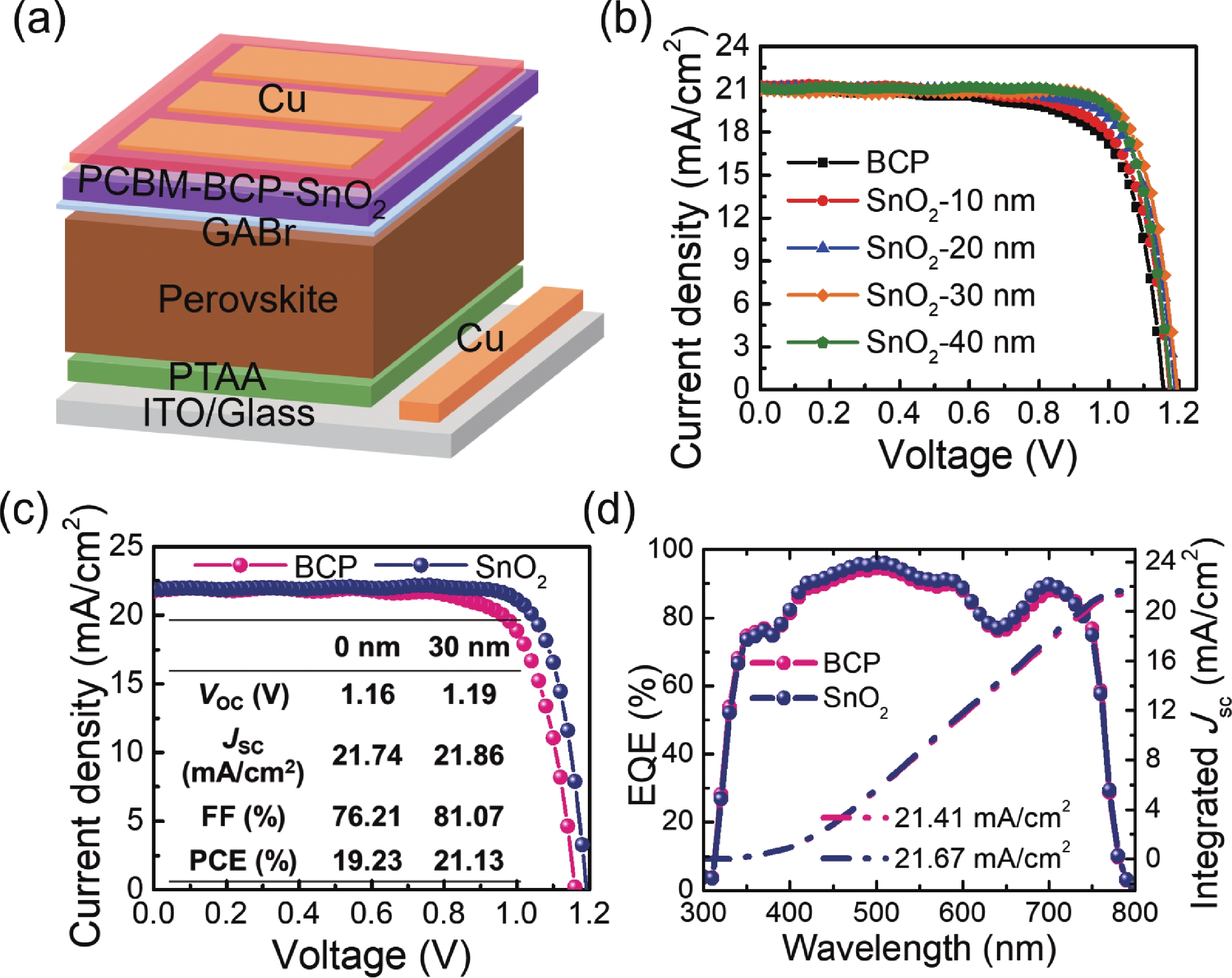
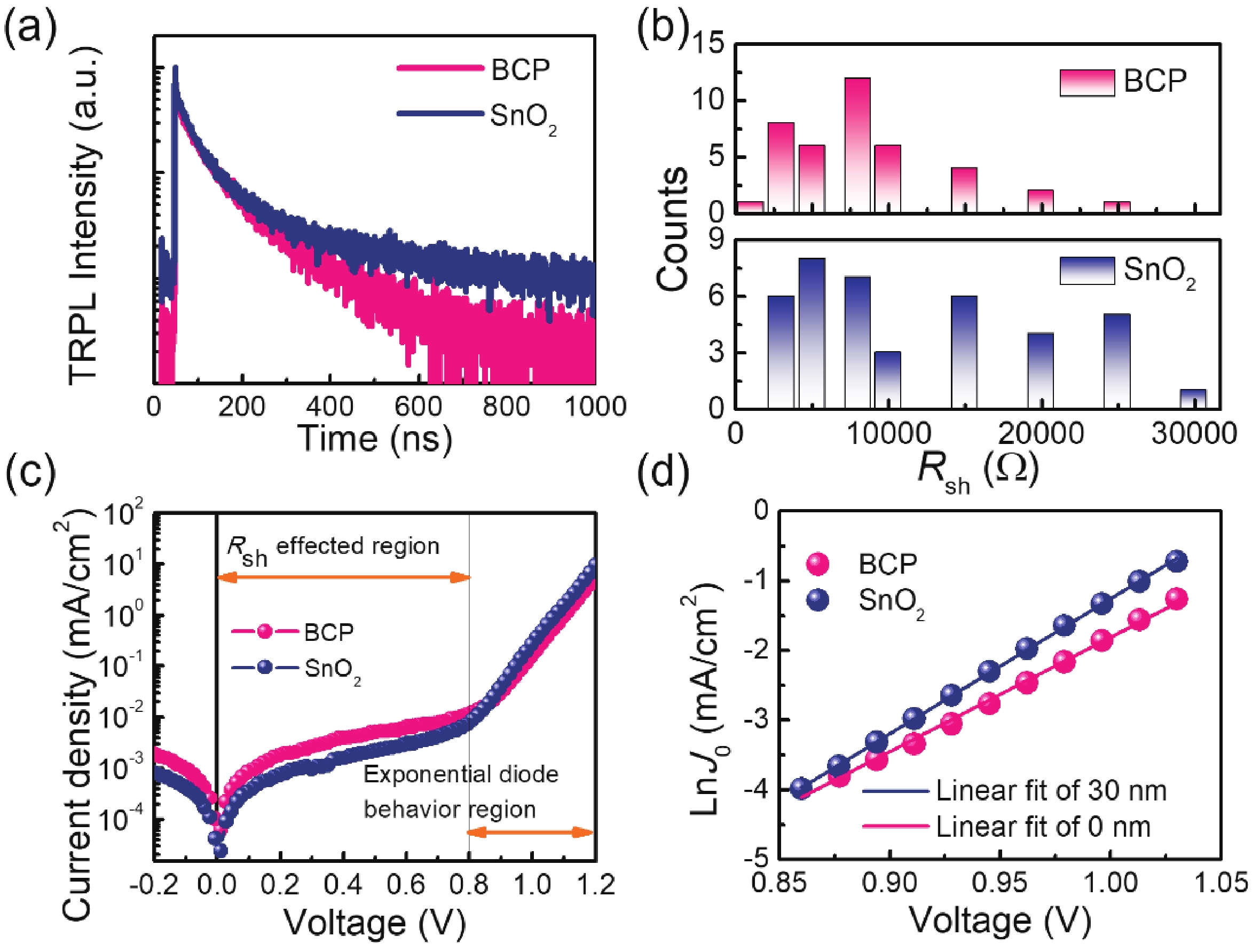
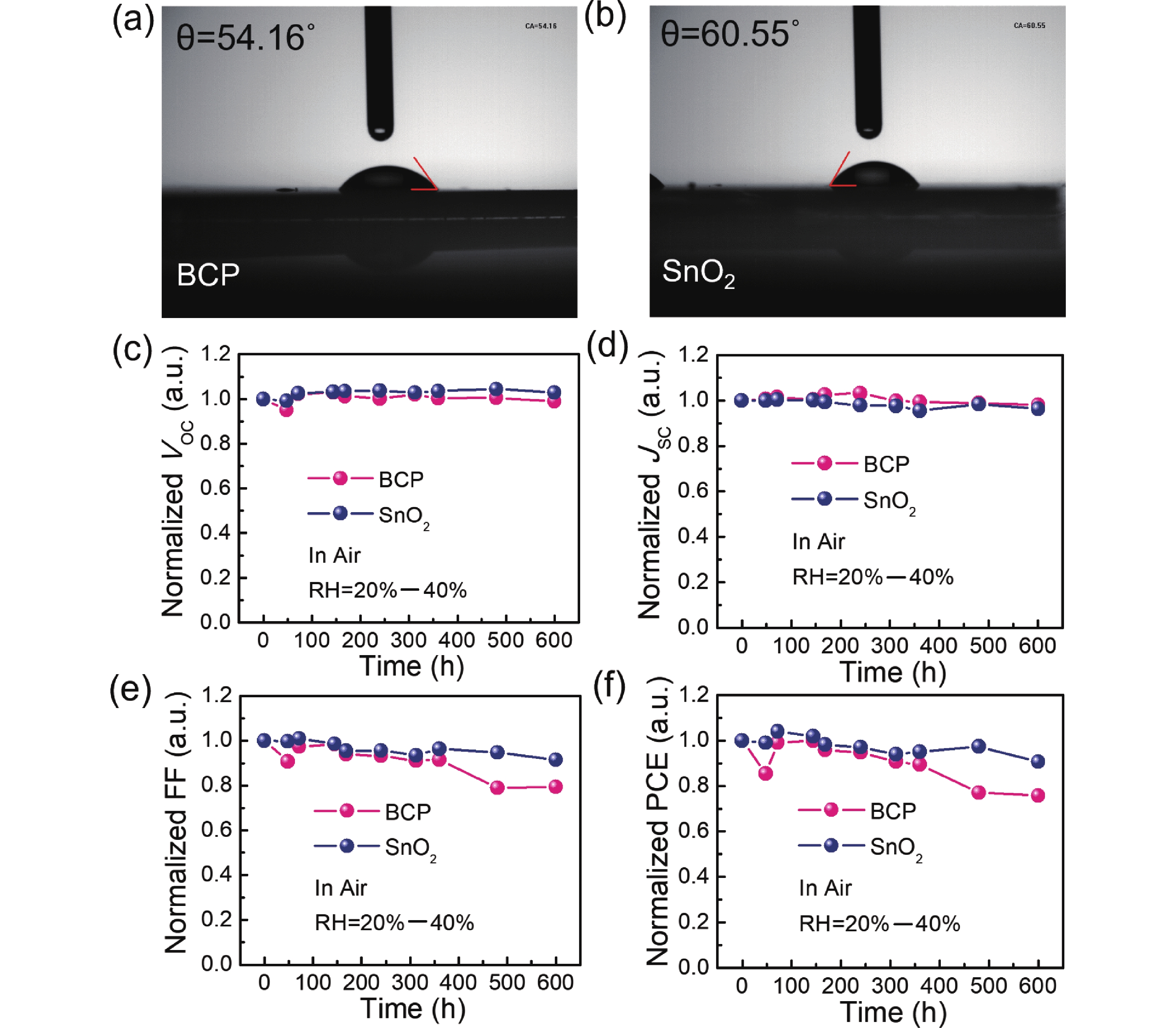
Abstract: Inverted perovskite solar cells (IPSCs) have attracted tremendous research interest in recent years due to their applications in perovskite/silicon tandem solar cells. However, further performance improvements and long-term stability issues are the main obstacles that deeply hinder the development of devices. Herein, we demonstrate a facile atomic layer deposition (ALD) processed tin dioxide (SnO2) as an additional buffer layer for efficient and stable wide-bandgap IPSCs. The additional buffer layer increases the shunt resistance and reduces the reverse current saturation density, resulting in the enhancement of efficiency from 19.23% to 21.13%. The target device with a bandgap of 1.63 eV obtains open-circuit voltage of 1.19 V, short circuit current density of 21.86 mA/cm2, and fill factor of 81.07%. More importantly, the compact and stable SnO2 film invests the IPSCs with superhydrophobicity, thus significantly enhancing the moisture resistance. Eventually, the target device can maintain 90% of its initial efficiency after 600 h storage in ambient conditions with relative humidity of 20%–40% without encapsulation. The ALD-processed SnO2 provides a promising way to boost the efficiency and stability of IPSCs, and a great potential for perovskite-based tandem solar cells in the near future.
Key words: atomic layer deposition, tin dioxide, additional buffer layer, efficiency and stability, inverted perovskite solar cells
| [1] | |
| [2] |
Chen B, Ren N, Li Y, et al. Insights into the development of monolithic perovskite/silicon tandem solar cells. Adv Energy Mater, 2021, 2003628 doi: 10.1002/aenm.202003628
|
| [3] |
Hou F, Li Y, Yan L, et al. Control perovskite crystals vertical growth for obtaining high-performance monolithic perovskite/silicon heterojunction tandem solar cells with VOC of 1.93?V. Solar RRL, 2021, 5, 2100357 doi: 10.1002/solr.202100357
|
| [4] |
Chen B, Wang P, Li R, et al. Composite electron transport layer for efficient n-i-p type monolithic perovskite/silicon tandem solar cells with high open-circuit voltage. J Energy Chem, 2021, 63, 461 doi: 10.1016/j.jechem.2021.07.018
|
| [5] |
National Renewable Energy Laboratory, Best Research Cell Efficiency Chart. https://www.nrel.gov/pv/cell-efficiency.html
|
| [6] |
Kim D, Jung H J, Park I J, et al. Efficient, stable silicon tandem cells enabled by anion-engineered wide-bandgap perovskites. Science, 2020, 368, 155 doi: 10.1126/science.aba3433
|
| [7] |
Xu J, Boyd C C, Yu Z J, et al. Triple-halide wide–band gap perovskites with suppressed phase segregation for efficient tandems. Science, 2020, 367, 1097 doi: 10.1126/science.aaz5074
|
| [8] |
Zuo C, Ding L. Drop-casting to make efficient perovskite solar cells under high humidity. Angew Chem Int Ed, 2021, 133, 11342 doi: 10.1002/ange.202101868
|
| [9] |
Li F, Deng X, Qi F, et al. Regulating surface termination for efficient inverted perovskite solar cells with greater than 23% efficiency. J Am Chem Soc, 2020, 142, 20134 doi: 10.1021/jacs.0c09845
|
| [10] |
Unger EL, Kegelmann L, Suchan K, et al. Correction: Roadmap and roadblocks for the band gap tunability of metal halide perovskites. J Mater Chem A, 2017, 5, 15983 doi: 10.1039/C7TA90141K
|
| [11] |
Niu G, Li W, Li J, et al. Progress of interface engineering in perovskite solar cells. Sci China Mater, 2016, 59, 728 doi: 10.1007/s40843-016-5094-6
|
| [12] |
Xu C, Zhang Z, Hu Y, et al. Printed hole-conductor-free mesoscopic perovskite solar cells with excellent long-term stability using peai as an additive. J Energy Chem, 2018, 27, 764 doi: 10.1016/j.jechem.2018.01.030
|
| [13] |
Lu H, Liu Y, Ahlawat P, et al. Vapor-assisted deposition of highly efficient, stable black-phase FAPbI3 perovskite solar cells. Science, 2020, 370, eabb8985 doi: 10.1126/science.abb8985
|
| [14] |
Min H, Kim M, Lee S U, et al. Efficient, stable solar cells by using inherent bandgap of α-phase formamidinium lead iodide. Science, 2019, 366, 749 doi: 10.1126/science.aay7044
|
| [15] |
Jeon N J, Noh J H, Kim Y C, et al. Solvent engineering for high-performance inorganic-organic hybrid perovskite solar cells. Nat Mater, 2014, 13, 897 doi: 10.1038/nmat4014
|
| [16] |
Yang W S, Noh J H, Jeon N J. High-performance photovoltaic perovskite layers fabricated through intramolecular exchange. Science, 2015, 348(6240), 1234 doi: 10.1126/science.aaa9272
|
| [17] |
Ren Y, Duan B, Xu Y, et al. New insight into solvent engineering technology from evolution of intermediates via one-step spin-coating approach. Sci China Mater, 2017, 60, 392 doi: 10.1007/s40843-017-9027-1
|
| [18] |
Zheng X, Hou Y, Bao C, et al. Managing grains and interfaces via ligand anchoring enables 22.3%-efficiency inverted perovskite solar cells. Nat Energy, 2020, 5, 131 doi: 10.1038/s41560-019-0538-4
|
| [19] |
Song W, Cao G. Surface-defect passivation through complexation with organic molecules leads to enhanced power conversion efficiency and long term stability of perovskite photovoltaics. Sci China Mater, 2020, 63, 479 doi: 10.1007/s40843-020-1249-3
|
| [20] |
Kim M, Kim G H, Lee T K, et al. Methylammonium chloride induces intermediate phase stabilization for efficient perovskite solar cells. Joule, 2019, 3, 2179 doi: 10.1016/j.joule.2019.06.014
|
| [21] |
Yang X, Fu Y, Su R, et al. Superior carrier lifetimes exceeding 6 micros in polycrystalline halide perovskites. Adv Mater, 2020, 32, e2002585 doi: 10.1002/adma.202002585
|
| [22] |
Yao X, Liang J, Li T, et al. Electron transport layer driven to improve the open-circuit voltage of CH3NH3PbI3 planar perovskite solar cells. Sci China Mater, 2017, 61, 65 doi: 10.1007/s40843-017-9130-x
|
| [23] |
Zhu P, Gu S, Luo X, et al. Simultaneous contact and grain-boundary passivation in planar perovskite solar cells using SnO-2-KCl composite electron transport layer. Adv Energy Mater, 2020, 10, 1903083 doi: 10.1002/aenm.201903083
|
| [24] |
Wang P, Li R, Chen B, et al. Gradient energy alignment engineering for planar perovskite solar cells with efficiency over 23. Adv Mater, 2020, 32, e1905766 doi: 10.1002/adma.201905766
|
| [25] |
Chen Y, Xu C, Xiong J, et al. Benefits of fullerene/SnO2 bilayers as electron transport layer for efficient planar perovskite solar cells. Organ Electron, 2018, 58, 294 doi: 10.1016/j.orgel.2018.03.041
|
| [26] |
Wang P, Chen B, Li R, et al. Cobalt chloride hexahydrate assisted in reducing energy loss in perovskite solar cells with record open-circuit voltage of 1.20 V. ACS Energy Lett, 2021, 6, 2121 doi: 10.1021/acsenergylett.1c00443
|
| [27] |
Liu Z, Krückemeier L, Krogmeier B, et al. Open-circuit voltages exceeding 1.26 V in planar methylammonium lead iodide perovskite solar cells. ACS Energy Lett, 2018, 4, 110 doi: 10.1021/acsenergylett.8b01906
|
| [28] |
Wu S, Zhang J, Li Z, et al. Modulation of defects and interfaces through alkylammonium interlayer for efficient inverted perovskite solar cells. Joule, 2020, 4, 1248 doi: 10.1016/j.joule.2020.04.001
|
| [29] |
Xu C Y, Hu W, Wang G, et al. Coordinated optical matching of a texture interface made from demixing blended polymers for high-performance inverted perovskite solar cells. ACS Nano, 2020, 14, 196 doi: 10.1021/acsnano.9b07594
|
| [30] |
Lee J W, Park N G. Chemical approaches for stabilizing perovskite solar cells. Adv Energy Mater, 2019, 10, 1903249 doi: 10.1002/aenm.201903249
|
| [31] |
Jia L, Zhang L, Ding L, et al. Using fluorinated and crosslinkable fullerene derivatives to improve the stability of perovskite solar cells. J Semicond, 2021, 42, 120201 doi: 10.1088/1674-4926/42/12/120201
|
| [32] |
Zhang L, Zuo C, Ding L. Efficient MAPbI3 solar cells made via drop-coating at room temperature. J Semicond, 2021, 42, 072201 doi: 10.1088/1674-4926/42/7/072201
|
| [33] |
Ramasamy E, Karthikeyan V, Rameshkumar K, et al. Glass-to-glass encapsulation with ultraviolet light curable epoxy edge sealing for stable perovskite solar cells. Mater Lett, 2019, 250, 51 doi: 10.1016/j.matlet.2019.04.082
|
| [34] |
Matteocci F, Cinà L, Lamanna E, et al. Encapsulation for long-term stability enhancement of perovskite solar cells. Nano Energy, 2016, 30, 162 doi: 10.1016/j.nanoen.2016.09.041
|
| [35] |
Zheng H, Dai S, Zhou K, et al. New-type highly stable 2D/3D perovskite materials: the effect of introducing ammonium cation on performance of perovskite solar cells. Sci China Mater, 2019, 62, 508 doi: 10.1007/s40843-018-9343-1
|
| [36] |
You J, Meng L, Song TB, et al. Improved air stability of perovskite solar cells via solution-processed metal oxide transport layers. Nat Nanotechnol, 2016, 11, 75 doi: 10.1038/nnano.2015.230
|
| [37] |
Fang R, Wu S, Chen W, et al. [6, 6]-phenyl-c61-butyric acid methyl ester/cerium oxide bilayer structure as efficient and stable electron transport layer for inverted perovskite solar cells. ACS Nano, 2018, 12, 2403 doi: 10.1021/acsnano.7b07754
|
| [38] |
Liu J, Aydin E, Yin J, et al. 28.2%-efficient, outdoor-stable perovskite/silicon tandem solar cell. Joule, 2021, 5, 1 doi: 10.1016/j.joule.2020.12.026
|
| [39] |
K?hnen E, Wagner P, Lang F. 27.9% efficient monolithic perovskite/silicon tandem solar cells on industry compatible bottom cells. Sol RRL, 2021, 5, 2100244 doi: 10.1002/solr.202100244
|
| [40] |
Isikgor F, Furlan F, Liu J, et al. Concurrent cationic and anionic perovskite defect passivation enables 27.4% perovskite/silicon tandems with suppression of halide segregation. Joule, 2021, 5, 1566 doi: 10.1016/j.joule.2021.05.013
|
| [41] |
Zhu Z, Bai Y, Liu X, et al. Enhanced efficiency and stability of inverted perovskite solar cells using highly crystalline SnO2 nanocrystals as the robust electron-transporting layer. Adv Mater, 2016, 28, 6478 doi: 10.1002/adma.201600619
|
| [42] |
Raninga R D, Jagt R A, Béchu S, et al. Strong performance enhancement in lead-halide perovskite solar cells through rapid, atmospheric deposition of n-type buffer layer oxides. Nano Energy, 2020, 75, 104946 doi: 10.1016/j.nanoen.2020.104946
|
| [43] |
Chen Q, Zhou H, Song T B, et al. Controllable self-induced passivation of hybrid lead iodide perovskites toward high performance solar cells. Nano Letter, 2014, 14, 4158 doi: 10.1021/nl501838y
|
| [44] |
Cheung S, Cheung N. Extraction of schottky diode parameters from forward current-voltage characteristics. Appl Phys Lett, 1986, 49, 85 doi: 10.1063/1.97359
|

| [1] | |
| [2] |
Chen B, Ren N, Li Y, et al. Insights into the development of monolithic perovskite/silicon tandem solar cells. Adv Energy Mater, 2021, 2003628 doi: 10.1002/aenm.202003628
|
| [3] |
Hou F, Li Y, Yan L, et al. Control perovskite crystals vertical growth for obtaining high-performance monolithic perovskite/silicon heterojunction tandem solar cells with VOC of 1.93?V. Solar RRL, 2021, 5, 2100357 doi: 10.1002/solr.202100357
|
| [4] |
Chen B, Wang P, Li R, et al. Composite electron transport layer for efficient n-i-p type monolithic perovskite/silicon tandem solar cells with high open-circuit voltage. J Energy Chem, 2021, 63, 461 doi: 10.1016/j.jechem.2021.07.018
|
| [5] |
National Renewable Energy Laboratory, Best Research Cell Efficiency Chart. https://www.nrel.gov/pv/cell-efficiency.html
|
| [6] |
Kim D, Jung H J, Park I J, et al. Efficient, stable silicon tandem cells enabled by anion-engineered wide-bandgap perovskites. Science, 2020, 368, 155 doi: 10.1126/science.aba3433
|
| [7] |
Xu J, Boyd C C, Yu Z J, et al. Triple-halide wide–band gap perovskites with suppressed phase segregation for efficient tandems. Science, 2020, 367, 1097 doi: 10.1126/science.aaz5074
|
| [8] |
Zuo C, Ding L. Drop-casting to make efficient perovskite solar cells under high humidity. Angew Chem Int Ed, 2021, 133, 11342 doi: 10.1002/ange.202101868
|
| [9] |
Li F, Deng X, Qi F, et al. Regulating surface termination for efficient inverted perovskite solar cells with greater than 23% efficiency. J Am Chem Soc, 2020, 142, 20134 doi: 10.1021/jacs.0c09845
|
| [10] |
Unger EL, Kegelmann L, Suchan K, et al. Correction: Roadmap and roadblocks for the band gap tunability of metal halide perovskites. J Mater Chem A, 2017, 5, 15983 doi: 10.1039/C7TA90141K
|
| [11] |
Niu G, Li W, Li J, et al. Progress of interface engineering in perovskite solar cells. Sci China Mater, 2016, 59, 728 doi: 10.1007/s40843-016-5094-6
|
| [12] |
Xu C, Zhang Z, Hu Y, et al. Printed hole-conductor-free mesoscopic perovskite solar cells with excellent long-term stability using peai as an additive. J Energy Chem, 2018, 27, 764 doi: 10.1016/j.jechem.2018.01.030
|
| [13] |
Lu H, Liu Y, Ahlawat P, et al. Vapor-assisted deposition of highly efficient, stable black-phase FAPbI3 perovskite solar cells. Science, 2020, 370, eabb8985 doi: 10.1126/science.abb8985
|
| [14] |
Min H, Kim M, Lee S U, et al. Efficient, stable solar cells by using inherent bandgap of α-phase formamidinium lead iodide. Science, 2019, 366, 749 doi: 10.1126/science.aay7044
|
| [15] |
Jeon N J, Noh J H, Kim Y C, et al. Solvent engineering for high-performance inorganic-organic hybrid perovskite solar cells. Nat Mater, 2014, 13, 897 doi: 10.1038/nmat4014
|
| [16] |
Yang W S, Noh J H, Jeon N J. High-performance photovoltaic perovskite layers fabricated through intramolecular exchange. Science, 2015, 348(6240), 1234 doi: 10.1126/science.aaa9272
|
| [17] |
Ren Y, Duan B, Xu Y, et al. New insight into solvent engineering technology from evolution of intermediates via one-step spin-coating approach. Sci China Mater, 2017, 60, 392 doi: 10.1007/s40843-017-9027-1
|
| [18] |
Zheng X, Hou Y, Bao C, et al. Managing grains and interfaces via ligand anchoring enables 22.3%-efficiency inverted perovskite solar cells. Nat Energy, 2020, 5, 131 doi: 10.1038/s41560-019-0538-4
|
| [19] |
Song W, Cao G. Surface-defect passivation through complexation with organic molecules leads to enhanced power conversion efficiency and long term stability of perovskite photovoltaics. Sci China Mater, 2020, 63, 479 doi: 10.1007/s40843-020-1249-3
|
| [20] |
Kim M, Kim G H, Lee T K, et al. Methylammonium chloride induces intermediate phase stabilization for efficient perovskite solar cells. Joule, 2019, 3, 2179 doi: 10.1016/j.joule.2019.06.014
|
| [21] |
Yang X, Fu Y, Su R, et al. Superior carrier lifetimes exceeding 6 micros in polycrystalline halide perovskites. Adv Mater, 2020, 32, e2002585 doi: 10.1002/adma.202002585
|
| [22] |
Yao X, Liang J, Li T, et al. Electron transport layer driven to improve the open-circuit voltage of CH3NH3PbI3 planar perovskite solar cells. Sci China Mater, 2017, 61, 65 doi: 10.1007/s40843-017-9130-x
|
| [23] |
Zhu P, Gu S, Luo X, et al. Simultaneous contact and grain-boundary passivation in planar perovskite solar cells using SnO-2-KCl composite electron transport layer. Adv Energy Mater, 2020, 10, 1903083 doi: 10.1002/aenm.201903083
|
| [24] |
Wang P, Li R, Chen B, et al. Gradient energy alignment engineering for planar perovskite solar cells with efficiency over 23. Adv Mater, 2020, 32, e1905766 doi: 10.1002/adma.201905766
|
| [25] |
Chen Y, Xu C, Xiong J, et al. Benefits of fullerene/SnO2 bilayers as electron transport layer for efficient planar perovskite solar cells. Organ Electron, 2018, 58, 294 doi: 10.1016/j.orgel.2018.03.041
|
| [26] |
Wang P, Chen B, Li R, et al. Cobalt chloride hexahydrate assisted in reducing energy loss in perovskite solar cells with record open-circuit voltage of 1.20 V. ACS Energy Lett, 2021, 6, 2121 doi: 10.1021/acsenergylett.1c00443
|
| [27] |
Liu Z, Krückemeier L, Krogmeier B, et al. Open-circuit voltages exceeding 1.26 V in planar methylammonium lead iodide perovskite solar cells. ACS Energy Lett, 2018, 4, 110 doi: 10.1021/acsenergylett.8b01906
|
| [28] |
Wu S, Zhang J, Li Z, et al. Modulation of defects and interfaces through alkylammonium interlayer for efficient inverted perovskite solar cells. Joule, 2020, 4, 1248 doi: 10.1016/j.joule.2020.04.001
|
| [29] |
Xu C Y, Hu W, Wang G, et al. Coordinated optical matching of a texture interface made from demixing blended polymers for high-performance inverted perovskite solar cells. ACS Nano, 2020, 14, 196 doi: 10.1021/acsnano.9b07594
|
| [30] |
Lee J W, Park N G. Chemical approaches for stabilizing perovskite solar cells. Adv Energy Mater, 2019, 10, 1903249 doi: 10.1002/aenm.201903249
|
| [31] |
Jia L, Zhang L, Ding L, et al. Using fluorinated and crosslinkable fullerene derivatives to improve the stability of perovskite solar cells. J Semicond, 2021, 42, 120201 doi: 10.1088/1674-4926/42/12/120201
|
| [32] |
Zhang L, Zuo C, Ding L. Efficient MAPbI3 solar cells made via drop-coating at room temperature. J Semicond, 2021, 42, 072201 doi: 10.1088/1674-4926/42/7/072201
|
| [33] |
Ramasamy E, Karthikeyan V, Rameshkumar K, et al. Glass-to-glass encapsulation with ultraviolet light curable epoxy edge sealing for stable perovskite solar cells. Mater Lett, 2019, 250, 51 doi: 10.1016/j.matlet.2019.04.082
|
| [34] |
Matteocci F, Cinà L, Lamanna E, et al. Encapsulation for long-term stability enhancement of perovskite solar cells. Nano Energy, 2016, 30, 162 doi: 10.1016/j.nanoen.2016.09.041
|
| [35] |
Zheng H, Dai S, Zhou K, et al. New-type highly stable 2D/3D perovskite materials: the effect of introducing ammonium cation on performance of perovskite solar cells. Sci China Mater, 2019, 62, 508 doi: 10.1007/s40843-018-9343-1
|
| [36] |
You J, Meng L, Song TB, et al. Improved air stability of perovskite solar cells via solution-processed metal oxide transport layers. Nat Nanotechnol, 2016, 11, 75 doi: 10.1038/nnano.2015.230
|
| [37] |
Fang R, Wu S, Chen W, et al. [6, 6]-phenyl-c61-butyric acid methyl ester/cerium oxide bilayer structure as efficient and stable electron transport layer for inverted perovskite solar cells. ACS Nano, 2018, 12, 2403 doi: 10.1021/acsnano.7b07754
|
| [38] |
Liu J, Aydin E, Yin J, et al. 28.2%-efficient, outdoor-stable perovskite/silicon tandem solar cell. Joule, 2021, 5, 1 doi: 10.1016/j.joule.2020.12.026
|
| [39] |
K?hnen E, Wagner P, Lang F. 27.9% efficient monolithic perovskite/silicon tandem solar cells on industry compatible bottom cells. Sol RRL, 2021, 5, 2100244 doi: 10.1002/solr.202100244
|
| [40] |
Isikgor F, Furlan F, Liu J, et al. Concurrent cationic and anionic perovskite defect passivation enables 27.4% perovskite/silicon tandems with suppression of halide segregation. Joule, 2021, 5, 1566 doi: 10.1016/j.joule.2021.05.013
|
| [41] |
Zhu Z, Bai Y, Liu X, et al. Enhanced efficiency and stability of inverted perovskite solar cells using highly crystalline SnO2 nanocrystals as the robust electron-transporting layer. Adv Mater, 2016, 28, 6478 doi: 10.1002/adma.201600619
|
| [42] |
Raninga R D, Jagt R A, Béchu S, et al. Strong performance enhancement in lead-halide perovskite solar cells through rapid, atmospheric deposition of n-type buffer layer oxides. Nano Energy, 2020, 75, 104946 doi: 10.1016/j.nanoen.2020.104946
|
| [43] |
Chen Q, Zhou H, Song T B, et al. Controllable self-induced passivation of hybrid lead iodide perovskites toward high performance solar cells. Nano Letter, 2014, 14, 4158 doi: 10.1021/nl501838y
|
| [44] |
Cheung S, Cheung N. Extraction of schottky diode parameters from forward current-voltage characteristics. Appl Phys Lett, 1986, 49, 85 doi: 10.1063/1.97359
|
Article views: 3964 Times PDF downloads: 173 Times Cited by: 0 Times
Received: 04 December 2021 Revised: 20 December 2021 Online: Accepted Manuscript: 19 February 2022Uncorrected proof: 19 April 2022Published: 01 May 2022
| Citation: |
Bingbing Chen, Pengyang Wang, Ningyu Ren, Renjie Li, Ying Zhao, Xiaodan Zhang. Tin dioxide buffer layer-assisted efficiency and stability of wide-bandgap inverted perovskite solar cells[J]. Journal of Semiconductors, 2022, 43(5): 052201. doi: 10.1088/1674-4926/43/5/052201
****
B B Chen, P Y Wang, N Y Ren, R J Li, Y Zhao, X D Zhang. Tin dioxide buffer layer-assisted efficiency and stability of wide-bandgap inverted perovskite solar cells[J]. J. Semicond, 2022, 43(5): 052201. doi: 10.1088/1674-4926/43/5/052201
|
| [1] | |
| [2] |
Chen B, Ren N, Li Y, et al. Insights into the development of monolithic perovskite/silicon tandem solar cells. Adv Energy Mater, 2021, 2003628 doi: 10.1002/aenm.202003628
|
| [3] |
Hou F, Li Y, Yan L, et al. Control perovskite crystals vertical growth for obtaining high-performance monolithic perovskite/silicon heterojunction tandem solar cells with VOC of 1.93?V. Solar RRL, 2021, 5, 2100357 doi: 10.1002/solr.202100357
|
| [4] |
Chen B, Wang P, Li R, et al. Composite electron transport layer for efficient n-i-p type monolithic perovskite/silicon tandem solar cells with high open-circuit voltage. J Energy Chem, 2021, 63, 461 doi: 10.1016/j.jechem.2021.07.018
|
| [5] |
National Renewable Energy Laboratory, Best Research Cell Efficiency Chart. https://www.nrel.gov/pv/cell-efficiency.html
|
| [6] |
Kim D, Jung H J, Park I J, et al. Efficient, stable silicon tandem cells enabled by anion-engineered wide-bandgap perovskites. Science, 2020, 368, 155 doi: 10.1126/science.aba3433
|
| [7] |
Xu J, Boyd C C, Yu Z J, et al. Triple-halide wide–band gap perovskites with suppressed phase segregation for efficient tandems. Science, 2020, 367, 1097 doi: 10.1126/science.aaz5074
|
| [8] |
Zuo C, Ding L. Drop-casting to make efficient perovskite solar cells under high humidity. Angew Chem Int Ed, 2021, 133, 11342 doi: 10.1002/ange.202101868
|
| [9] |
Li F, Deng X, Qi F, et al. Regulating surface termination for efficient inverted perovskite solar cells with greater than 23% efficiency. J Am Chem Soc, 2020, 142, 20134 doi: 10.1021/jacs.0c09845
|
| [10] |
Unger EL, Kegelmann L, Suchan K, et al. Correction: Roadmap and roadblocks for the band gap tunability of metal halide perovskites. J Mater Chem A, 2017, 5, 15983 doi: 10.1039/C7TA90141K
|
| [11] |
Niu G, Li W, Li J, et al. Progress of interface engineering in perovskite solar cells. Sci China Mater, 2016, 59, 728 doi: 10.1007/s40843-016-5094-6
|
| [12] |
Xu C, Zhang Z, Hu Y, et al. Printed hole-conductor-free mesoscopic perovskite solar cells with excellent long-term stability using peai as an additive. J Energy Chem, 2018, 27, 764 doi: 10.1016/j.jechem.2018.01.030
|
| [13] |
Lu H, Liu Y, Ahlawat P, et al. Vapor-assisted deposition of highly efficient, stable black-phase FAPbI3 perovskite solar cells. Science, 2020, 370, eabb8985 doi: 10.1126/science.abb8985
|
| [14] |
Min H, Kim M, Lee S U, et al. Efficient, stable solar cells by using inherent bandgap of α-phase formamidinium lead iodide. Science, 2019, 366, 749 doi: 10.1126/science.aay7044
|
| [15] |
Jeon N J, Noh J H, Kim Y C, et al. Solvent engineering for high-performance inorganic-organic hybrid perovskite solar cells. Nat Mater, 2014, 13, 897 doi: 10.1038/nmat4014
|
| [16] |
Yang W S, Noh J H, Jeon N J. High-performance photovoltaic perovskite layers fabricated through intramolecular exchange. Science, 2015, 348(6240), 1234 doi: 10.1126/science.aaa9272
|
| [17] |
Ren Y, Duan B, Xu Y, et al. New insight into solvent engineering technology from evolution of intermediates via one-step spin-coating approach. Sci China Mater, 2017, 60, 392 doi: 10.1007/s40843-017-9027-1
|
| [18] |
Zheng X, Hou Y, Bao C, et al. Managing grains and interfaces via ligand anchoring enables 22.3%-efficiency inverted perovskite solar cells. Nat Energy, 2020, 5, 131 doi: 10.1038/s41560-019-0538-4
|
| [19] |
Song W, Cao G. Surface-defect passivation through complexation with organic molecules leads to enhanced power conversion efficiency and long term stability of perovskite photovoltaics. Sci China Mater, 2020, 63, 479 doi: 10.1007/s40843-020-1249-3
|
| [20] |
Kim M, Kim G H, Lee T K, et al. Methylammonium chloride induces intermediate phase stabilization for efficient perovskite solar cells. Joule, 2019, 3, 2179 doi: 10.1016/j.joule.2019.06.014
|
| [21] |
Yang X, Fu Y, Su R, et al. Superior carrier lifetimes exceeding 6 micros in polycrystalline halide perovskites. Adv Mater, 2020, 32, e2002585 doi: 10.1002/adma.202002585
|
| [22] |
Yao X, Liang J, Li T, et al. Electron transport layer driven to improve the open-circuit voltage of CH3NH3PbI3 planar perovskite solar cells. Sci China Mater, 2017, 61, 65 doi: 10.1007/s40843-017-9130-x
|
| [23] |
Zhu P, Gu S, Luo X, et al. Simultaneous contact and grain-boundary passivation in planar perovskite solar cells using SnO-2-KCl composite electron transport layer. Adv Energy Mater, 2020, 10, 1903083 doi: 10.1002/aenm.201903083
|
| [24] |
Wang P, Li R, Chen B, et al. Gradient energy alignment engineering for planar perovskite solar cells with efficiency over 23. Adv Mater, 2020, 32, e1905766 doi: 10.1002/adma.201905766
|
| [25] |
Chen Y, Xu C, Xiong J, et al. Benefits of fullerene/SnO2 bilayers as electron transport layer for efficient planar perovskite solar cells. Organ Electron, 2018, 58, 294 doi: 10.1016/j.orgel.2018.03.041
|
| [26] |
Wang P, Chen B, Li R, et al. Cobalt chloride hexahydrate assisted in reducing energy loss in perovskite solar cells with record open-circuit voltage of 1.20 V. ACS Energy Lett, 2021, 6, 2121 doi: 10.1021/acsenergylett.1c00443
|
| [27] |
Liu Z, Krückemeier L, Krogmeier B, et al. Open-circuit voltages exceeding 1.26 V in planar methylammonium lead iodide perovskite solar cells. ACS Energy Lett, 2018, 4, 110 doi: 10.1021/acsenergylett.8b01906
|
| [28] |
Wu S, Zhang J, Li Z, et al. Modulation of defects and interfaces through alkylammonium interlayer for efficient inverted perovskite solar cells. Joule, 2020, 4, 1248 doi: 10.1016/j.joule.2020.04.001
|
| [29] |
Xu C Y, Hu W, Wang G, et al. Coordinated optical matching of a texture interface made from demixing blended polymers for high-performance inverted perovskite solar cells. ACS Nano, 2020, 14, 196 doi: 10.1021/acsnano.9b07594
|
| [30] |
Lee J W, Park N G. Chemical approaches for stabilizing perovskite solar cells. Adv Energy Mater, 2019, 10, 1903249 doi: 10.1002/aenm.201903249
|
| [31] |
Jia L, Zhang L, Ding L, et al. Using fluorinated and crosslinkable fullerene derivatives to improve the stability of perovskite solar cells. J Semicond, 2021, 42, 120201 doi: 10.1088/1674-4926/42/12/120201
|
| [32] |
Zhang L, Zuo C, Ding L. Efficient MAPbI3 solar cells made via drop-coating at room temperature. J Semicond, 2021, 42, 072201 doi: 10.1088/1674-4926/42/7/072201
|
| [33] |
Ramasamy E, Karthikeyan V, Rameshkumar K, et al. Glass-to-glass encapsulation with ultraviolet light curable epoxy edge sealing for stable perovskite solar cells. Mater Lett, 2019, 250, 51 doi: 10.1016/j.matlet.2019.04.082
|
| [34] |
Matteocci F, Cinà L, Lamanna E, et al. Encapsulation for long-term stability enhancement of perovskite solar cells. Nano Energy, 2016, 30, 162 doi: 10.1016/j.nanoen.2016.09.041
|
| [35] |
Zheng H, Dai S, Zhou K, et al. New-type highly stable 2D/3D perovskite materials: the effect of introducing ammonium cation on performance of perovskite solar cells. Sci China Mater, 2019, 62, 508 doi: 10.1007/s40843-018-9343-1
|
| [36] |
You J, Meng L, Song TB, et al. Improved air stability of perovskite solar cells via solution-processed metal oxide transport layers. Nat Nanotechnol, 2016, 11, 75 doi: 10.1038/nnano.2015.230
|
| [37] |
Fang R, Wu S, Chen W, et al. [6, 6]-phenyl-c61-butyric acid methyl ester/cerium oxide bilayer structure as efficient and stable electron transport layer for inverted perovskite solar cells. ACS Nano, 2018, 12, 2403 doi: 10.1021/acsnano.7b07754
|
| [38] |
Liu J, Aydin E, Yin J, et al. 28.2%-efficient, outdoor-stable perovskite/silicon tandem solar cell. Joule, 2021, 5, 1 doi: 10.1016/j.joule.2020.12.026
|
| [39] |
K?hnen E, Wagner P, Lang F. 27.9% efficient monolithic perovskite/silicon tandem solar cells on industry compatible bottom cells. Sol RRL, 2021, 5, 2100244 doi: 10.1002/solr.202100244
|
| [40] |
Isikgor F, Furlan F, Liu J, et al. Concurrent cationic and anionic perovskite defect passivation enables 27.4% perovskite/silicon tandems with suppression of halide segregation. Joule, 2021, 5, 1566 doi: 10.1016/j.joule.2021.05.013
|
| [41] |
Zhu Z, Bai Y, Liu X, et al. Enhanced efficiency and stability of inverted perovskite solar cells using highly crystalline SnO2 nanocrystals as the robust electron-transporting layer. Adv Mater, 2016, 28, 6478 doi: 10.1002/adma.201600619
|
| [42] |
Raninga R D, Jagt R A, Béchu S, et al. Strong performance enhancement in lead-halide perovskite solar cells through rapid, atmospheric deposition of n-type buffer layer oxides. Nano Energy, 2020, 75, 104946 doi: 10.1016/j.nanoen.2020.104946
|
| [43] |
Chen Q, Zhou H, Song T B, et al. Controllable self-induced passivation of hybrid lead iodide perovskites toward high performance solar cells. Nano Letter, 2014, 14, 4158 doi: 10.1021/nl501838y
|
| [44] |
Cheung S, Cheung N. Extraction of schottky diode parameters from forward current-voltage characteristics. Appl Phys Lett, 1986, 49, 85 doi: 10.1063/1.97359
|
2022052201suppl.pdf
|
|
Journal of Semiconductors © 2017 All Rights Reserved 京ICP備05085259號-2