


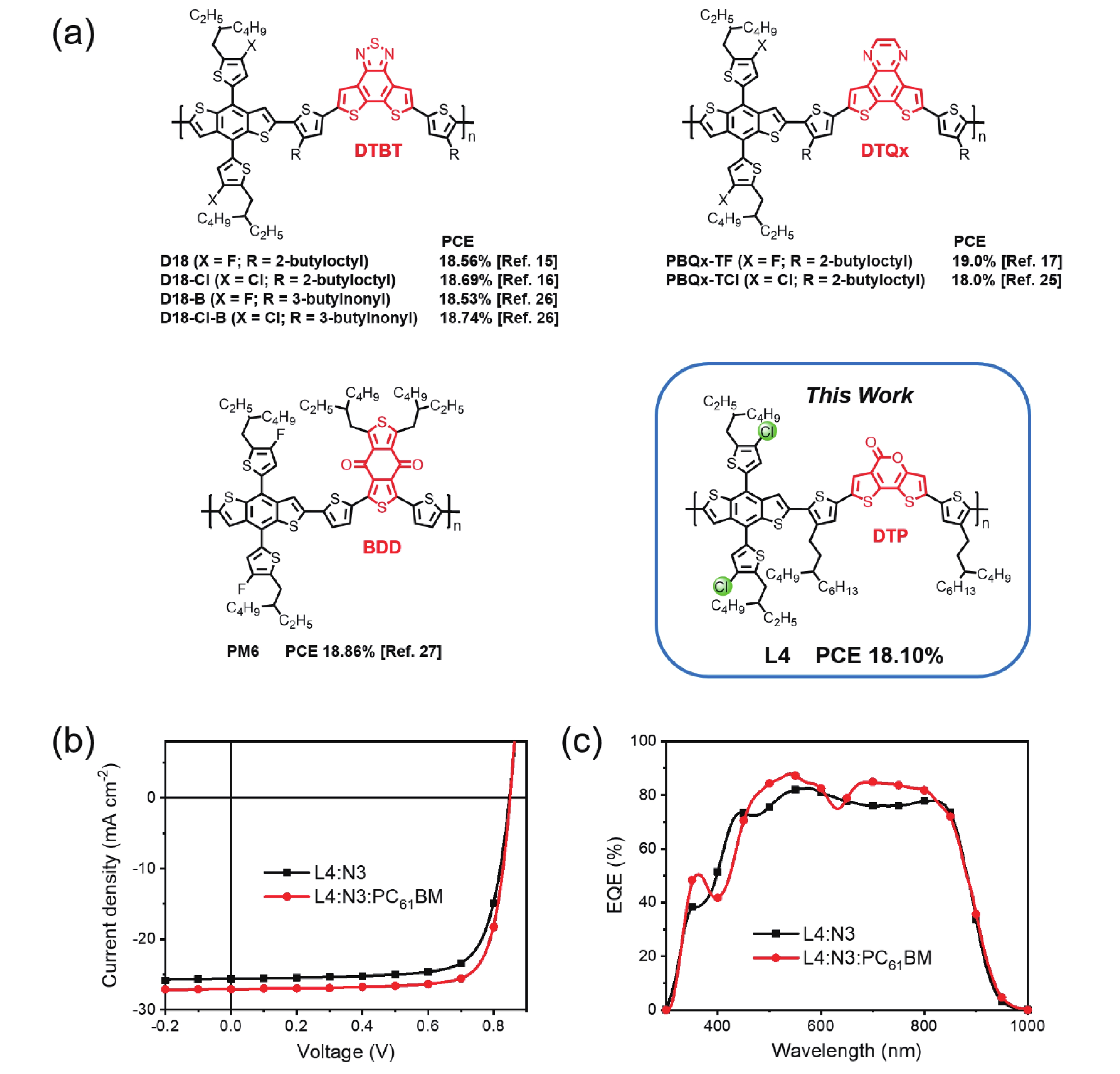
Fig. 1.
(Color online) (a) Polymer donors offering PCEs over 18%. (b) J–V curves for L4:N3 and L4:N3:PC61BM solar cells. (c) EQE spectra for L4:N3 and L4:N3:PC61BM solar cells.
SHORT COMMUNICATION
Ke Jin1, Zongliang Ou2, Lixiu Zhang1, Yongbo Yuan4, Zuo Xiao1, , Qiuling Song2, , Chenyi Yi3, and Liming Ding1,
Corresponding author: Zuo Xiao, xiaoz@nanoctr.cn; Qiuling Song, qsong@hqu.edu.cn; Chenyi Yi, yicy@mail.tsinghua.edu.cn; Liming Ding, ding@nanoctr.cn
| [1] |
Tong Y, Xiao Z, Du X, et al. Progress of the key materials for organic solar cells. Sci China Chem, 2020, 63, 758 doi: 10.1007/s11426-020-9726-0
|
| [2] |
Armin A, Li W, Sandberg O J, et al. A history and perspective of non-fullerene electron acceptors for organic solar cells. Adv Energy Mater, 2021, 11, 20003570 doi: 10.1002/aenm.202003570
|
| [3] |
Xiao Z, Yang S, Yang Z, et al. Carbon-oxygen-bridged ladder-type building blocks for highly efficient nonfullerene acceptors. Adv Mater, 2018, 31, 1804790 doi: 10.1002/adma.201804790
|
| [4] |
Xiao Z, Jia X, Ding L. Ternary organic solar cells offer 14% power conversion efficiency. Sci Bull, 2017, 62, 1562 doi: 10.1016/j.scib.2017.11.003
|
| [5] |
Liu L, Liu Q, Xiao Z, et al. Induced J-aggregation in acceptor alloy enhances photocurrent. Sci Bull, 2019, 64, 1083 doi: 10.1016/j.scib.2019.06.005
|
| [6] |
Li H, Xiao Z, Ding L, et al. Thermostable single-junction organic solar cells with a power conversion efficiency of 14.62%. Sci Bull, 2018, 63, 340 doi: 10.1016/j.scib.2018.02.015
|
| [7] |
Liu B, Xu Y, Xia D, et al. Semitransparent organic solar cells based on non-fullerene electron acceptors. Acta Phys Chim Sin, 2021, 37, 2009056 doi: 10.3866/PKU.WHXB202009056
|
| [8] |
Yuan J, Zhang Y, Zhou L, et al. Single-junction organic solar cell with over 15% efficiency using fused-ring acceptor with electron-deficient core. Joule, 2019, 3, 1140 doi: 10.1016/j.joule.2019.01.004
|
| [9] |
Cui Y, Yao H, Zhang J, et al. Single-junction organic photovoltaic cells with approaching 18% efficiency. Adv Mater, 2020, 32, 1908205 doi: 10.1002/adma.201908205
|
| [10] |
Li C, Zhou J, Song J, et al. Non-fullerene acceptors with branched side chains and improved molecular packing to exceed 18% efficiency in organic solar cells. Nat Energy, 2021, 6, 605 doi: 10.1038/s41560-021-00820-x
|
| [11] |
Wang T, Qin J, Xiao Z, et al. A 2.16 eV bandgap polymer donor gives 16% power conversion efficiency. Sci Bull, 2020, 65, 179 doi: 10.1016/j.scib.2019.11.030
|
| [12] |
Wang T, Qin J, Xiao Z, et al. Mutiple conformation locks gift polymer donor high efficiency. Nano Energy, 2020, 77, 105161 doi: 10.1016/j.nanoen.2020.105161
|
| [13] |
Sun C, Pan F, Bin H, et al. A low cost and high performance polymer donor material for polymer solar cells. Nat Commun, 2018, 9, 743 doi: 10.1038/s41467-018-03207-x
|
| [14] |
Liu Q, Jiang Y, Jin K, et al. 18% Efficiency organic solar cells. Sci Bull, 2020, 65, 272 doi: 10.1016/j.scib.2020.01.001
|
| [15] |
Jin K, Xiao Z, Ding L. D18, an eximious solar polymer!. J Semicond, 2021, 42, 010502 doi: 10.1088/1674-4926/42/1/010502
|
| [16] |
Jin K, Xiao Z, Ding L. 18.69% PCE from organic solar cells. J Semicond, 2021, 42, 060502 doi: 10.1088/1674-4926/42/6/060502
|
| [17] |
Cui Y, Xu Y, Yao H, et al. Single-junction organic photovoltaic cell with 19% efficiency. Adv Mater, 2021, 33, 2102420 doi: 10.1002/adma.202102420
|
| [18] |
Cai Y, Huo L, Sun Y. Recent adcances in wide-bandgap photovoltaic polymers. Adv Mater, 2017, 29, 1605437 doi: 10.1002/adma.201605437
|
| [19] |
Fan B, Zhang D, Li M, et al. Achieving over 16% efficiency for single-junction organic solar cells. Sci China Chem, 2019, 62, 746 doi: 10.1007/s11426-019-9457-5
|
| [20] |
Liu J, Liu L, Zuo C, et al. 5H-dithieno[3,2-b:2',3'-d]pyran-5-one unit yields efficient wide-bandgap polymer donors. Sci Bull, 2019, 64, 1655 doi: 10.1016/j.scib.2019.09.001
|
| [21] |
Xiong J, Jin K, Jiang Y, et al. Thiolactone copolymer donor gifts organic solar cells a 16.72% efficiency. Sci Bull, 2019, 64, 1573 doi: 10.1016/j.scib.2019.10.002
|
| [22] |
Jiang Y, Jin K, Chen X, et al. Post-sulphuration enhances the performance of a lactone polymer donor. J Semicond, 2021, 42, 070501 doi: 10.1088/1674-4926/42/7/070501
|
| [23] |
Qin J, Zhang L, Zuo C, et al. A chlorinated copolymer donor demonstrates a 18.13% power conversion efficiency. J Semicond, 2021, 42, 010501 doi: 10.1088/1674-4926/42/1/010501
|
| [24] |
Zhu C, Meng L, Zhang J, et al. A quinoxaline-based D-A copolymer donor achieving 17.62% efficiency of organic solar cells. Adv Mater, 2021, 33, 2100474 doi: 10.1002/adma.202100474
|
| [25] |
Xu Y, Cui Y, Yao H, et al. A new conjugated polymer that enables the integration of photovoltaic and light-emitting functions in one device. Adv Mater, 2021, 33, 2101090 doi: 10.1002/adma.202101090
|
| [26] |
Meng X, Jin K, Xiao Z, et al. Side chain engineering on D18 polymers yields 18.74% power conversion efficiency. J Semicond, 2021, 42, 100501 doi: 10.1088/1674-4926/42/10/100501
|
| [27] |
Bi P, Zhang S, Chen Z, et al. Reduced non-radiative charge recombination enables organic photovoltaic cell approaching 19% efficiency. Joule, 2021, 5, 2408 doi: 10.1016/j.joule.2021.06.020
|
| [28] |
Xue R, Zhang J, Li Y, et al. Organic solar cell materials toward commercialization. Small, 2018, 14, 1801793 doi: 10.1002/smll.201801793
|
| [29] |
Xu J, Sun A, Xiao Z, et al. Efficient wide-bandgap copolymer donors with reduced synthesis cost. J Mater Chem C, 2021, 9, 16187 doi: 10.1039/D1TC01746B
|
| [30] |
Qin X, Li X, Huang Q, et al. Rhodium(III)-catalyzed ortho C-H heteroarylation of (hetero)aromatic carboxylic acids: a rapid and concise access to π-conjugated poly-heterocycles. Angew Chem Int Ed, 2015, 54, 7167 doi: 10.1002/anie.201501982
|
| [31] |
Ou Z, Qin J, Jin K, et al. Engineering of the alkyl chain branching point on a lactone polymer donor yields 17.81% efficiency. J Mater Chem A, 2022, 10, 3314 doi: 10.1039/D1TA10233H
|
| [32] |
Yao H, Wang J, Xu Y, et al. Recent progress in chlorinated organic photovoltaic materials. Acc Chem Res, 2020, 53, 822 doi: 10.1021/acs.accounts.0c00009
|
| [33] |
Jiang K, Wei Q, Lai J Y L, et al. Alkyl chain tuning of small molecule acceptors for efficient organic solar cells. Joule, 2019, 3, 3020 doi: 10.1016/j.joule.2019.09.010
|
| [34] |
Xiao Z, Liu F, Geng X, et al. A carbon-oxygen-bridged ladder-type building block for efficient donor and acceptor materials used in organic solar cells. Sci Bull, 2017, 62, 1331 doi: 10.1016/j.scib.2017.09.017
|
| [35] |
Xiao Z, Jia X, Li D, et al. 26 mA cm–2 Jsc from organic solar cells with a low-bandgap nonfullerene acceptor. Sci Bull, 2017, 62, 494 doi: 10.1016/j.scib.2017.10.017
|
| [36] |
Xiao Z, Geng X, He D, et al. Development of isomer-free fullerene bisadducts for efficient polymer solar cells. Sci Bull, 2016, 9, 2114 doi: 10.1039/C6EE01026A
|
| [37] |
Li D, Xiao Z, Wang S, et al. A thieno[3,2-c]isoquinolin-5(4H)-one building block for efficient thick-film solar cells. Adv Energy Mater, 2018, 8, 1800397 doi: 10.1002/aenm.201800397
|
| [38] |
Gao Y, Li D, Xiao Z, et al. High-performance wide-bandgap copolymers with dithieno[3,2-b:2',3'-d]pyridin-5(4H)-one units. Mater Chem Front, 2019, 3, 399 doi: 10.1039/C8QM00604K
|
| [39] |
Li T, Zhang H, Xiao Z, et al. A carbon-oxygen-bridged hexacyclic ladder-type building block for low-bandgap nonfullerene acceptors. Mater Chem Front, 2018, 2, 700 doi: 10.1039/C8QM00004B
|
| [40] |
Jin K, Deng C, Zhang L, et al. A heptacyclic carbon-oxygem-bridged ladder-type building for A-D-A acceptors. Mater Chem Front, 2018, 2, 1716 doi: 10.1039/C8QM00285A
|
| [41] |
Qin J, Zhang L, Xiao Z, et al. Over 16% efficiency from thick-film organic solar cells. Sci Bull, 2020, 65, 1979 doi: 10.1016/j.scib.2020.08.027
|
| [42] |
An M, Xie F, Geng X, et al. A high-performance D-A copolymer based on dithieno[3,2-b:2',3'-d]pyridin-5(4H)-one unit compatible with fullerene and nonfullerene acceptors in solar cells. Adv Energy Mater, 2017, 7, 1602509 doi: 10.1002/aenm.201602509
|
| [1] |
Tong Y, Xiao Z, Du X, et al. Progress of the key materials for organic solar cells. Sci China Chem, 2020, 63, 758 doi: 10.1007/s11426-020-9726-0
|
| [2] |
Armin A, Li W, Sandberg O J, et al. A history and perspective of non-fullerene electron acceptors for organic solar cells. Adv Energy Mater, 2021, 11, 20003570 doi: 10.1002/aenm.202003570
|
| [3] |
Xiao Z, Yang S, Yang Z, et al. Carbon-oxygen-bridged ladder-type building blocks for highly efficient nonfullerene acceptors. Adv Mater, 2018, 31, 1804790 doi: 10.1002/adma.201804790
|
| [4] |
Xiao Z, Jia X, Ding L. Ternary organic solar cells offer 14% power conversion efficiency. Sci Bull, 2017, 62, 1562 doi: 10.1016/j.scib.2017.11.003
|
| [5] |
Liu L, Liu Q, Xiao Z, et al. Induced J-aggregation in acceptor alloy enhances photocurrent. Sci Bull, 2019, 64, 1083 doi: 10.1016/j.scib.2019.06.005
|
| [6] |
Li H, Xiao Z, Ding L, et al. Thermostable single-junction organic solar cells with a power conversion efficiency of 14.62%. Sci Bull, 2018, 63, 340 doi: 10.1016/j.scib.2018.02.015
|
| [7] |
Liu B, Xu Y, Xia D, et al. Semitransparent organic solar cells based on non-fullerene electron acceptors. Acta Phys Chim Sin, 2021, 37, 2009056 doi: 10.3866/PKU.WHXB202009056
|
| [8] |
Yuan J, Zhang Y, Zhou L, et al. Single-junction organic solar cell with over 15% efficiency using fused-ring acceptor with electron-deficient core. Joule, 2019, 3, 1140 doi: 10.1016/j.joule.2019.01.004
|
| [9] |
Cui Y, Yao H, Zhang J, et al. Single-junction organic photovoltaic cells with approaching 18% efficiency. Adv Mater, 2020, 32, 1908205 doi: 10.1002/adma.201908205
|
| [10] |
Li C, Zhou J, Song J, et al. Non-fullerene acceptors with branched side chains and improved molecular packing to exceed 18% efficiency in organic solar cells. Nat Energy, 2021, 6, 605 doi: 10.1038/s41560-021-00820-x
|
| [11] |
Wang T, Qin J, Xiao Z, et al. A 2.16 eV bandgap polymer donor gives 16% power conversion efficiency. Sci Bull, 2020, 65, 179 doi: 10.1016/j.scib.2019.11.030
|
| [12] |
Wang T, Qin J, Xiao Z, et al. Mutiple conformation locks gift polymer donor high efficiency. Nano Energy, 2020, 77, 105161 doi: 10.1016/j.nanoen.2020.105161
|
| [13] |
Sun C, Pan F, Bin H, et al. A low cost and high performance polymer donor material for polymer solar cells. Nat Commun, 2018, 9, 743 doi: 10.1038/s41467-018-03207-x
|
| [14] |
Liu Q, Jiang Y, Jin K, et al. 18% Efficiency organic solar cells. Sci Bull, 2020, 65, 272 doi: 10.1016/j.scib.2020.01.001
|
| [15] |
Jin K, Xiao Z, Ding L. D18, an eximious solar polymer!. J Semicond, 2021, 42, 010502 doi: 10.1088/1674-4926/42/1/010502
|
| [16] |
Jin K, Xiao Z, Ding L. 18.69% PCE from organic solar cells. J Semicond, 2021, 42, 060502 doi: 10.1088/1674-4926/42/6/060502
|
| [17] |
Cui Y, Xu Y, Yao H, et al. Single-junction organic photovoltaic cell with 19% efficiency. Adv Mater, 2021, 33, 2102420 doi: 10.1002/adma.202102420
|
| [18] |
Cai Y, Huo L, Sun Y. Recent adcances in wide-bandgap photovoltaic polymers. Adv Mater, 2017, 29, 1605437 doi: 10.1002/adma.201605437
|
| [19] |
Fan B, Zhang D, Li M, et al. Achieving over 16% efficiency for single-junction organic solar cells. Sci China Chem, 2019, 62, 746 doi: 10.1007/s11426-019-9457-5
|
| [20] |
Liu J, Liu L, Zuo C, et al. 5H-dithieno[3,2-b:2',3'-d]pyran-5-one unit yields efficient wide-bandgap polymer donors. Sci Bull, 2019, 64, 1655 doi: 10.1016/j.scib.2019.09.001
|
| [21] |
Xiong J, Jin K, Jiang Y, et al. Thiolactone copolymer donor gifts organic solar cells a 16.72% efficiency. Sci Bull, 2019, 64, 1573 doi: 10.1016/j.scib.2019.10.002
|
| [22] |
Jiang Y, Jin K, Chen X, et al. Post-sulphuration enhances the performance of a lactone polymer donor. J Semicond, 2021, 42, 070501 doi: 10.1088/1674-4926/42/7/070501
|
| [23] |
Qin J, Zhang L, Zuo C, et al. A chlorinated copolymer donor demonstrates a 18.13% power conversion efficiency. J Semicond, 2021, 42, 010501 doi: 10.1088/1674-4926/42/1/010501
|
| [24] |
Zhu C, Meng L, Zhang J, et al. A quinoxaline-based D-A copolymer donor achieving 17.62% efficiency of organic solar cells. Adv Mater, 2021, 33, 2100474 doi: 10.1002/adma.202100474
|
| [25] |
Xu Y, Cui Y, Yao H, et al. A new conjugated polymer that enables the integration of photovoltaic and light-emitting functions in one device. Adv Mater, 2021, 33, 2101090 doi: 10.1002/adma.202101090
|
| [26] |
Meng X, Jin K, Xiao Z, et al. Side chain engineering on D18 polymers yields 18.74% power conversion efficiency. J Semicond, 2021, 42, 100501 doi: 10.1088/1674-4926/42/10/100501
|
| [27] |
Bi P, Zhang S, Chen Z, et al. Reduced non-radiative charge recombination enables organic photovoltaic cell approaching 19% efficiency. Joule, 2021, 5, 2408 doi: 10.1016/j.joule.2021.06.020
|
| [28] |
Xue R, Zhang J, Li Y, et al. Organic solar cell materials toward commercialization. Small, 2018, 14, 1801793 doi: 10.1002/smll.201801793
|
| [29] |
Xu J, Sun A, Xiao Z, et al. Efficient wide-bandgap copolymer donors with reduced synthesis cost. J Mater Chem C, 2021, 9, 16187 doi: 10.1039/D1TC01746B
|
| [30] |
Qin X, Li X, Huang Q, et al. Rhodium(III)-catalyzed ortho C-H heteroarylation of (hetero)aromatic carboxylic acids: a rapid and concise access to π-conjugated poly-heterocycles. Angew Chem Int Ed, 2015, 54, 7167 doi: 10.1002/anie.201501982
|
| [31] |
Ou Z, Qin J, Jin K, et al. Engineering of the alkyl chain branching point on a lactone polymer donor yields 17.81% efficiency. J Mater Chem A, 2022, 10, 3314 doi: 10.1039/D1TA10233H
|
| [32] |
Yao H, Wang J, Xu Y, et al. Recent progress in chlorinated organic photovoltaic materials. Acc Chem Res, 2020, 53, 822 doi: 10.1021/acs.accounts.0c00009
|
| [33] |
Jiang K, Wei Q, Lai J Y L, et al. Alkyl chain tuning of small molecule acceptors for efficient organic solar cells. Joule, 2019, 3, 3020 doi: 10.1016/j.joule.2019.09.010
|
| [34] |
Xiao Z, Liu F, Geng X, et al. A carbon-oxygen-bridged ladder-type building block for efficient donor and acceptor materials used in organic solar cells. Sci Bull, 2017, 62, 1331 doi: 10.1016/j.scib.2017.09.017
|
| [35] |
Xiao Z, Jia X, Li D, et al. 26 mA cm–2 Jsc from organic solar cells with a low-bandgap nonfullerene acceptor. Sci Bull, 2017, 62, 494 doi: 10.1016/j.scib.2017.10.017
|
| [36] |
Xiao Z, Geng X, He D, et al. Development of isomer-free fullerene bisadducts for efficient polymer solar cells. Sci Bull, 2016, 9, 2114 doi: 10.1039/C6EE01026A
|
| [37] |
Li D, Xiao Z, Wang S, et al. A thieno[3,2-c]isoquinolin-5(4H)-one building block for efficient thick-film solar cells. Adv Energy Mater, 2018, 8, 1800397 doi: 10.1002/aenm.201800397
|
| [38] |
Gao Y, Li D, Xiao Z, et al. High-performance wide-bandgap copolymers with dithieno[3,2-b:2',3'-d]pyridin-5(4H)-one units. Mater Chem Front, 2019, 3, 399 doi: 10.1039/C8QM00604K
|
| [39] |
Li T, Zhang H, Xiao Z, et al. A carbon-oxygen-bridged hexacyclic ladder-type building block for low-bandgap nonfullerene acceptors. Mater Chem Front, 2018, 2, 700 doi: 10.1039/C8QM00004B
|
| [40] |
Jin K, Deng C, Zhang L, et al. A heptacyclic carbon-oxygem-bridged ladder-type building for A-D-A acceptors. Mater Chem Front, 2018, 2, 1716 doi: 10.1039/C8QM00285A
|
| [41] |
Qin J, Zhang L, Xiao Z, et al. Over 16% efficiency from thick-film organic solar cells. Sci Bull, 2020, 65, 1979 doi: 10.1016/j.scib.2020.08.027
|
| [42] |
An M, Xie F, Geng X, et al. A high-performance D-A copolymer based on dithieno[3,2-b:2',3'-d]pyridin-5(4H)-one unit compatible with fullerene and nonfullerene acceptors in solar cells. Adv Energy Mater, 2017, 7, 1602509 doi: 10.1002/aenm.201602509
|









Article views: 1740 Times PDF downloads: 91 Times Cited by: 0 Times
Received: 23 February 2022 Revised: Online: Accepted Manuscript: 25 February 2022Uncorrected proof: 25 February 2022Published: 01 May 2022
| Citation: |
Ke Jin, Zongliang Ou, Lixiu Zhang, Yongbo Yuan, Zuo Xiao, Qiuling Song, Chenyi Yi, Liming Ding. A chlorinated lactone polymer donor featuring high performance and low cost[J]. Journal of Semiconductors, 2022, 43(5): 050501. doi: 10.1088/1674-4926/43/5/050501
****
K Jin, Z L Ou, L X Zhang, Y B Yuan, Z Xiao, Q L Song, C Y Yi, L M Ding. A chlorinated lactone polymer donor featuring high performance and low cost[J]. J. Semicond, 2022, 43(5): 050501. doi: 10.1088/1674-4926/43/5/050501

|
| [1] |
Tong Y, Xiao Z, Du X, et al. Progress of the key materials for organic solar cells. Sci China Chem, 2020, 63, 758 doi: 10.1007/s11426-020-9726-0
|
| [2] |
Armin A, Li W, Sandberg O J, et al. A history and perspective of non-fullerene electron acceptors for organic solar cells. Adv Energy Mater, 2021, 11, 20003570 doi: 10.1002/aenm.202003570
|
| [3] |
Xiao Z, Yang S, Yang Z, et al. Carbon-oxygen-bridged ladder-type building blocks for highly efficient nonfullerene acceptors. Adv Mater, 2018, 31, 1804790 doi: 10.1002/adma.201804790
|
| [4] |
Xiao Z, Jia X, Ding L. Ternary organic solar cells offer 14% power conversion efficiency. Sci Bull, 2017, 62, 1562 doi: 10.1016/j.scib.2017.11.003
|
| [5] |
Liu L, Liu Q, Xiao Z, et al. Induced J-aggregation in acceptor alloy enhances photocurrent. Sci Bull, 2019, 64, 1083 doi: 10.1016/j.scib.2019.06.005
|
| [6] |
Li H, Xiao Z, Ding L, et al. Thermostable single-junction organic solar cells with a power conversion efficiency of 14.62%. Sci Bull, 2018, 63, 340 doi: 10.1016/j.scib.2018.02.015
|
| [7] |
Liu B, Xu Y, Xia D, et al. Semitransparent organic solar cells based on non-fullerene electron acceptors. Acta Phys Chim Sin, 2021, 37, 2009056 doi: 10.3866/PKU.WHXB202009056
|
| [8] |
Yuan J, Zhang Y, Zhou L, et al. Single-junction organic solar cell with over 15% efficiency using fused-ring acceptor with electron-deficient core. Joule, 2019, 3, 1140 doi: 10.1016/j.joule.2019.01.004
|
| [9] |
Cui Y, Yao H, Zhang J, et al. Single-junction organic photovoltaic cells with approaching 18% efficiency. Adv Mater, 2020, 32, 1908205 doi: 10.1002/adma.201908205
|
| [10] |
Li C, Zhou J, Song J, et al. Non-fullerene acceptors with branched side chains and improved molecular packing to exceed 18% efficiency in organic solar cells. Nat Energy, 2021, 6, 605 doi: 10.1038/s41560-021-00820-x
|
| [11] |
Wang T, Qin J, Xiao Z, et al. A 2.16 eV bandgap polymer donor gives 16% power conversion efficiency. Sci Bull, 2020, 65, 179 doi: 10.1016/j.scib.2019.11.030
|
| [12] |
Wang T, Qin J, Xiao Z, et al. Mutiple conformation locks gift polymer donor high efficiency. Nano Energy, 2020, 77, 105161 doi: 10.1016/j.nanoen.2020.105161
|
| [13] |
Sun C, Pan F, Bin H, et al. A low cost and high performance polymer donor material for polymer solar cells. Nat Commun, 2018, 9, 743 doi: 10.1038/s41467-018-03207-x
|
| [14] |
Liu Q, Jiang Y, Jin K, et al. 18% Efficiency organic solar cells. Sci Bull, 2020, 65, 272 doi: 10.1016/j.scib.2020.01.001
|
| [15] |
Jin K, Xiao Z, Ding L. D18, an eximious solar polymer!. J Semicond, 2021, 42, 010502 doi: 10.1088/1674-4926/42/1/010502
|
| [16] |
Jin K, Xiao Z, Ding L. 18.69% PCE from organic solar cells. J Semicond, 2021, 42, 060502 doi: 10.1088/1674-4926/42/6/060502
|
| [17] |
Cui Y, Xu Y, Yao H, et al. Single-junction organic photovoltaic cell with 19% efficiency. Adv Mater, 2021, 33, 2102420 doi: 10.1002/adma.202102420
|
| [18] |
Cai Y, Huo L, Sun Y. Recent adcances in wide-bandgap photovoltaic polymers. Adv Mater, 2017, 29, 1605437 doi: 10.1002/adma.201605437
|
| [19] |
Fan B, Zhang D, Li M, et al. Achieving over 16% efficiency for single-junction organic solar cells. Sci China Chem, 2019, 62, 746 doi: 10.1007/s11426-019-9457-5
|
| [20] |
Liu J, Liu L, Zuo C, et al. 5H-dithieno[3,2-b:2',3'-d]pyran-5-one unit yields efficient wide-bandgap polymer donors. Sci Bull, 2019, 64, 1655 doi: 10.1016/j.scib.2019.09.001
|
| [21] |
Xiong J, Jin K, Jiang Y, et al. Thiolactone copolymer donor gifts organic solar cells a 16.72% efficiency. Sci Bull, 2019, 64, 1573 doi: 10.1016/j.scib.2019.10.002
|
| [22] |
Jiang Y, Jin K, Chen X, et al. Post-sulphuration enhances the performance of a lactone polymer donor. J Semicond, 2021, 42, 070501 doi: 10.1088/1674-4926/42/7/070501
|
| [23] |
Qin J, Zhang L, Zuo C, et al. A chlorinated copolymer donor demonstrates a 18.13% power conversion efficiency. J Semicond, 2021, 42, 010501 doi: 10.1088/1674-4926/42/1/010501
|
| [24] |
Zhu C, Meng L, Zhang J, et al. A quinoxaline-based D-A copolymer donor achieving 17.62% efficiency of organic solar cells. Adv Mater, 2021, 33, 2100474 doi: 10.1002/adma.202100474
|
| [25] |
Xu Y, Cui Y, Yao H, et al. A new conjugated polymer that enables the integration of photovoltaic and light-emitting functions in one device. Adv Mater, 2021, 33, 2101090 doi: 10.1002/adma.202101090
|
| [26] |
Meng X, Jin K, Xiao Z, et al. Side chain engineering on D18 polymers yields 18.74% power conversion efficiency. J Semicond, 2021, 42, 100501 doi: 10.1088/1674-4926/42/10/100501
|
| [27] |
Bi P, Zhang S, Chen Z, et al. Reduced non-radiative charge recombination enables organic photovoltaic cell approaching 19% efficiency. Joule, 2021, 5, 2408 doi: 10.1016/j.joule.2021.06.020
|
| [28] |
Xue R, Zhang J, Li Y, et al. Organic solar cell materials toward commercialization. Small, 2018, 14, 1801793 doi: 10.1002/smll.201801793
|
| [29] |
Xu J, Sun A, Xiao Z, et al. Efficient wide-bandgap copolymer donors with reduced synthesis cost. J Mater Chem C, 2021, 9, 16187 doi: 10.1039/D1TC01746B
|
| [30] |
Qin X, Li X, Huang Q, et al. Rhodium(III)-catalyzed ortho C-H heteroarylation of (hetero)aromatic carboxylic acids: a rapid and concise access to π-conjugated poly-heterocycles. Angew Chem Int Ed, 2015, 54, 7167 doi: 10.1002/anie.201501982
|
| [31] |
Ou Z, Qin J, Jin K, et al. Engineering of the alkyl chain branching point on a lactone polymer donor yields 17.81% efficiency. J Mater Chem A, 2022, 10, 3314 doi: 10.1039/D1TA10233H
|
| [32] |
Yao H, Wang J, Xu Y, et al. Recent progress in chlorinated organic photovoltaic materials. Acc Chem Res, 2020, 53, 822 doi: 10.1021/acs.accounts.0c00009
|
| [33] |
Jiang K, Wei Q, Lai J Y L, et al. Alkyl chain tuning of small molecule acceptors for efficient organic solar cells. Joule, 2019, 3, 3020 doi: 10.1016/j.joule.2019.09.010
|
| [34] |
Xiao Z, Liu F, Geng X, et al. A carbon-oxygen-bridged ladder-type building block for efficient donor and acceptor materials used in organic solar cells. Sci Bull, 2017, 62, 1331 doi: 10.1016/j.scib.2017.09.017
|
| [35] |
Xiao Z, Jia X, Li D, et al. 26 mA cm–2 Jsc from organic solar cells with a low-bandgap nonfullerene acceptor. Sci Bull, 2017, 62, 494 doi: 10.1016/j.scib.2017.10.017
|
| [36] |
Xiao Z, Geng X, He D, et al. Development of isomer-free fullerene bisadducts for efficient polymer solar cells. Sci Bull, 2016, 9, 2114 doi: 10.1039/C6EE01026A
|
| [37] |
Li D, Xiao Z, Wang S, et al. A thieno[3,2-c]isoquinolin-5(4H)-one building block for efficient thick-film solar cells. Adv Energy Mater, 2018, 8, 1800397 doi: 10.1002/aenm.201800397
|
| [38] |
Gao Y, Li D, Xiao Z, et al. High-performance wide-bandgap copolymers with dithieno[3,2-b:2',3'-d]pyridin-5(4H)-one units. Mater Chem Front, 2019, 3, 399 doi: 10.1039/C8QM00604K
|
| [39] |
Li T, Zhang H, Xiao Z, et al. A carbon-oxygen-bridged hexacyclic ladder-type building block for low-bandgap nonfullerene acceptors. Mater Chem Front, 2018, 2, 700 doi: 10.1039/C8QM00004B
|
| [40] |
Jin K, Deng C, Zhang L, et al. A heptacyclic carbon-oxygem-bridged ladder-type building for A-D-A acceptors. Mater Chem Front, 2018, 2, 1716 doi: 10.1039/C8QM00285A
|
| [41] |
Qin J, Zhang L, Xiao Z, et al. Over 16% efficiency from thick-film organic solar cells. Sci Bull, 2020, 65, 1979 doi: 10.1016/j.scib.2020.08.027
|
| [42] |
An M, Xie F, Geng X, et al. A high-performance D-A copolymer based on dithieno[3,2-b:2',3'-d]pyridin-5(4H)-one unit compatible with fullerene and nonfullerene acceptors in solar cells. Adv Energy Mater, 2017, 7, 1602509 doi: 10.1002/aenm.201602509
|
 2022050501suppl.pdf
|

|

 WeChat ID
Journal of Semiconductors © 2017 All Rights Reserved 京ICP備05085259號-2
 DownLoad: