SEMICONDUCTOR DEVICES
Bin Zhang1, , Xiaokuo Yang1, , Jiahao Liu1, Weiwei Li1, 2 and Jie Xu1
Corresponding author: Bin Zhang, Email: kgdzhangbin@163.com; Xiaokuo Yang, yangxk0123@163.com
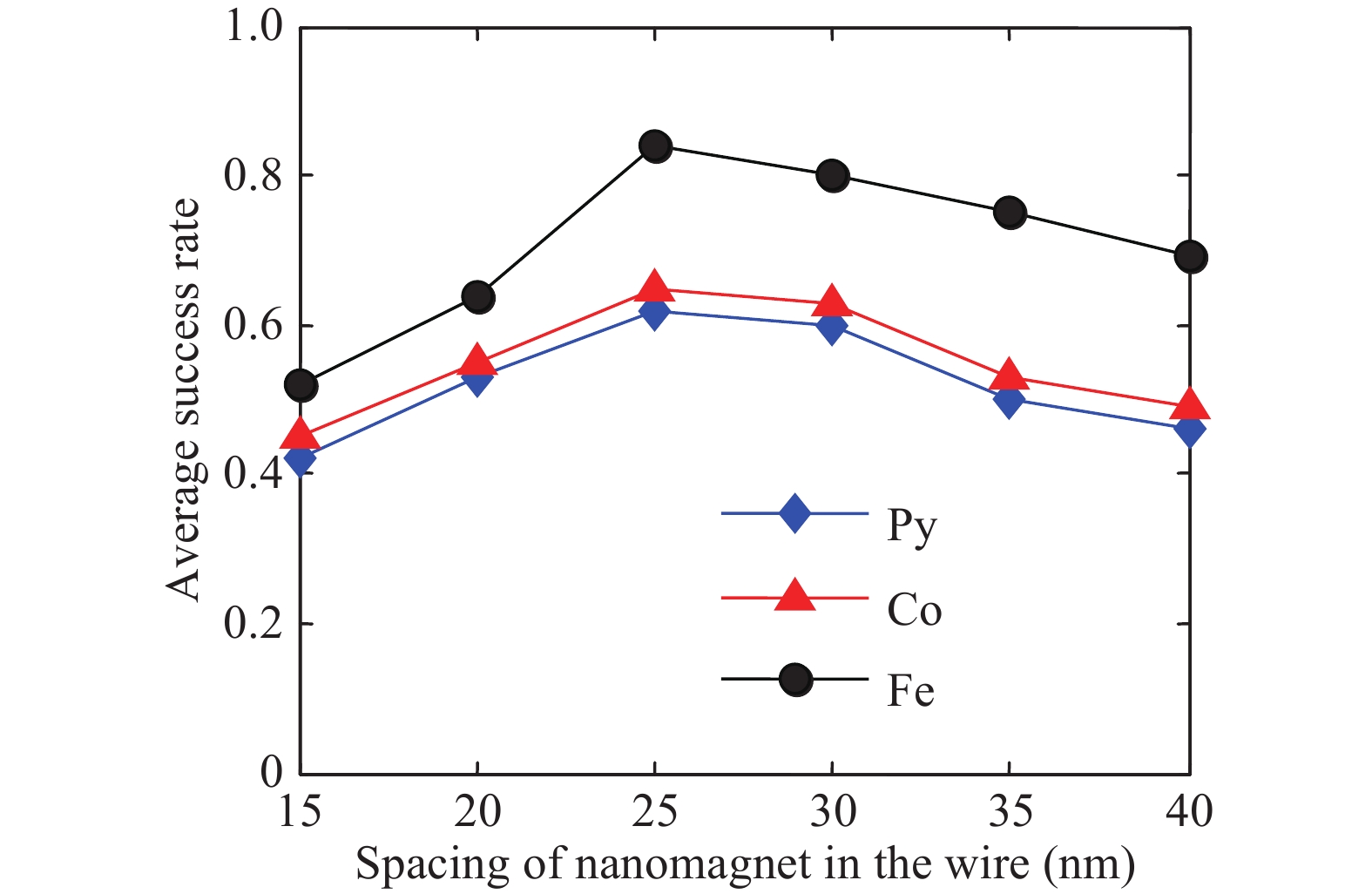
Abstract: Nanomagnet logic (NML) devices have been proposed as one of the best candidates for the next generation of integrated circuits thanks to its substantial advantages of nonvolatility, radiation hardening and potentially low power. In this article, errors of nanomagnetic interconnect wire subjected to magnet edge imperfections have been evaluated for the purpose of reliable logic propagation. The missing corner defects of nanomagnet in the wire are modeled with a triangle, and the interconnect fabricated with various magnetic materials is thoroughly investigated by micromagnetic simulations under different corner defect amplitudes and device spacings. The results show that as the defect amplitude increases, the success rate of logic propagation in the interconnect decreases. More results show that from the interconnect wire fabricated with materials, iron demonstrates the best defect tolerance ability among three representative and frequently used NML materials, also logic transmission errors can be mitigated by adjusting spacing between nanomagnets. These findings can provide key technical guides for designing reliable interconnects.
Key words: nanomagnet logic device, defect, interconnect, reliability
| [1] |
Bernstein K, Cavin III R K, Porod W, et al. Device and architecture outlook for beyond CMOS switches. Proc IEEE, 2010, 98(12): 2169 doi: 10.1109/JPROC.2010.2066530
|
| [2] |
Tóth G, Lent C S. Quantum computing with quantum-dot cellular automata. Phys Rev A, 2001, 63(5): 052315 doi: 10.1103/PhysRevA.63.052315
|
| [3] |
Colci M, Johnson M. Dipolar coupling between nanopillar spin valves and magnetic quantum cellular automata arrays. IEEE Trans Nanotechnol, 2013, 12(5): 824 doi: 10.1109/TNANO.2013.2275033
|
| [4] |
Imre A, Csaba G, Ji L, et al. Majority logic gate for magnetic quantum-dot cellular automata. Science, 2006, 311(5758): 205 doi: 10.1126/science.1120506
|
| [5] |
Yang X K, Cai L, Zhang B, et al. Micromagnetic simulation of exploratory magnetic logic device with missing corner defect. J Magn Magn Mater, 2015(11): 391 doi: 10.1016/j.jmmm.2015.06.068
|
| [6] |
Allwood D A, Xiong G, Faulkner C C, et al. Magnetic domain-wall logic. Science, 2005, 309(5741): 1688 doi: 10.1126/science.1108813
|
| [7] |
Suh D I, Kil J P, Kim K W, et al. A single magnetic tunnel junction representing the basic logic functions-NAND, NOR, and IMP. IEEE Electron Device Letters, 2015, 36(4): 402 doi: 10.1109/LED.2015.2406881
|
| [8] |
Fong X, Kim Y, Yogendra K, et al. Spin-transfer torque devices for logic and memory: prospects and perspectives. IEEE Trans Comput-Aid Des Integr Circuits Syst, 2016, 35(1): 1 doi: 10.1109/TCAD.2015.2481793
|
| [9] |
Hu L, Hesjedal T. Micromagnetic investigation of the S-state reconfigurable logic element. IEEE Trans Magnet, 2012, 48(7): 2103 doi: 10.1109/TMAG.2012.2183607
|
| [10] |
Imtaar M A, Yadav A, Epping A, et al. Nanomagnet fabrication using nanoimprint lithography and electrodeposition. IEEE Trans Nanotechnol, 2013, 12(4): 547 doi: 10.1109/TNANO.2013.2257833
|
| [11] |
Yang X K, Cai L, Wang S Z, et al. Reliability and performance evaluation of QCA devices with rotation cell defect. IEEE Trans Nanotechnol, 2012, 11(9): 1009 doi: 10.1109/TNANO.2012.2211613
|
| [12] |
Niemier M, Varga E, Bernstein G H, et al. Shape engineering for controlled switching with nanomagnet logic. IEEE Trans Nanotechnol, 2012, 11(2): 220 doi: 10.1109/TNANO.2010.2056697
|
| [13] |
Shah F A, Sankar V K, Li P, et al. Compensation of orange-peel coupling effect in magnetic tunnel junction free layer via shape engineering for nanomagnet logic applications. J Appl Phys, 2014, 115(17): 17B902 doi: 10.1063/1.4863935
|
| [14] |
Spedalieri F M, Jacob A P, Nikonov D E, et al. Performance of magnetic quantum cellular automata and limitations due to thermal noise. IEEE Trans Nanotechnol, 2011, 10(3): 537 doi: 10.1109/TNANO.2010.2050597
|
| [15] |
Alam M T, Kurtz S J, Siddiq M. On-chip clocking of nanomagnet logic lines and gates. IEEE Trans Nanotechnol, 2012, 11(2): 273 doi: 10.1109/TNANO.2011.2169983
|
| [16] |
Chunsheng E, Rantschler J, Khizroev S, et al. Micromagnetics of signal propagation in magnetic cellular logic data channels. J Appl Phys, 2008, 104(5): 054311 doi: 10.1063/1.2975836
|
| [17] |
Donahue M J, Porter D G. OOMMF user's guide. Version 1.0. Interagency Report NISTIR 6376, National Institute of Standards and Technology (NIST), Gaithersburg, MD
|
| [18] |
Yang X K, Cai L, Wang J H, et al. Experimental study of magnetic quantum-dot cellular automata function arrays. Acta Phys Sin, 2012, 61(4): 047502
|
| [19] |
Kumari A, Bhanja S. Landauer clocking for magnetic cellular automata (MCA) arrays. IEEE Trans Very Large Scale Integr Syst, 2011, 19(4): 714 doi: 10.1109/TVLSI.2009.2036627
|
| [20] |
D’Souza N, Fashami M S, Bandyopadhyay S, et al. Experimental clocking of nanomagnets with strain for ultralow power boolean logic. Nano Lett, 2016, 16(2): 1069 doi: 10.1021/acs.nanolett.5b04205
|
| [21] |
Gross L, Schlittler R R, Meyer G, et al. Magnetologic devices fabricated by nanostencil lithography. Nanotechnology, 2010, 21(32): 325301 doi: 10.1088/0957-4484/21/32/325301
|

Table 1. Three materials parameters and device sizes.
| Parameter | Permalloy | Co | Fe |
| MS (A/m) | 8 × 10⁵ | 10 × 105 | 17.5 × 10⁵ |
| A (J/m) | 10.5 × 10?12 | 13 × 10?12 | 21 × 10?12 |
| Size (nm3) | 60 × 100 × 30 | 60 × 100 × 10 | 60 × 100 × 6 |
DownLoad: CSV
| [1] |
Bernstein K, Cavin III R K, Porod W, et al. Device and architecture outlook for beyond CMOS switches. Proc IEEE, 2010, 98(12): 2169 doi: 10.1109/JPROC.2010.2066530
|
| [2] |
Tóth G, Lent C S. Quantum computing with quantum-dot cellular automata. Phys Rev A, 2001, 63(5): 052315 doi: 10.1103/PhysRevA.63.052315
|
| [3] |
Colci M, Johnson M. Dipolar coupling between nanopillar spin valves and magnetic quantum cellular automata arrays. IEEE Trans Nanotechnol, 2013, 12(5): 824 doi: 10.1109/TNANO.2013.2275033
|
| [4] |
Imre A, Csaba G, Ji L, et al. Majority logic gate for magnetic quantum-dot cellular automata. Science, 2006, 311(5758): 205 doi: 10.1126/science.1120506
|
| [5] |
Yang X K, Cai L, Zhang B, et al. Micromagnetic simulation of exploratory magnetic logic device with missing corner defect. J Magn Magn Mater, 2015(11): 391 doi: 10.1016/j.jmmm.2015.06.068
|
| [6] |
Allwood D A, Xiong G, Faulkner C C, et al. Magnetic domain-wall logic. Science, 2005, 309(5741): 1688 doi: 10.1126/science.1108813
|
| [7] |
Suh D I, Kil J P, Kim K W, et al. A single magnetic tunnel junction representing the basic logic functions-NAND, NOR, and IMP. IEEE Electron Device Letters, 2015, 36(4): 402 doi: 10.1109/LED.2015.2406881
|
| [8] |
Fong X, Kim Y, Yogendra K, et al. Spin-transfer torque devices for logic and memory: prospects and perspectives. IEEE Trans Comput-Aid Des Integr Circuits Syst, 2016, 35(1): 1 doi: 10.1109/TCAD.2015.2481793
|
| [9] |
Hu L, Hesjedal T. Micromagnetic investigation of the S-state reconfigurable logic element. IEEE Trans Magnet, 2012, 48(7): 2103 doi: 10.1109/TMAG.2012.2183607
|
| [10] |
Imtaar M A, Yadav A, Epping A, et al. Nanomagnet fabrication using nanoimprint lithography and electrodeposition. IEEE Trans Nanotechnol, 2013, 12(4): 547 doi: 10.1109/TNANO.2013.2257833
|
| [11] |
Yang X K, Cai L, Wang S Z, et al. Reliability and performance evaluation of QCA devices with rotation cell defect. IEEE Trans Nanotechnol, 2012, 11(9): 1009 doi: 10.1109/TNANO.2012.2211613
|
| [12] |
Niemier M, Varga E, Bernstein G H, et al. Shape engineering for controlled switching with nanomagnet logic. IEEE Trans Nanotechnol, 2012, 11(2): 220 doi: 10.1109/TNANO.2010.2056697
|
| [13] |
Shah F A, Sankar V K, Li P, et al. Compensation of orange-peel coupling effect in magnetic tunnel junction free layer via shape engineering for nanomagnet logic applications. J Appl Phys, 2014, 115(17): 17B902 doi: 10.1063/1.4863935
|
| [14] |
Spedalieri F M, Jacob A P, Nikonov D E, et al. Performance of magnetic quantum cellular automata and limitations due to thermal noise. IEEE Trans Nanotechnol, 2011, 10(3): 537 doi: 10.1109/TNANO.2010.2050597
|
| [15] |
Alam M T, Kurtz S J, Siddiq M. On-chip clocking of nanomagnet logic lines and gates. IEEE Trans Nanotechnol, 2012, 11(2): 273 doi: 10.1109/TNANO.2011.2169983
|
| [16] |
Chunsheng E, Rantschler J, Khizroev S, et al. Micromagnetics of signal propagation in magnetic cellular logic data channels. J Appl Phys, 2008, 104(5): 054311 doi: 10.1063/1.2975836
|
| [17] |
Donahue M J, Porter D G. OOMMF user's guide. Version 1.0. Interagency Report NISTIR 6376, National Institute of Standards and Technology (NIST), Gaithersburg, MD
|
| [18] |
Yang X K, Cai L, Wang J H, et al. Experimental study of magnetic quantum-dot cellular automata function arrays. Acta Phys Sin, 2012, 61(4): 047502
|
| [19] |
Kumari A, Bhanja S. Landauer clocking for magnetic cellular automata (MCA) arrays. IEEE Trans Very Large Scale Integr Syst, 2011, 19(4): 714 doi: 10.1109/TVLSI.2009.2036627
|
| [20] |
D’Souza N, Fashami M S, Bandyopadhyay S, et al. Experimental clocking of nanomagnets with strain for ultralow power boolean logic. Nano Lett, 2016, 16(2): 1069 doi: 10.1021/acs.nanolett.5b04205
|
| [21] |
Gross L, Schlittler R R, Meyer G, et al. Magnetologic devices fabricated by nanostencil lithography. Nanotechnology, 2010, 21(32): 325301 doi: 10.1088/0957-4484/21/32/325301
|
Article views: 4009 Times PDF downloads: 34 Times Cited by: 0 Times
Received: 22 June 2017 Revised: 24 July 2017 Online: Uncorrected proof: 24 January 2018Accepted Manuscript: 02 February 2018Published: 02 February 2018
| Citation: |
Bin Zhang, Xiaokuo Yang, Jiahao Liu, Weiwei Li, Jie Xu. Reliability analysis of magnetic logic interconnect wire subjected to magnet edge imperfections[J]. Journal of Semiconductors, 2018, 39(2): 024004. doi: 10.1088/1674-4926/39/2/024004
****
B Zhang, X K Yang, J H Liu, W W Li, J Xu. Reliability analysis of magnetic logic interconnect wire subjected to magnet edge imperfections[J]. J. Semicond., 2018, 39(2): 024004. doi: 10.1088/1674-4926/39/2/024004.
|
Project supported by the National Natural Science Foundation of China (No. 61302022) and the Scientific Research Foundation for Postdoctor of Air Force Engineering University (Nos. 2015BSKYQD03, 2016KYMZ06).
| [1] |
Bernstein K, Cavin III R K, Porod W, et al. Device and architecture outlook for beyond CMOS switches. Proc IEEE, 2010, 98(12): 2169 doi: 10.1109/JPROC.2010.2066530
|
| [2] |
Tóth G, Lent C S. Quantum computing with quantum-dot cellular automata. Phys Rev A, 2001, 63(5): 052315 doi: 10.1103/PhysRevA.63.052315
|
| [3] |
Colci M, Johnson M. Dipolar coupling between nanopillar spin valves and magnetic quantum cellular automata arrays. IEEE Trans Nanotechnol, 2013, 12(5): 824 doi: 10.1109/TNANO.2013.2275033
|
| [4] |
Imre A, Csaba G, Ji L, et al. Majority logic gate for magnetic quantum-dot cellular automata. Science, 2006, 311(5758): 205 doi: 10.1126/science.1120506
|
| [5] |
Yang X K, Cai L, Zhang B, et al. Micromagnetic simulation of exploratory magnetic logic device with missing corner defect. J Magn Magn Mater, 2015(11): 391 doi: 10.1016/j.jmmm.2015.06.068
|
| [6] |
Allwood D A, Xiong G, Faulkner C C, et al. Magnetic domain-wall logic. Science, 2005, 309(5741): 1688 doi: 10.1126/science.1108813
|
| [7] |
Suh D I, Kil J P, Kim K W, et al. A single magnetic tunnel junction representing the basic logic functions-NAND, NOR, and IMP. IEEE Electron Device Letters, 2015, 36(4): 402 doi: 10.1109/LED.2015.2406881
|
| [8] |
Fong X, Kim Y, Yogendra K, et al. Spin-transfer torque devices for logic and memory: prospects and perspectives. IEEE Trans Comput-Aid Des Integr Circuits Syst, 2016, 35(1): 1 doi: 10.1109/TCAD.2015.2481793
|
| [9] |
Hu L, Hesjedal T. Micromagnetic investigation of the S-state reconfigurable logic element. IEEE Trans Magnet, 2012, 48(7): 2103 doi: 10.1109/TMAG.2012.2183607
|
| [10] |
Imtaar M A, Yadav A, Epping A, et al. Nanomagnet fabrication using nanoimprint lithography and electrodeposition. IEEE Trans Nanotechnol, 2013, 12(4): 547 doi: 10.1109/TNANO.2013.2257833
|
| [11] |
Yang X K, Cai L, Wang S Z, et al. Reliability and performance evaluation of QCA devices with rotation cell defect. IEEE Trans Nanotechnol, 2012, 11(9): 1009 doi: 10.1109/TNANO.2012.2211613
|
| [12] |
Niemier M, Varga E, Bernstein G H, et al. Shape engineering for controlled switching with nanomagnet logic. IEEE Trans Nanotechnol, 2012, 11(2): 220 doi: 10.1109/TNANO.2010.2056697
|
| [13] |
Shah F A, Sankar V K, Li P, et al. Compensation of orange-peel coupling effect in magnetic tunnel junction free layer via shape engineering for nanomagnet logic applications. J Appl Phys, 2014, 115(17): 17B902 doi: 10.1063/1.4863935
|
| [14] |
Spedalieri F M, Jacob A P, Nikonov D E, et al. Performance of magnetic quantum cellular automata and limitations due to thermal noise. IEEE Trans Nanotechnol, 2011, 10(3): 537 doi: 10.1109/TNANO.2010.2050597
|
| [15] |
Alam M T, Kurtz S J, Siddiq M. On-chip clocking of nanomagnet logic lines and gates. IEEE Trans Nanotechnol, 2012, 11(2): 273 doi: 10.1109/TNANO.2011.2169983
|
| [16] |
Chunsheng E, Rantschler J, Khizroev S, et al. Micromagnetics of signal propagation in magnetic cellular logic data channels. J Appl Phys, 2008, 104(5): 054311 doi: 10.1063/1.2975836
|
| [17] |
Donahue M J, Porter D G. OOMMF user's guide. Version 1.0. Interagency Report NISTIR 6376, National Institute of Standards and Technology (NIST), Gaithersburg, MD
|
| [18] |
Yang X K, Cai L, Wang J H, et al. Experimental study of magnetic quantum-dot cellular automata function arrays. Acta Phys Sin, 2012, 61(4): 047502
|
| [19] |
Kumari A, Bhanja S. Landauer clocking for magnetic cellular automata (MCA) arrays. IEEE Trans Very Large Scale Integr Syst, 2011, 19(4): 714 doi: 10.1109/TVLSI.2009.2036627
|
| [20] |
D’Souza N, Fashami M S, Bandyopadhyay S, et al. Experimental clocking of nanomagnets with strain for ultralow power boolean logic. Nano Lett, 2016, 16(2): 1069 doi: 10.1021/acs.nanolett.5b04205
|
| [21] |
Gross L, Schlittler R R, Meyer G, et al. Magnetologic devices fabricated by nanostencil lithography. Nanotechnology, 2010, 21(32): 325301 doi: 10.1088/0957-4484/21/32/325301
|
Journal of Semiconductors © 2017 All Rights Reserved 京ICP備05085259號-2