ARTICLES
Xuejiao Wang1, 2, 3, 4, 5, §, Guanlan Chen1, 2, 3, 4, 5, §, Ying Liu1, 2, 3, 4, 5, Guangyi Wang1, 2, 3, 4, 5, Wei Han1, 2, 3, 4, 5, Jin Wang1, 2, 3, 4, 5, Pengfei Liu1, 2, 3, 4, 5, Jilei Wang6, Shaojuan Bao6, Bo Yu7, Ying Liu7, Xinliang Chen1, 2, 3, 4, 5, Shengzhi Xu1, 2, 3, 4, 5, Ying Zhao1, 2, 3, 4, 5, and Xiaodan Zhang1, 2, 3, 4, 5,
Corresponding author: Ying Zhao, zhaoygds@nankai.edu.cn; Xiaodan Zhang, xdzhang@nankai.edu.cn
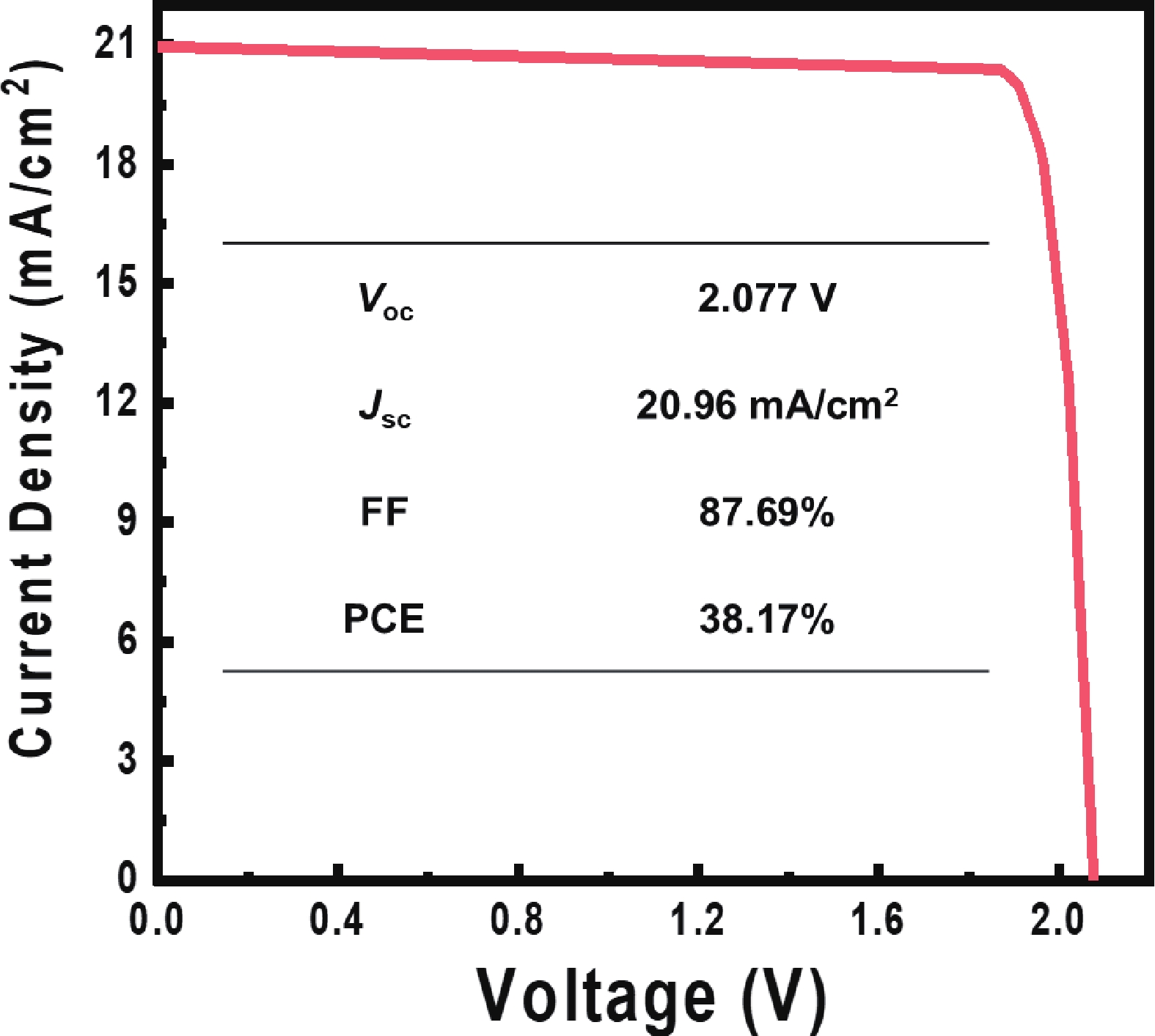
Abstract: As the development of single-junction solar cells reaches a bottleneck, tandem solar cells have emerged as a critical pathway to further enhance power conversion efficiency. Among them, monolithic perovskite/silicon heterojunction tandem solar cells are currently the fastest-growing technology, achieving the highest efficiencies at relatively low costs. The interconnecting layer, which connects the two sub-cells, plays a crucial role in tandem cell performance. It collects electrons and holes from the respective sub-cells and facilitates recombination and tunneling at the interface. Therefore, the properties of the interconnecting layer are pivotal to the overall device performance. In this work, we applied statistical analysis and machine learning algorithms to systematically analyze the interconnecting layer. A comprehensive dataset on interconnecting layer parameters was established, and predictive modeling was performed using Lasso linear regression, random forest, and multilayer perceptron (a type of neural network). The analysis revealed key feature importance for experimental parameters, providing valuable insights into the application of interconnecting layers in perovskite/silicon heterojunction tandem solar cells. The final optimized interconnecting layer can achieve a proof-of-concept efficiency of 38.17%, providing guidance and direction for the development of monolithic perovskite/silicon tandem solar cells.
Key words: perovskite/silicon heterojunction tandem solar cells, interconnecting layer, machine learning
| [1] |
Wu H, Ye F, Yang M, et al. Silicon heterojunction back-contact solar cells by laser patterning. Nature, 2024, 635(8039), 604 doi: 10.1038/s41586-024-08110-8
|
| [2] |
Richter A, Hermle M, Glunz S W. Reassessment of the limiting efficiency for crystalline silicon solar cells. IEEE J Photovolt, 2013, 3(4), 1184 doi: 10.1109/JPHOTOV.2013.2270351
|
| [3] |
Kerr M J, Cuevas A, Campbell P. Limiting efficiency of crystalline silicon solar cells due to Coulomb-enhanced Auger recombination. Progress Photovoltaics, 2003, 11(2), 97 doi: 10.1002/pip.464
|
| [4] |
Albrecht S, Saliba M, Correa Baena J P, et al. Monolithic perovskite/silicon-heterojunction tandem solar cells processed at low temperature. Energy Environ Sci, 2016, 9(1), 81 doi: 10.1039/C5EE02965A
|
| [5] |
Werner J, Niesen B, Ballif C. Perovskite/silicon tandem solar cells: Marriage of convenience or true love story? –an overview. Adv Materials Inter, 2018, 5(1), 1700731 doi: 10.1002/admi.201700731
|
| [6] |
Sahli F, Werner J, Kamino B A, et al. Fully textured monolithic perovskite/silicon tandem solar cells with 25.2% power conversion efficiency. Nat Mater, 2018, 17(9), 820 doi: 10.1038/s41563-018-0115-4
|
| [7] |
Yan L L, Li Y X, Shi B, et al. Reducing electrical losses of textured monolithic perovskite/silicon tandem solar cells by tailoring nanocrystalline silicon tunneling recombination junction. Sol Energy Mater Sol Cells, 2022, 245, 111868 doi: 10.1016/j.solmat.2022.111868
|
| [8] |
Turkay D, Artuk K, Chin X Y, et al. Synergetic substrate and additive engineering for over 30%-efficient perovskite-Si tandem solar cells. Joule, 2024, 8(6), 1735 doi: 10.1016/j.joule.2024.04.015
|
| [9] |
Mariotti S, K?hnen E, Scheler F, et al. Interface engineering for high-performance, triple-halide perovskite-silicon tandem solar cells. Science, 2023, 381(6653), 63 doi: 10.1126/science.adf5872
|
| [10] |
Al-Ashouri A, K?hnen E, Li B, et al. Monolithic perovskite/silicon tandem solar cell with >29% efficiency by enhanced hole extraction. Science, 2020, 370(6522), 1300 doi: 10.1126/science.abd4016
|
| [11] |
Aydin E, Ugur E, Yildirim B K, et al. Enhanced optoelectronic coupling for perovskite/silicon tandem solar cells. Nature, 2023, 623(7988), 732 doi: 10.1038/s41586-023-06667-4
|
| [12] |
Liu J, He Y C, Ding L, et al. Perovskite/silicon tandem solar cells with bilayer interface passivation. Nature, 2024, 635(8039), 596 doi: 10.1038/s41586-024-07997-7
|
| [13] |
Werner J, Walter A, Rucavado E, et al. Zinc tin oxide as high-temperature stable recombination layer for mesoscopic perovskite/silicon monolithic tandem solar cells. Appl Phys Lett, 2016, 109(23), 233902 doi: 10.1063/1.4971361
|
| [14] |
Chin X Y, Turkay D, Steele J A, et al. Interface passivation for 31.25%-efficient perovskite/silicon tandem solar cells. Science, 2023, 381(6653), 59 doi: 10.1126/science.adg0091
|
| [15] |
Golobostanfard M R, Othman M, Turkay D, et al. Bifacial perovskite/silicon heterojunction tandem solar cells based on FAPbI3-based perovskite via hybrid evaporation-spin coating. Nano Energy, 2024, 131, 110269 doi: 10.1016/j.nanoen.2024.110269
|
| [16] |
Liu Y M, Tan X Y, Liang J, et al. Machine learning for perovskite solar cells and component materials: Key technologies and prospects. Adv Funct Materials, 2023, 33(17), 2214271 doi: 10.1002/adfm.202214271
|
| [17] |
Saqib M, Shoukat U, Soliman M M, et al. Machine learning assisted designing of hole-transporting materials for high performance perovskite solar cells. Chem Phys, 2025, 589, 112515 doi: 10.1016/j.chemphys.2024.112515
|
| [18] |
Zhang L, He M, Shao S F. Machine learning for halide perovskite materials. Nano Energy, 2020, 78, 105380 doi: 10.1016/j.nanoen.2020.105380
|
| [19] |
Jiang K L, Ma Z P, Lan J, et al. Screening of functional small molecules via modified machine learning strategy toward efficient all-inorganic perovskite solar cells. ACS Appl Mater Interfaces, 2024, 16(24), 31833 doi: 10.1021/acsami.4c06226
|
| [20] |
Gok E C, Yildirim M O, Haris M P U, et al. Predicting perovskite bandgap and solar cell performance with machine learning. Sol RRL, 2022, 6(2), 2100927 doi: 10.1002/solr.202100927
|
| [21] |
Li J X, Pradhan B, Gaur S, et al. Predictions and strategies learned from machine learning to develop high-performing perovskite solar cells. Adv Energy Mater, 2019, 9(46), 1901891 doi: 10.1002/aenm.201901891
|
| [22] |
Karade V C, Sutar S S, Shin S W, et al. Machine learning assisted analysis, prediction, and fabrication of high-efficiency CZTSSe thin film solar cells. Adv Funct Mater, 2023, 33(41), 2303459 doi: 10.1002/adfm.202303459
|
| [23] |
Li X L, Hou Z F, Gao S S, et al. Efficient optimization of the performance of Mn2+-doped kesterite solar cell: Machine learning aided synthesis of high efficient Cu2(Mn, Zn)Sn(S, Se)4 solar cells (solar RRL 12∕2018). Sol RRL, 2018, 2(12), 1870237 doi: 10.1002/solr.201870237
|
| [24] |
Zhu C W, Liu W, Li Y Y, et al. Key factors governing the device performance of CIGS solar cells: Insights from machine learning. Sol Energy, 2021, 228, 45 doi: 10.1016/j.solener.2021.09.031
|
| [25] |
Bandaru N, Enduri M K, Venkata Reddy C, et al. Aspects of effectiveness and significance: The use of machine learning methods to study CuIn1-xGaxSe2 solar cells. Sol Energy, 2023, 263, 111941 doi: 10.1016/j.solener.2023.111941
|
| [26] |
Zhou J K, Jesper Jacobsson T, Wang Z, et al. Data-driven tunnel oxide passivated contact solar cell performance analysis using machine learning. Adv Mater, 2024, 36(14), e2309351 doi: 10.1002/adma.202309351
|
| [27] |
Liu Y M, Ahmadpour M, Adam J, et al. Modeling multijunction solar cells by nonlocal tunneling and subcell analysis. IEEE J Photovolt, 2018, 8(5), 1363 doi: 10.1109/JPHOTOV.2018.2851308
|
| [28] |
Shrivastav N, Madan J, Pandey R, et al. Investigations aimed at producing 33% efficient perovskite-silicon tandem solar cells through device simulations. RSC Adv, 2021, 11(59), 37366 doi: 10.1039/D1RA06250F
|
| [29] |
Mohamad I S, Doroody C, Alkharasani W M, et al. Elucidating the effects of interconnecting layer thickness and bandgap variations on the performance of monolithic perovskite/silicon tandem solar cell by wxAMPS. Materials, 2023, 16(11), 4106 doi: 10.3390/ma16114106
|
| [30] |
He Y Z, Chen H Z , Wang S Q, et al. Unveiling recombination in top cells: SCAPS-1D simulations for high-efficiency bifacial planar perovskite/silicon tandem solar cells. Sol Energy, 2024, 282, 112921 doi: 10.1016/j.solener.2024.112921
|
| [31] |
Liu W Z, Liu Y J, Yang Z Q, et al. Flexible solar cells based on foldable silicon wafers with blunted edges. Nature, 2023, 617(7962), 717 doi: 10.1038/s41586-023-05921-z
|
| [32] |
Wu T J, Liu Z L, Lin H, et al. Free-standing ultrathin silicon wafers and solar cells through edges reinforcement. Nat Commun, 2024, 15(1), 3843 doi: 10.1038/s41467-024-48290-5
|
| [33] |
Li Y, Ru X N, Yang M, et al. Flexible silicon solar cells with high power-to-weight ratios. Nature, 2024, 626(7997), 105 doi: 10.1038/s41586-023-06948-y
|
| [34] |
Allen T G, Ugur E, Aydin E, et al. A practical efficiency target for perovskite/silicon tandem solar cells. ACS Energy Lett, 2025, 10(1), 238 doi: 10.1021/acsenergylett.4c02152
|
| [35] |
Green M A, Dunlop E D, Yoshita M, et al. Solar cell efficiency tables (version 65). Prog Photovolt: Res Appl, 2025, 33(1), 3 doi: 10.1002/pip.3867
|

Table 1. wxAMPS simulation parameters for each layer[28?30].
| Material properties | Top cell | Interconnecting layer | Bottom cell | ||||||||||||
| IZO | SnO2 | C60 | PSC | Me-4PACz | ITO | n-nc-SiOx:H | p-nc-SiOx:H | n-nc-SiOx:H | i-a-Si:H | n-Si | i-a-Si:H | p-nc-SiOx:H | |||
| Dielectric constant | 10 | 3.3 | 4.2 | 10 | 10 | 11.9 | 11.9 | 11.9 | 11.9 | 11.9 | 11.9 | 11.9 | 11.9 | ||
| Bandgap (eV) | 3.8 | 3.5 | 1.7 | 1.68 | 3.3 | 3.8 | 1.8–2.6 | 1.8–2.6 | 2.3 | 1.74 | 1.12 | 1.74 | 2.2 | ||
| Electron affinity (eV) | 4.3 | 4.1 | 3.9 | 3.9 | 2.8 | 4.3 | 3.8 | 3.8 | 3.8 | 3.9 | 4.05 | 3.9 | 3.8 | ||
| CB effective density (1019/cm3) | 0.1 | 0.22 | 8 | 1 | 1 | 0.1 | 10 | 10 | 10 | 10 | 2.8 | 10 | 10 | ||
| VB effective density (1019/cm3) | 1 | 1.8 | 8 | 1 | 1 | 1 | 10 | 10 | 10 | 10 | 1.04 | 10 | 10 | ||
| Electron mobility (cm2/(V?s)) | 60 | 50 | 0.08 | 20 | 6 | 50 | 20 | 20 | 20 | 20 | 1400 | 20 | 20 | ||
| Hole mobility (cm2/(V?s)) | 10 | 30 | 0.0035 | 2 | 24 | 25 | 5 | 5 | 5 | 5 | 450 | 5 | 5 | ||
| ND (1019/cm3) | 50 | 0.01 | 0.01 | 0.01 | / | 50 | 100 | / | 1 | / | 0.005 | / | / | ||
| NA (1019/cm3) | / | / | / | / | 0.1 | / | / | 100 | / | / | / | / | 1 | ||
DownLoad: CSV
Table 2. Details of the extracted features.
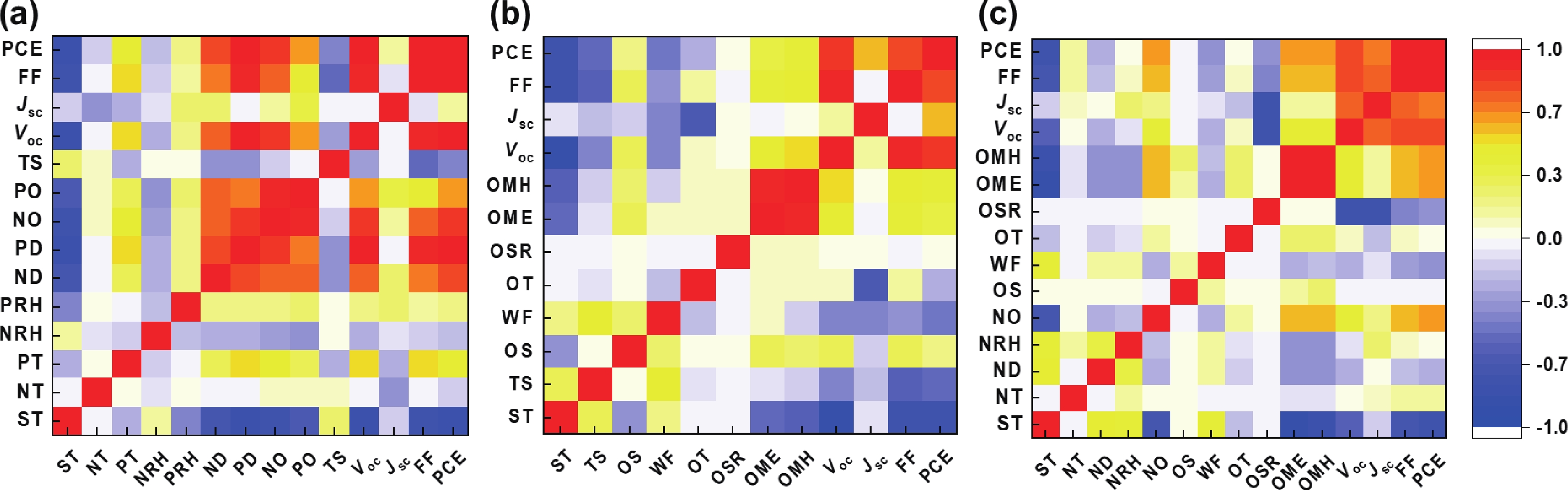
| Features | Features type | Feature space |
| ST—silicon wafer thickness | Numerical variables | 150–280 μm |
| NT—n-type silicon thin film thickness | Numerical variables | 0–50 nm |
| PT—p-type silicon thin film thickness | Numerical variables | 0–50 nm |
| NRH—hydrogen dilution ratio of n-type silicon thin film | Numerical variables | 70–120 |
| PRH—hydrogen dilution ratio of p-type silicon thin film | Numerical variables | 180–240 |
| ND—doping ratio of n-type silicon thin film | Numerical variables | 0.3–2.2 |
| PD—doping ratio of p-type silicon thin film | Numerical variables | 0.5–2.5 |
| NO—oxygen doping ratio of n-type silicon thin film | Numerical variables | 0–1.4 |
| PO—oxygen doping ratio of p-type silicon thin film | Numerical variables | 0–1 |
| TS—active area of tandem solar cell | Numerical variables | 1–65.1 cm2 |
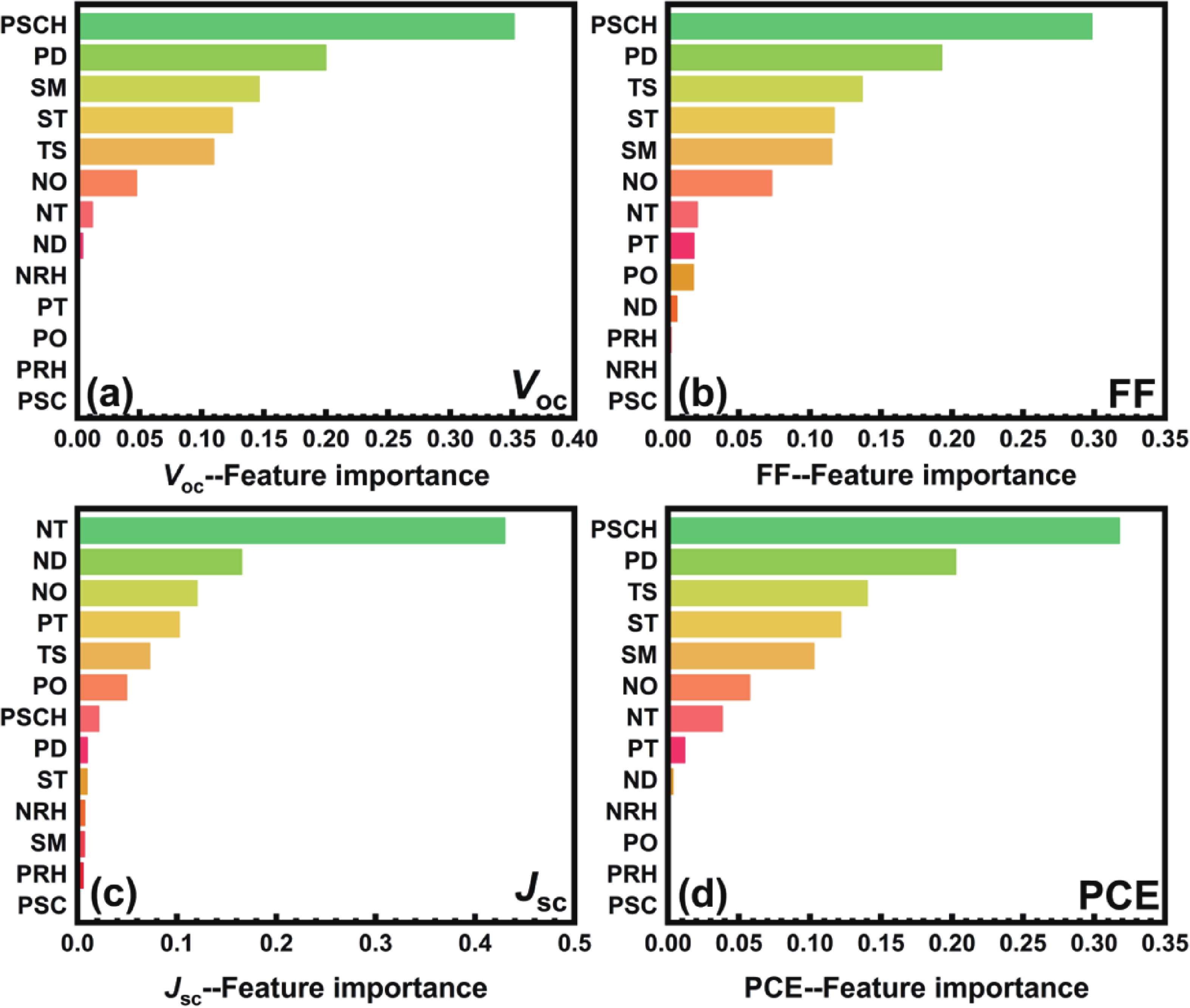
| SM—surface morphology of silicon wafer | Categorical variables | 2 (texture, plane) |
| PSC—the type of perovskite solar cell structure | Categorical variables | 2 (n?i?p, p?i?n) |
| PSCH—the perovskite solar cell hole transport layers | Categorical variables | 12 |
| TMO—the type of TCO | Categorical variables | 7 |
| OS—doping ratio of ITO targets | Numerical variables | 0.03–15.6 |
| WF—work function of TCO | Numerical variables | 4.3–5.27 |
| OT—the thickness of TCO ICL | Numerical variables | 1–110 |
| OSR—sheet resistance of the TCO | Numerical variables | 15–∞ |
| OME—electron mobility of the TCO | Numerical variables | 2–100 cm2/(V?s) |
| OMH—hole mobility of the TCO | Numerical variables | 5–25 cm2/(V?s) |
| Voc | Numerical variables | 1.37–2.09 V |
| Jsc | Numerical variables | 12–20.5 mA/cm2 |
| FF | Numerical variables | 23%–86.9% |
| PCE | Numerical variables | 5%–35.4% |
| Note: For categorical variables, the feature space represents the number of feature categories, while for numerical variables, it represents the range of variation. | ||
DownLoad: CSV
Table 3. One-way ANOVA results of dataset of Si-ICL.
| Categorical variables | Numerical variables | F value | P value |
| PSCH | Voc | 3530.267259 | 5.483809 × 10–159 |
| PSCH | Jsc | 15.73319 | 4.421083 × 10⁻⁷ |
| PSCH | FF | 694.53997 | 8.995908 × 10–92 |
| PSCH | PCE | 1264.88677 | 1.077701 × 10–115 |
DownLoad: CSV
Table 4. One-way ANOVA results of dataset of TCO-ICL.
| Categorical variables |
Numerical variables |
F value | P value |
| TMO | Voc | 4.851974 | 9.88 × 10⁻³ |
| TMO | Jsc | 3.233722 | 4.38 × 10⁻² |
| TMO | FF | 4.872835 | 9.69 × 10⁻³ |
| TMO | PCE | 1.297649 | 2.78 × 10⁻¹ |
| PSCH | Voc | 237.973744 | 5.86 × 10–53 |
| PSCH | Jsc | 3.321445 | 5.32 × 10⁻³ |
| PSCH | FF | 58.700255 | 5.36 × 10⁻²⁹ |
| PSCH | PCE | 33.91421 | 4.20 × 10⁻²¹ |
DownLoad: CSV
Table 5. The specific parameters of the ICL in optimal device.
| Materials properties | Si thin film | TCO |
| Bandgap (eV) | 2.5 | 3.8 |
| Thickness (nm) | 20 | 3 |
| Refractive index (@ 950 nm) |
2.2 | 1.5 |
| Note: the refractive index (@ 950 nm) of n-type doping layer of SHJ solar cells is 2.95, which forms a graded refractive index matching structure with ICL. | ||
DownLoad: CSV
Table 6. Summary of the highest PCE including both experimental and simulation achieved for perovskite/SHJ tandem solar cells.
DownLoad: CSV
| [1] |
Wu H, Ye F, Yang M, et al. Silicon heterojunction back-contact solar cells by laser patterning. Nature, 2024, 635(8039), 604 doi: 10.1038/s41586-024-08110-8
|
| [2] |
Richter A, Hermle M, Glunz S W. Reassessment of the limiting efficiency for crystalline silicon solar cells. IEEE J Photovolt, 2013, 3(4), 1184 doi: 10.1109/JPHOTOV.2013.2270351
|
| [3] |
Kerr M J, Cuevas A, Campbell P. Limiting efficiency of crystalline silicon solar cells due to Coulomb-enhanced Auger recombination. Progress Photovoltaics, 2003, 11(2), 97 doi: 10.1002/pip.464
|
| [4] |
Albrecht S, Saliba M, Correa Baena J P, et al. Monolithic perovskite/silicon-heterojunction tandem solar cells processed at low temperature. Energy Environ Sci, 2016, 9(1), 81 doi: 10.1039/C5EE02965A
|
| [5] |
Werner J, Niesen B, Ballif C. Perovskite/silicon tandem solar cells: Marriage of convenience or true love story? –an overview. Adv Materials Inter, 2018, 5(1), 1700731 doi: 10.1002/admi.201700731
|
| [6] |
Sahli F, Werner J, Kamino B A, et al. Fully textured monolithic perovskite/silicon tandem solar cells with 25.2% power conversion efficiency. Nat Mater, 2018, 17(9), 820 doi: 10.1038/s41563-018-0115-4
|
| [7] |
Yan L L, Li Y X, Shi B, et al. Reducing electrical losses of textured monolithic perovskite/silicon tandem solar cells by tailoring nanocrystalline silicon tunneling recombination junction. Sol Energy Mater Sol Cells, 2022, 245, 111868 doi: 10.1016/j.solmat.2022.111868
|
| [8] |
Turkay D, Artuk K, Chin X Y, et al. Synergetic substrate and additive engineering for over 30%-efficient perovskite-Si tandem solar cells. Joule, 2024, 8(6), 1735 doi: 10.1016/j.joule.2024.04.015
|
| [9] |
Mariotti S, K?hnen E, Scheler F, et al. Interface engineering for high-performance, triple-halide perovskite-silicon tandem solar cells. Science, 2023, 381(6653), 63 doi: 10.1126/science.adf5872
|
| [10] |
Al-Ashouri A, K?hnen E, Li B, et al. Monolithic perovskite/silicon tandem solar cell with >29% efficiency by enhanced hole extraction. Science, 2020, 370(6522), 1300 doi: 10.1126/science.abd4016
|
| [11] |
Aydin E, Ugur E, Yildirim B K, et al. Enhanced optoelectronic coupling for perovskite/silicon tandem solar cells. Nature, 2023, 623(7988), 732 doi: 10.1038/s41586-023-06667-4
|
| [12] |
Liu J, He Y C, Ding L, et al. Perovskite/silicon tandem solar cells with bilayer interface passivation. Nature, 2024, 635(8039), 596 doi: 10.1038/s41586-024-07997-7
|
| [13] |
Werner J, Walter A, Rucavado E, et al. Zinc tin oxide as high-temperature stable recombination layer for mesoscopic perovskite/silicon monolithic tandem solar cells. Appl Phys Lett, 2016, 109(23), 233902 doi: 10.1063/1.4971361
|
| [14] |
Chin X Y, Turkay D, Steele J A, et al. Interface passivation for 31.25%-efficient perovskite/silicon tandem solar cells. Science, 2023, 381(6653), 59 doi: 10.1126/science.adg0091
|
| [15] |
Golobostanfard M R, Othman M, Turkay D, et al. Bifacial perovskite/silicon heterojunction tandem solar cells based on FAPbI3-based perovskite via hybrid evaporation-spin coating. Nano Energy, 2024, 131, 110269 doi: 10.1016/j.nanoen.2024.110269
|
| [16] |
Liu Y M, Tan X Y, Liang J, et al. Machine learning for perovskite solar cells and component materials: Key technologies and prospects. Adv Funct Materials, 2023, 33(17), 2214271 doi: 10.1002/adfm.202214271
|
| [17] |
Saqib M, Shoukat U, Soliman M M, et al. Machine learning assisted designing of hole-transporting materials for high performance perovskite solar cells. Chem Phys, 2025, 589, 112515 doi: 10.1016/j.chemphys.2024.112515
|
| [18] |
Zhang L, He M, Shao S F. Machine learning for halide perovskite materials. Nano Energy, 2020, 78, 105380 doi: 10.1016/j.nanoen.2020.105380
|
| [19] |
Jiang K L, Ma Z P, Lan J, et al. Screening of functional small molecules via modified machine learning strategy toward efficient all-inorganic perovskite solar cells. ACS Appl Mater Interfaces, 2024, 16(24), 31833 doi: 10.1021/acsami.4c06226
|
| [20] |
Gok E C, Yildirim M O, Haris M P U, et al. Predicting perovskite bandgap and solar cell performance with machine learning. Sol RRL, 2022, 6(2), 2100927 doi: 10.1002/solr.202100927
|
| [21] |
Li J X, Pradhan B, Gaur S, et al. Predictions and strategies learned from machine learning to develop high-performing perovskite solar cells. Adv Energy Mater, 2019, 9(46), 1901891 doi: 10.1002/aenm.201901891
|
| [22] |
Karade V C, Sutar S S, Shin S W, et al. Machine learning assisted analysis, prediction, and fabrication of high-efficiency CZTSSe thin film solar cells. Adv Funct Mater, 2023, 33(41), 2303459 doi: 10.1002/adfm.202303459
|
| [23] |
Li X L, Hou Z F, Gao S S, et al. Efficient optimization of the performance of Mn2+-doped kesterite solar cell: Machine learning aided synthesis of high efficient Cu2(Mn, Zn)Sn(S, Se)4 solar cells (solar RRL 12∕2018). Sol RRL, 2018, 2(12), 1870237 doi: 10.1002/solr.201870237
|
| [24] |
Zhu C W, Liu W, Li Y Y, et al. Key factors governing the device performance of CIGS solar cells: Insights from machine learning. Sol Energy, 2021, 228, 45 doi: 10.1016/j.solener.2021.09.031
|
| [25] |
Bandaru N, Enduri M K, Venkata Reddy C, et al. Aspects of effectiveness and significance: The use of machine learning methods to study CuIn1-xGaxSe2 solar cells. Sol Energy, 2023, 263, 111941 doi: 10.1016/j.solener.2023.111941
|
| [26] |
Zhou J K, Jesper Jacobsson T, Wang Z, et al. Data-driven tunnel oxide passivated contact solar cell performance analysis using machine learning. Adv Mater, 2024, 36(14), e2309351 doi: 10.1002/adma.202309351
|
| [27] |
Liu Y M, Ahmadpour M, Adam J, et al. Modeling multijunction solar cells by nonlocal tunneling and subcell analysis. IEEE J Photovolt, 2018, 8(5), 1363 doi: 10.1109/JPHOTOV.2018.2851308
|
| [28] |
Shrivastav N, Madan J, Pandey R, et al. Investigations aimed at producing 33% efficient perovskite-silicon tandem solar cells through device simulations. RSC Adv, 2021, 11(59), 37366 doi: 10.1039/D1RA06250F
|
| [29] |
Mohamad I S, Doroody C, Alkharasani W M, et al. Elucidating the effects of interconnecting layer thickness and bandgap variations on the performance of monolithic perovskite/silicon tandem solar cell by wxAMPS. Materials, 2023, 16(11), 4106 doi: 10.3390/ma16114106
|
| [30] |
He Y Z, Chen H Z , Wang S Q, et al. Unveiling recombination in top cells: SCAPS-1D simulations for high-efficiency bifacial planar perovskite/silicon tandem solar cells. Sol Energy, 2024, 282, 112921 doi: 10.1016/j.solener.2024.112921
|
| [31] |
Liu W Z, Liu Y J, Yang Z Q, et al. Flexible solar cells based on foldable silicon wafers with blunted edges. Nature, 2023, 617(7962), 717 doi: 10.1038/s41586-023-05921-z
|
| [32] |
Wu T J, Liu Z L, Lin H, et al. Free-standing ultrathin silicon wafers and solar cells through edges reinforcement. Nat Commun, 2024, 15(1), 3843 doi: 10.1038/s41467-024-48290-5
|
| [33] |
Li Y, Ru X N, Yang M, et al. Flexible silicon solar cells with high power-to-weight ratios. Nature, 2024, 626(7997), 105 doi: 10.1038/s41586-023-06948-y
|
| [34] |
Allen T G, Ugur E, Aydin E, et al. A practical efficiency target for perovskite/silicon tandem solar cells. ACS Energy Lett, 2025, 10(1), 238 doi: 10.1021/acsenergylett.4c02152
|
| [35] |
Green M A, Dunlop E D, Yoshita M, et al. Solar cell efficiency tables (version 65). Prog Photovolt: Res Appl, 2025, 33(1), 3 doi: 10.1002/pip.3867
|
Article views: 1883 Times PDF downloads: 229 Times Cited by: 0 Times
Received: 08 May 2025 Revised: Online: Accepted Manuscript: 15 May 2025Uncorrected proof: 16 June 2025Published: 04 November 2025
| Citation: |
Xuejiao Wang, Guanlan Chen, Ying Liu, Guangyi Wang, Wei Han, Jin Wang, Pengfei Liu, Jilei Wang, Shaojuan Bao, Bo Yu, Ying Liu, Xinliang Chen, Shengzhi Xu, Ying Zhao, Xiaodan Zhang. Machine learning facilitates the development of interconnecting layers for perovskite/silicon heterojunction tandem solar cells with proof-of-concept efficiency > 38%[J]. Journal of Semiconductors, 2025, 46(11): 112801. doi: 10.1088/1674-4926/25050011
****
X J Wang, G L Chen, Y Liu, G Y Wang, W Han, J Wang, P F Liu, J L Wang, S J Bao, B Yu, Y Liu, X L Chen, S Z Xu, Y Zhao, and X D Zhang, Machine learning facilitates the development of interconnecting layers for perovskite/silicon heterojunction tandem solar cells with proof-of-concept efficiency > 38%[J]. J. Semicond., 2025, 46(11), 112801 doi: 10.1088/1674-4926/25050011
|
Xuejiao Wang received the B.Sci. degree in Optoelectronic Information Science and Engineering from Hebei University, Baoding, China, in 2018. Then she received the M. Sc. Degree in Optical Engineering from Hebei University, Baoding, China, in 2021. She is currently pursuing the D.Eng. degree in Nankai University, Tianjin, China. Her research interests include the silicon heterojunction solar cells and perovskite/silicon tandem solar cells
Guanlan Chen received the B.Eng. degree in Communication Engineering from Tongji University, Shanghai, China, in 2020. He is currently pursuing the D.Eng. degree with the College of Electronic Information and Optical Engineering, Nankai University, Tianjin, China. His research interests include the silicon film and transparent conductive oxide (TCO) in silicon heterojunction solar cells and perovskite/silicon tandem solar cells
Ying Zhao, a professor at Nankai University, is the director of the State Key Laboratory of Photovoltaic Materials and Cells, the director of China Photovoltaic Committee of the Chinese Renewable Energy Society and vice Chairman of the International Advisory Committee of the International Photovoltaic Science and Engineering Conference (PVSEC)
Xiaodan Zhang, a professor at Nankai University, is the director of the Institute of Optoelectronic Thin Film Devices and Technology, the deputy director of the State Key Laboratory of Photovoltaic Materials and Cells. Her current research interests include perovskite/crystalline silicon tandem solar cells, perovskite solar cells, novel silicon solar cells utilizing oxide-based carrier transport layers, photo/electrocatalytic materials, solar cell-driven photoelectrochemical water splitting and CO2 reduction
| [1] |
Wu H, Ye F, Yang M, et al. Silicon heterojunction back-contact solar cells by laser patterning. Nature, 2024, 635(8039), 604 doi: 10.1038/s41586-024-08110-8
|
| [2] |
Richter A, Hermle M, Glunz S W. Reassessment of the limiting efficiency for crystalline silicon solar cells. IEEE J Photovolt, 2013, 3(4), 1184 doi: 10.1109/JPHOTOV.2013.2270351
|
| [3] |
Kerr M J, Cuevas A, Campbell P. Limiting efficiency of crystalline silicon solar cells due to Coulomb-enhanced Auger recombination. Progress Photovoltaics, 2003, 11(2), 97 doi: 10.1002/pip.464
|
| [4] |
Albrecht S, Saliba M, Correa Baena J P, et al. Monolithic perovskite/silicon-heterojunction tandem solar cells processed at low temperature. Energy Environ Sci, 2016, 9(1), 81 doi: 10.1039/C5EE02965A
|
| [5] |
Werner J, Niesen B, Ballif C. Perovskite/silicon tandem solar cells: Marriage of convenience or true love story? –an overview. Adv Materials Inter, 2018, 5(1), 1700731 doi: 10.1002/admi.201700731
|
| [6] |
Sahli F, Werner J, Kamino B A, et al. Fully textured monolithic perovskite/silicon tandem solar cells with 25.2% power conversion efficiency. Nat Mater, 2018, 17(9), 820 doi: 10.1038/s41563-018-0115-4
|
| [7] |
Yan L L, Li Y X, Shi B, et al. Reducing electrical losses of textured monolithic perovskite/silicon tandem solar cells by tailoring nanocrystalline silicon tunneling recombination junction. Sol Energy Mater Sol Cells, 2022, 245, 111868 doi: 10.1016/j.solmat.2022.111868
|
| [8] |
Turkay D, Artuk K, Chin X Y, et al. Synergetic substrate and additive engineering for over 30%-efficient perovskite-Si tandem solar cells. Joule, 2024, 8(6), 1735 doi: 10.1016/j.joule.2024.04.015
|
| [9] |
Mariotti S, K?hnen E, Scheler F, et al. Interface engineering for high-performance, triple-halide perovskite-silicon tandem solar cells. Science, 2023, 381(6653), 63 doi: 10.1126/science.adf5872
|
| [10] |
Al-Ashouri A, K?hnen E, Li B, et al. Monolithic perovskite/silicon tandem solar cell with >29% efficiency by enhanced hole extraction. Science, 2020, 370(6522), 1300 doi: 10.1126/science.abd4016
|
| [11] |
Aydin E, Ugur E, Yildirim B K, et al. Enhanced optoelectronic coupling for perovskite/silicon tandem solar cells. Nature, 2023, 623(7988), 732 doi: 10.1038/s41586-023-06667-4
|
| [12] |
Liu J, He Y C, Ding L, et al. Perovskite/silicon tandem solar cells with bilayer interface passivation. Nature, 2024, 635(8039), 596 doi: 10.1038/s41586-024-07997-7
|
| [13] |
Werner J, Walter A, Rucavado E, et al. Zinc tin oxide as high-temperature stable recombination layer for mesoscopic perovskite/silicon monolithic tandem solar cells. Appl Phys Lett, 2016, 109(23), 233902 doi: 10.1063/1.4971361
|
| [14] |
Chin X Y, Turkay D, Steele J A, et al. Interface passivation for 31.25%-efficient perovskite/silicon tandem solar cells. Science, 2023, 381(6653), 59 doi: 10.1126/science.adg0091
|
| [15] |
Golobostanfard M R, Othman M, Turkay D, et al. Bifacial perovskite/silicon heterojunction tandem solar cells based on FAPbI3-based perovskite via hybrid evaporation-spin coating. Nano Energy, 2024, 131, 110269 doi: 10.1016/j.nanoen.2024.110269
|
| [16] |
Liu Y M, Tan X Y, Liang J, et al. Machine learning for perovskite solar cells and component materials: Key technologies and prospects. Adv Funct Materials, 2023, 33(17), 2214271 doi: 10.1002/adfm.202214271
|
| [17] |
Saqib M, Shoukat U, Soliman M M, et al. Machine learning assisted designing of hole-transporting materials for high performance perovskite solar cells. Chem Phys, 2025, 589, 112515 doi: 10.1016/j.chemphys.2024.112515
|
| [18] |
Zhang L, He M, Shao S F. Machine learning for halide perovskite materials. Nano Energy, 2020, 78, 105380 doi: 10.1016/j.nanoen.2020.105380
|
| [19] |
Jiang K L, Ma Z P, Lan J, et al. Screening of functional small molecules via modified machine learning strategy toward efficient all-inorganic perovskite solar cells. ACS Appl Mater Interfaces, 2024, 16(24), 31833 doi: 10.1021/acsami.4c06226
|
| [20] |
Gok E C, Yildirim M O, Haris M P U, et al. Predicting perovskite bandgap and solar cell performance with machine learning. Sol RRL, 2022, 6(2), 2100927 doi: 10.1002/solr.202100927
|
| [21] |
Li J X, Pradhan B, Gaur S, et al. Predictions and strategies learned from machine learning to develop high-performing perovskite solar cells. Adv Energy Mater, 2019, 9(46), 1901891 doi: 10.1002/aenm.201901891
|
| [22] |
Karade V C, Sutar S S, Shin S W, et al. Machine learning assisted analysis, prediction, and fabrication of high-efficiency CZTSSe thin film solar cells. Adv Funct Mater, 2023, 33(41), 2303459 doi: 10.1002/adfm.202303459
|
| [23] |
Li X L, Hou Z F, Gao S S, et al. Efficient optimization of the performance of Mn2+-doped kesterite solar cell: Machine learning aided synthesis of high efficient Cu2(Mn, Zn)Sn(S, Se)4 solar cells (solar RRL 12∕2018). Sol RRL, 2018, 2(12), 1870237 doi: 10.1002/solr.201870237
|
| [24] |
Zhu C W, Liu W, Li Y Y, et al. Key factors governing the device performance of CIGS solar cells: Insights from machine learning. Sol Energy, 2021, 228, 45 doi: 10.1016/j.solener.2021.09.031
|
| [25] |
Bandaru N, Enduri M K, Venkata Reddy C, et al. Aspects of effectiveness and significance: The use of machine learning methods to study CuIn1-xGaxSe2 solar cells. Sol Energy, 2023, 263, 111941 doi: 10.1016/j.solener.2023.111941
|
| [26] |
Zhou J K, Jesper Jacobsson T, Wang Z, et al. Data-driven tunnel oxide passivated contact solar cell performance analysis using machine learning. Adv Mater, 2024, 36(14), e2309351 doi: 10.1002/adma.202309351
|
| [27] |
Liu Y M, Ahmadpour M, Adam J, et al. Modeling multijunction solar cells by nonlocal tunneling and subcell analysis. IEEE J Photovolt, 2018, 8(5), 1363 doi: 10.1109/JPHOTOV.2018.2851308
|
| [28] |
Shrivastav N, Madan J, Pandey R, et al. Investigations aimed at producing 33% efficient perovskite-silicon tandem solar cells through device simulations. RSC Adv, 2021, 11(59), 37366 doi: 10.1039/D1RA06250F
|
| [29] |
Mohamad I S, Doroody C, Alkharasani W M, et al. Elucidating the effects of interconnecting layer thickness and bandgap variations on the performance of monolithic perovskite/silicon tandem solar cell by wxAMPS. Materials, 2023, 16(11), 4106 doi: 10.3390/ma16114106
|
| [30] |
He Y Z, Chen H Z , Wang S Q, et al. Unveiling recombination in top cells: SCAPS-1D simulations for high-efficiency bifacial planar perovskite/silicon tandem solar cells. Sol Energy, 2024, 282, 112921 doi: 10.1016/j.solener.2024.112921
|
| [31] |
Liu W Z, Liu Y J, Yang Z Q, et al. Flexible solar cells based on foldable silicon wafers with blunted edges. Nature, 2023, 617(7962), 717 doi: 10.1038/s41586-023-05921-z
|
| [32] |
Wu T J, Liu Z L, Lin H, et al. Free-standing ultrathin silicon wafers and solar cells through edges reinforcement. Nat Commun, 2024, 15(1), 3843 doi: 10.1038/s41467-024-48290-5
|
| [33] |
Li Y, Ru X N, Yang M, et al. Flexible silicon solar cells with high power-to-weight ratios. Nature, 2024, 626(7997), 105 doi: 10.1038/s41586-023-06948-y
|
| [34] |
Allen T G, Ugur E, Aydin E, et al. A practical efficiency target for perovskite/silicon tandem solar cells. ACS Energy Lett, 2025, 10(1), 238 doi: 10.1021/acsenergylett.4c02152
|
| [35] |
Green M A, Dunlop E D, Yoshita M, et al. Solar cell efficiency tables (version 65). Prog Photovolt: Res Appl, 2025, 33(1), 3 doi: 10.1002/pip.3867
|
Supplementary_material.pdf
|
|
Journal of Semiconductors © 2017 All Rights Reserved 京ICP備05085259號-2