


Fig. 1.
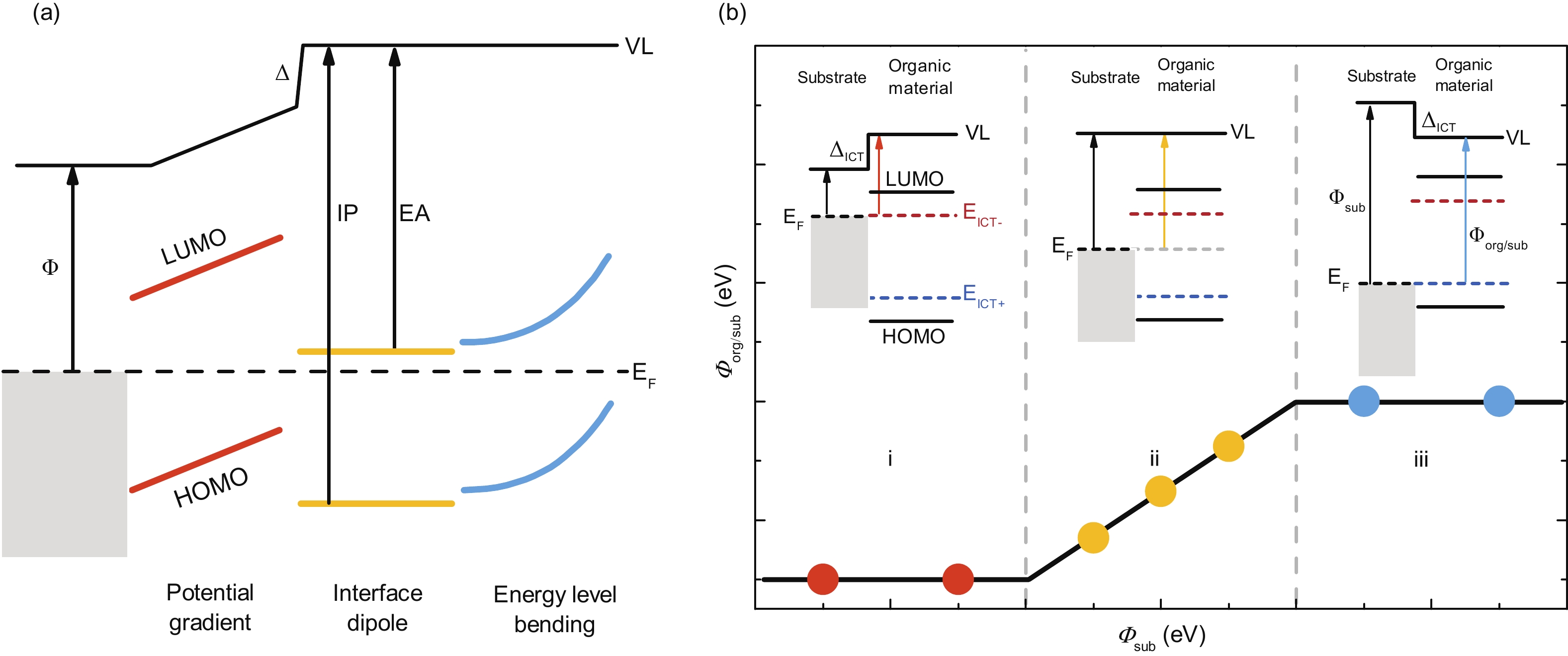
(Color online) (a) Schematic of the common interface phenomenon at organic/metal or organic/organic interfaces. (b) Schematic illustration of the integer charge transfer (ICT) model.
ARTICLES
Xian’e Li1, §, , Qilun Zhang1, 2, §, Xianjie Liu1 and Mats Fahlman1, 2
Corresponding author: Xian’e Li, Xiane.li@liu.se
Abstract: With the emergence of new materials for high-efficiency organic solar cells (OSCs), understanding and finetuning the interface energetics become increasingly important. Precise determination of the so-called pinning energies, one of the critical characteristics of the material to predict the energy level alignment (ELA) at either electrode/organic or organic/organic interfaces, are urgently needed for the new materials. Here, pinning energies of a wide variety of newly developed donors and non-fullerene acceptors (NFAs) are measured through ultraviolet photoelectron spectroscopy. The positive pinning energies of the studied donors and the negative pinning energies of NFAs are in the same energy range of 4.3?4.6 eV, which follows the design rules developed for fullerene-based OSCs. The ELA for metal/organic and inorganic/organic interfaces follows the predicted behavior for all of the materials studied. For organic–organic heterojunctions where both the donor and the NFA feature strong intramolecular charge transfer, the pinning energies often underestimate the experimentally obtained interface vacuum level shift, which has consequences for OSC device performance.
Key words: organic semiconductors, organic solar cells, pinning energies, integer charge transfer, interface dipoles
| [1] |
Hong G, Gan X, Leonhardt C, et al. A brief history of OLEDs—emitter development and industry milestones. Adv Mater, 2021, 33, 2005630 doi: 10.1002/adma.202005630
|
| [2] |
Torsi L, Magliulo M, Manoli K, et al. Organic field-effect transistor sensors: a tutorial review. Chem Soc Rev, 2013, 42, 8612 doi: 10.1039/c3cs60127g
|
| [3] |
Ren H, Chen J De, Li Y Q, et al. Recent progress in organic photodetectors and their applications. Adv Sci, 2021, 8, 2002418 doi: 10.1002/advs.202002418
|
| [4] |
Zhao Z, Liu B, Xie C, et al. Highly sensitive, sub-microsecond polymer photodetectors for blood oxygen saturation testing. Sci Chin, 2021, 64, 1302 doi: 10.1007/s11426-021-1008-9
|
| [5] |
Zhao Z, Xu C, Ma Y, et al. Ultraviolet narrowband photomultiplication type organic photodetectors with Fabry?Pérot resonator architecture. Adv Funct Mater, 2022, 32, 2203606 doi: 10.1002/adfm.202203606
|
| [6] |
Cheng P, Li G, Zhan X, et al. Next-generation organic photovoltaics based on non-fullerene acceptors. Nat Photonics, 2018, 12, 131 doi: 10.1038/s41566-018-0104-9
|
| [7] |
Liang Y, Feng D, Wu Y, et al. Highly efficient solar cell polymers developed via fine-tuning of structural and electronic properties. J Am Chem Soc, 2009, 131, 7792 doi: 10.1021/ja901545q
|
| [8] |
Li S, Ye L, Zhao W, et al. A wide band gap polymer with a deep highest occupied molecular orbital level enables 14.2% efficiency in polymer solar cells. J Am Chem Soc, 2018, 140, 7159 doi: 10.1021/jacs.8b02695
|
| [9] |
Xu Y, Cui Y, Yao H, et al. A new conjugated polymer that enables the integration of photovoltaic and light-emitting functions in one device. Adv Mater, 2021, 33, 2101090 doi: 10.1002/adma.202101090
|
| [10] |
Qin J, Zhang L, Zuo C, et al. A chlorinated copolymer donor demonstrates a 18.13% power conversion efficiency. J Semicond, 2021, 42, 010501 doi: 10.1088/1674-4926/42/1/010501
|
| [11] |
Yang H, Cui C, Li Y. Effects of heteroatom substitution on the photovoltaic performance of donor materials in organic solar cells. Accounts Mater Res, 2021, 2, 986 doi: 10.1021/accountsmr.1c00119
|
| [12] |
Xu W, Li X, Jeong S Y, et al. Achieving 17.5% efficiency for polymer solar cells via a donor and acceptor layered optimization strategy. J Mater Chem C, 2022, 10, 5489 doi: 10.1039/D2TC00024E
|
| [13] |
Xu W, Zhu X, Ma X, et al. Achieving 15.81% and 15.29% efficiency of all-polymer solar cells based on layer-by-layer and bulk heterojunction structures. J Mater Chem A, 2022, 10, 13492 doi: 10.1039/D2TA02914F
|
| [14] |
Liu Y, Wu Y, Geng Y, et al. Managing challenges in organic photovoltaics: properties and roles of donor/acceptor interfaces. Adv Funct Mater, 2022, 32, 2206707 doi: 10.1002/adfm.202206707
|
| [15] |
Bertrandie J, Han J, De Castro C S P, et al. The energy level conundrum of organic semiconductors in solar cells. Adv Mater, 2022, 34, 2202575 doi: 10.1002/adma.202202575
|
| [16] |
Duhm S. Interface energetics in organic electronic devices. Elsevier, 2021, 143 doi: doi.org/10.1016/B978-0-12-818890-3.00005-9
|
| [17] |
Braun B S, Salaneck W R, Fahlman M. Energy-level alignment at organic/metal and organic/organic interfaces. Adv Mater, 2009, 21, 1450 doi: 10.1002/adma.200802893
|
| [18] |
Fahlman M, Fabiano S, Gueskine V, et al. Interfaces in organic electronics. Nat Rev Mater, 2019, 4, 627 doi: 10.1038/s41578-019-0127-y
|
| [19] |
Aarnio H, Sehati P, Braun S, et al. Spontaneous charge transfer and dipole formation at the interface between P3HT and PCBM. Adv Energy Mater, 2011, 1, 792 doi: 10.1002/aenm.201100074
|
| [20] |
Fahlman M, Sehati P, Osikowicz W, et al. Photoelectron spectroscopy and modeling of interface properties related to organic photovoltaic cells. J Electron Spectrosc Relat Phenom, 2013, 190, 33 doi: 10.1016/j.elspec.2013.02.001
|
| [21] |
Bao Q, Sandberg O, Dagnelund D, et al. Trap-assisted recombination via integer charge transfer states in organic bulk heterojunction photovoltaics. Adv Funct Mater, 2014, 24, 6309 doi: 10.1002/adfm.201401513
|
| [22] |
Wang C, Moro F, Ni S, et al. Thermal-annealing effects on energy level alignment at organic heterojunctions and corresponding voltage losses in all-polymer solar cells. Nano Energy, 2020, 72, 104677 doi: 10.1016/j.nanoen.2020.104677
|
| [23] |
Li D, Zhu L, Liu X, et al. Enhanced and balanced charge transport boosting ternary solar cells over 17% efficiency. Adv Mater, 2020, 32, 2002344 doi: 10.1002/adma.202002344
|
| [24] |
Tengstedt C, Osikowicz W, Salaneck W R, et al. Fermi-level pinning at conjugated polymer interfaces. Appl Phys Lett, 2006, 88, 053502 doi: 10.1063/1.2168515
|
| [25] |
Lindell L, ?akr D, Brocks G, et al. Role of intrinsic molecular dipole in energy level alignment at organic interfaces. Appl Phys Lett, 2013, 102, 223301 doi: 10.1063/1.4809567
|
| [26] |
Wang C, Xu X, Zhang W, et al. Ternary organic solar cells with enhanced open circuit voltage. Nano Energy, 2017, 37, 24 doi: 10.1016/j.nanoen.2017.04.060
|
| [27] |
Wang C, Ni S, Braun S, et al. Effects of water vapor and oxygen on non-fullerene small molecule acceptors. J Mater Chem C, 2019, 7, 879 doi: 10.1039/C8TC05475D
|
| [28] |
Bao Q, Fabiano S, Andersson M, et al. Energy level bending in ultrathin polymer layers obtained through Langmuir-Sh?fer deposition. Adv Funct Mater, 2016, 26, 1077 doi: 10.1002/adfm.201504729
|
| [29] |
Li X, Zhang Q, Yu J, et al. Mapping the energy level alignment at donor/acceptor interfaces in non-fullerene organic solar cells. Nat Commun, 2022, 13, 2046 doi: 10.1038/s41467-022-29702-w
|
| [30] |
Atxabal A, Braun S, Arnold T, et al. Energy level alignment at metal/solution-processed organic semiconductor interfaces. Adv Mater, 2017, 29, 1606901 doi: 10.1002/adma.201606901
|
| [31] |
Bao Q, Braun S, Wang C, et al. Interfaces of (ultra)thin polymer films in organic electronics. Adv Mater Interfaces, 2019, 6, 1800897 doi: 10.1002/admi.201800897
|
| [32] |
Chen Y, Liu X, Braun S, et al. Image-force effects on energy level alignment at electron transport material/cathode interfaces. J Mater Chem C, 2019, 8, 173 doi: 10.1039/C9TC05128G
|
| [33] |
Holliday S, Ashraf R S, Wadsworth A, et al. High-efficiency and air-stable P3HT-based polymer solar cells with a new non-fullerene acceptor. Nat Commun, 2016, 7, 11585 doi: 10.1038/ncomms11585
|
| [34] |
Yang C, Yu R, Liu C, et al. Achieving over 10?% efficiency in poly(3-hexylthiophene)-based organic solar cells via solid additives. ChemSusChem, 2021, 14, 3607 doi: 10.1002/cssc.202100627
|
| [35] |
Arkhipov V I, Heremans P, B?ssler H. Why is exciton dissociation so efficient at the interface between a conjugated polymer and an electron acceptor? Appl Phys Lett, 2003, 82, 4605 doi: 10.1063/1.1586456
|
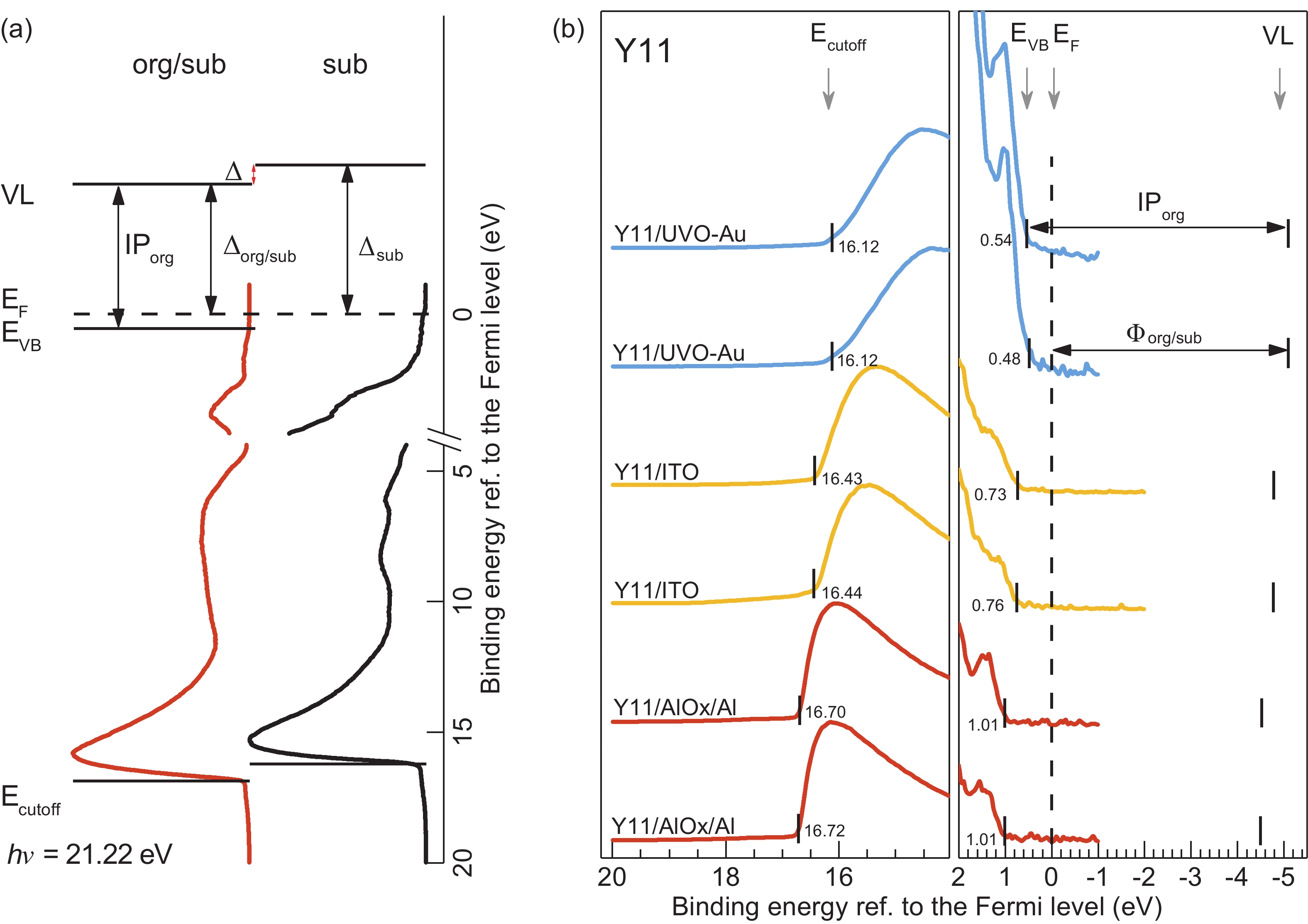
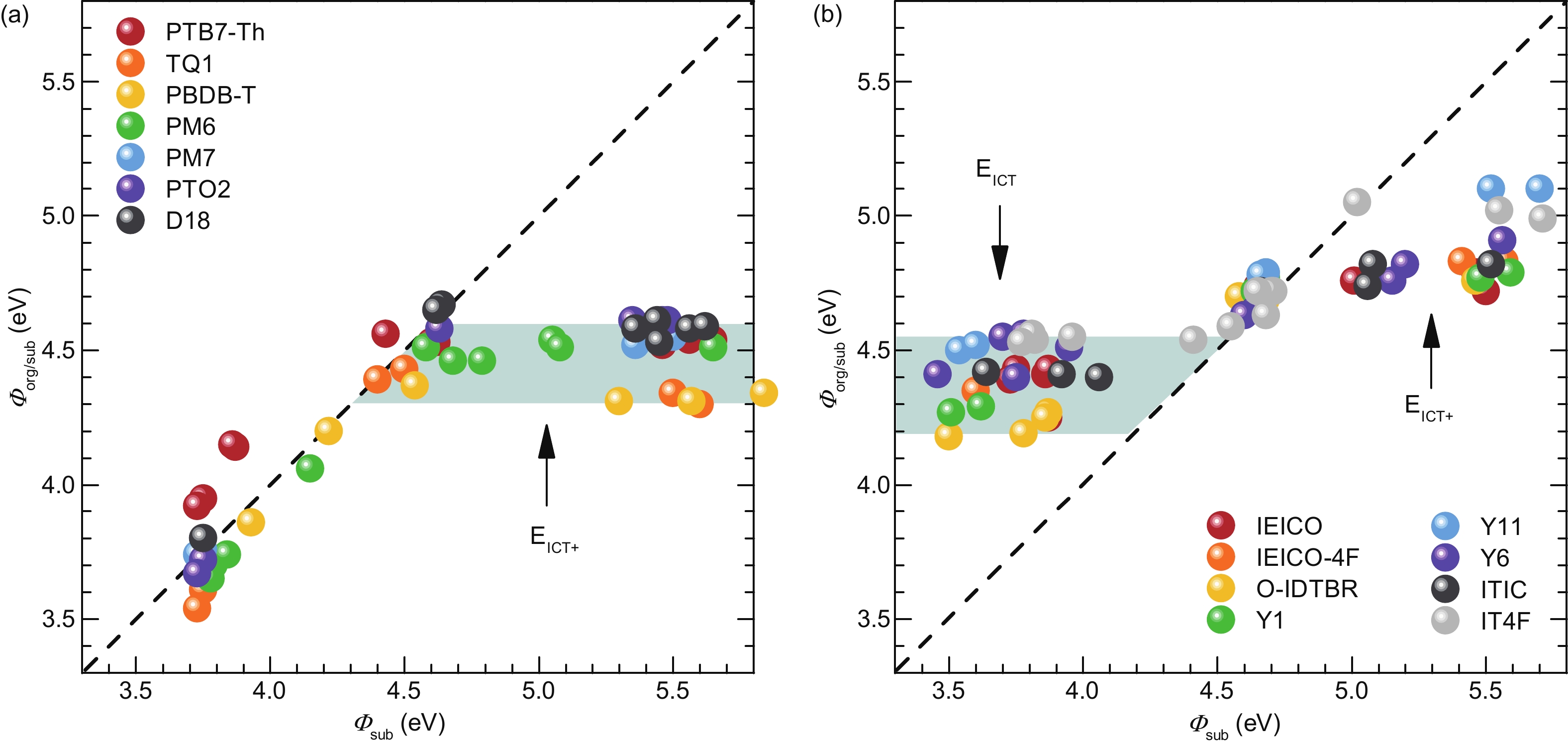
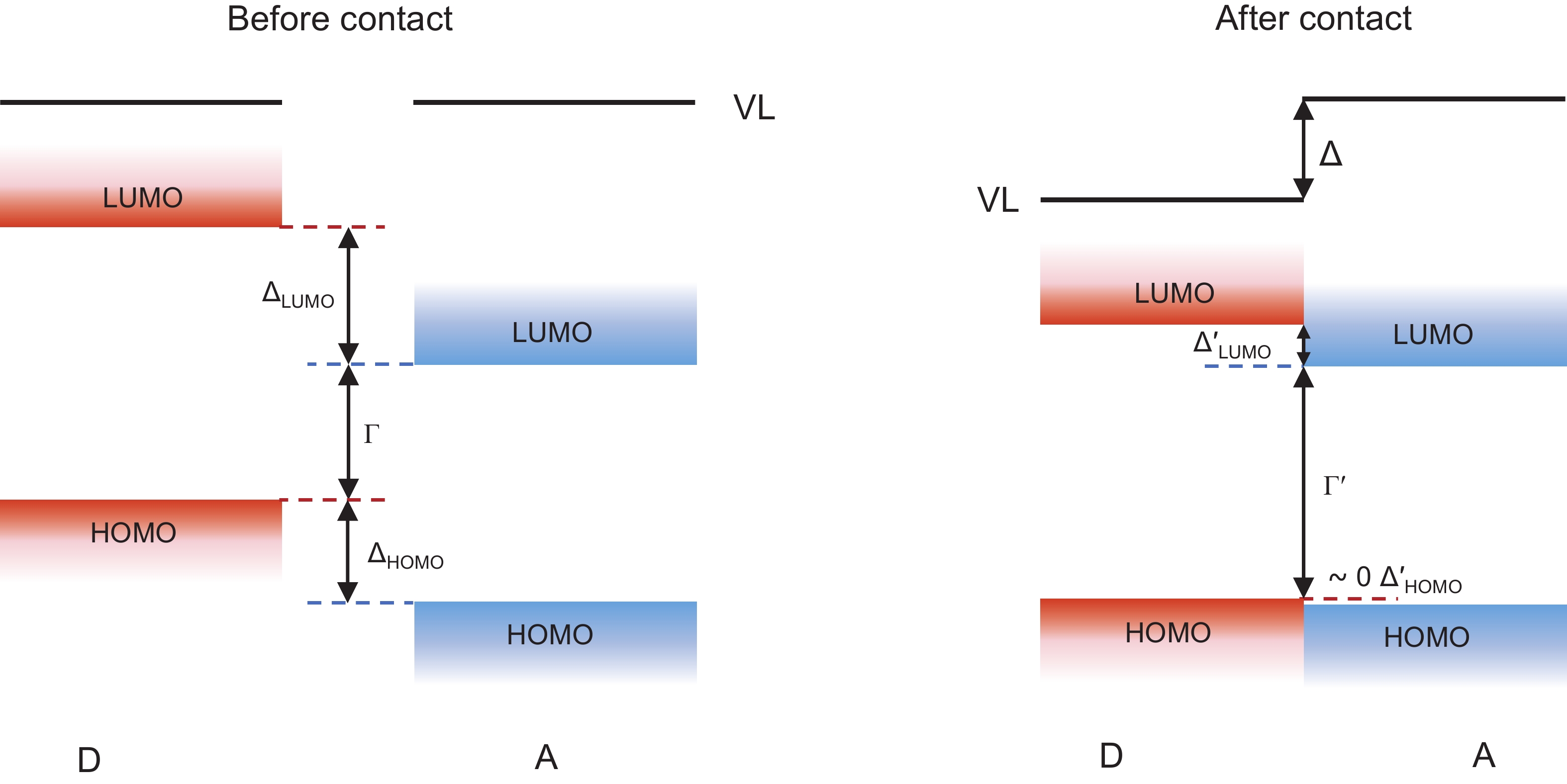
Table 1. Summary of the pinning energies (EICT+,–), ionization potentials (IP), and electron affinities (EA) of donors and acceptors.
| Materials | EICT+ (eV) | EICT? (eV) | IP (eV) | EA (eV) | |
| Donors | |||||
| PBDB-T | 4.34b | – | 4.88b | 2.88a | |
| PM6 | 4.50b | – | 5.06b | 3.05a | |
| PFO | 5.07b | – | 5.81b | – | |
| TQ1 | 4.29b | – | 4.80b | – | |
| P3HT | 4.14b | – | 4.54b | 2.17a | |
| D18 | 4.60b | – | 5.20b | 2.86a | |
| DR3 | 4.30 | – | 4.94 | 3.3a | |
| ZR1 | 4.40 | – | 5.02 | 3.37a | |
| PTB7-Th | 4.54 | – | 5.06 | 3.4a | |
| MDMO-PPV | 4.28 | – | 4.79 | – | |
| Meh-PPV | 4.37 | – | 4.99 | – | |
| DRTB-T-C4 | 4.60 | – | 5.01 | – | |
| PTO2 | 4.60 | – | 5.40 | 3.25a | |
| PM7 | 4.54 | – | 5.22 | 3.27a | |
| Acceptors | |||||
| IEICO | 4.74 | 4.24b | 5.24b | 3.75a | |
| IEICO-4F | 4.83 | 4.33b | 5.40b | 3.9a | |
| Y1 | 4.78 | 4.28 | 5.45 | 3.68a | |
| Y11 | 5.10 | 4.50b | 5.50b | -- | |
| Y6 | 4.90 | 4.46b | 5.58b | 4.07a | |
| N2200 | 4.74 | 4.16 | 5.66 | -- | |
| ITIC | 4.79b | 4.42b | 5.74b | 3.9a | |
| IT4F | 5.02b | 4.55b | 5.79b | 4.1a | |
| O-IDTBR | 4.76 | 4.16 | 5.48 | 3.6a | |
| SF(DPPB)4 | 4.60 | – | 5.37 | – | |
| PC70BM | 5.08 | 4.40b | 5.78b | – | |
| IC60BA | 5.15c | 4.05c | 5.93c | – | |
| C60 | 5.55c | 4.57c | 6.35c | – | |
| C70 | 5.48c | 4.65c | 6.30c | – | |
| aValues from Ref. [15]; bValues from Ref. [29]; cValues from Ref. [21]. | |||||
 DownLoad: CSV
| [1] |
Hong G, Gan X, Leonhardt C, et al. A brief history of OLEDs—emitter development and industry milestones. Adv Mater, 2021, 33, 2005630 doi: 10.1002/adma.202005630
|
| [2] |
Torsi L, Magliulo M, Manoli K, et al. Organic field-effect transistor sensors: a tutorial review. Chem Soc Rev, 2013, 42, 8612 doi: 10.1039/c3cs60127g
|
| [3] |
Ren H, Chen J De, Li Y Q, et al. Recent progress in organic photodetectors and their applications. Adv Sci, 2021, 8, 2002418 doi: 10.1002/advs.202002418
|
| [4] |
Zhao Z, Liu B, Xie C, et al. Highly sensitive, sub-microsecond polymer photodetectors for blood oxygen saturation testing. Sci Chin, 2021, 64, 1302 doi: 10.1007/s11426-021-1008-9
|
| [5] |
Zhao Z, Xu C, Ma Y, et al. Ultraviolet narrowband photomultiplication type organic photodetectors with Fabry?Pérot resonator architecture. Adv Funct Mater, 2022, 32, 2203606 doi: 10.1002/adfm.202203606
|
| [6] |
Cheng P, Li G, Zhan X, et al. Next-generation organic photovoltaics based on non-fullerene acceptors. Nat Photonics, 2018, 12, 131 doi: 10.1038/s41566-018-0104-9
|
| [7] |
Liang Y, Feng D, Wu Y, et al. Highly efficient solar cell polymers developed via fine-tuning of structural and electronic properties. J Am Chem Soc, 2009, 131, 7792 doi: 10.1021/ja901545q
|
| [8] |
Li S, Ye L, Zhao W, et al. A wide band gap polymer with a deep highest occupied molecular orbital level enables 14.2% efficiency in polymer solar cells. J Am Chem Soc, 2018, 140, 7159 doi: 10.1021/jacs.8b02695
|
| [9] |
Xu Y, Cui Y, Yao H, et al. A new conjugated polymer that enables the integration of photovoltaic and light-emitting functions in one device. Adv Mater, 2021, 33, 2101090 doi: 10.1002/adma.202101090
|
| [10] |
Qin J, Zhang L, Zuo C, et al. A chlorinated copolymer donor demonstrates a 18.13% power conversion efficiency. J Semicond, 2021, 42, 010501 doi: 10.1088/1674-4926/42/1/010501
|
| [11] |
Yang H, Cui C, Li Y. Effects of heteroatom substitution on the photovoltaic performance of donor materials in organic solar cells. Accounts Mater Res, 2021, 2, 986 doi: 10.1021/accountsmr.1c00119
|
| [12] |
Xu W, Li X, Jeong S Y, et al. Achieving 17.5% efficiency for polymer solar cells via a donor and acceptor layered optimization strategy. J Mater Chem C, 2022, 10, 5489 doi: 10.1039/D2TC00024E
|
| [13] |
Xu W, Zhu X, Ma X, et al. Achieving 15.81% and 15.29% efficiency of all-polymer solar cells based on layer-by-layer and bulk heterojunction structures. J Mater Chem A, 2022, 10, 13492 doi: 10.1039/D2TA02914F
|
| [14] |
Liu Y, Wu Y, Geng Y, et al. Managing challenges in organic photovoltaics: properties and roles of donor/acceptor interfaces. Adv Funct Mater, 2022, 32, 2206707 doi: 10.1002/adfm.202206707
|
| [15] |
Bertrandie J, Han J, De Castro C S P, et al. The energy level conundrum of organic semiconductors in solar cells. Adv Mater, 2022, 34, 2202575 doi: 10.1002/adma.202202575
|
| [16] |
Duhm S. Interface energetics in organic electronic devices. Elsevier, 2021, 143 doi: doi.org/10.1016/B978-0-12-818890-3.00005-9
|
| [17] |
Braun B S, Salaneck W R, Fahlman M. Energy-level alignment at organic/metal and organic/organic interfaces. Adv Mater, 2009, 21, 1450 doi: 10.1002/adma.200802893
|
| [18] |
Fahlman M, Fabiano S, Gueskine V, et al. Interfaces in organic electronics. Nat Rev Mater, 2019, 4, 627 doi: 10.1038/s41578-019-0127-y
|
| [19] |
Aarnio H, Sehati P, Braun S, et al. Spontaneous charge transfer and dipole formation at the interface between P3HT and PCBM. Adv Energy Mater, 2011, 1, 792 doi: 10.1002/aenm.201100074
|
| [20] |
Fahlman M, Sehati P, Osikowicz W, et al. Photoelectron spectroscopy and modeling of interface properties related to organic photovoltaic cells. J Electron Spectrosc Relat Phenom, 2013, 190, 33 doi: 10.1016/j.elspec.2013.02.001
|
| [21] |
Bao Q, Sandberg O, Dagnelund D, et al. Trap-assisted recombination via integer charge transfer states in organic bulk heterojunction photovoltaics. Adv Funct Mater, 2014, 24, 6309 doi: 10.1002/adfm.201401513
|
| [22] |
Wang C, Moro F, Ni S, et al. Thermal-annealing effects on energy level alignment at organic heterojunctions and corresponding voltage losses in all-polymer solar cells. Nano Energy, 2020, 72, 104677 doi: 10.1016/j.nanoen.2020.104677
|
| [23] |
Li D, Zhu L, Liu X, et al. Enhanced and balanced charge transport boosting ternary solar cells over 17% efficiency. Adv Mater, 2020, 32, 2002344 doi: 10.1002/adma.202002344
|
| [24] |
Tengstedt C, Osikowicz W, Salaneck W R, et al. Fermi-level pinning at conjugated polymer interfaces. Appl Phys Lett, 2006, 88, 053502 doi: 10.1063/1.2168515
|
| [25] |
Lindell L, ?akr D, Brocks G, et al. Role of intrinsic molecular dipole in energy level alignment at organic interfaces. Appl Phys Lett, 2013, 102, 223301 doi: 10.1063/1.4809567
|
| [26] |
Wang C, Xu X, Zhang W, et al. Ternary organic solar cells with enhanced open circuit voltage. Nano Energy, 2017, 37, 24 doi: 10.1016/j.nanoen.2017.04.060
|
| [27] |
Wang C, Ni S, Braun S, et al. Effects of water vapor and oxygen on non-fullerene small molecule acceptors. J Mater Chem C, 2019, 7, 879 doi: 10.1039/C8TC05475D
|
| [28] |
Bao Q, Fabiano S, Andersson M, et al. Energy level bending in ultrathin polymer layers obtained through Langmuir-Sh?fer deposition. Adv Funct Mater, 2016, 26, 1077 doi: 10.1002/adfm.201504729
|
| [29] |
Li X, Zhang Q, Yu J, et al. Mapping the energy level alignment at donor/acceptor interfaces in non-fullerene organic solar cells. Nat Commun, 2022, 13, 2046 doi: 10.1038/s41467-022-29702-w
|
| [30] |
Atxabal A, Braun S, Arnold T, et al. Energy level alignment at metal/solution-processed organic semiconductor interfaces. Adv Mater, 2017, 29, 1606901 doi: 10.1002/adma.201606901
|
| [31] |
Bao Q, Braun S, Wang C, et al. Interfaces of (ultra)thin polymer films in organic electronics. Adv Mater Interfaces, 2019, 6, 1800897 doi: 10.1002/admi.201800897
|
| [32] |
Chen Y, Liu X, Braun S, et al. Image-force effects on energy level alignment at electron transport material/cathode interfaces. J Mater Chem C, 2019, 8, 173 doi: 10.1039/C9TC05128G
|
| [33] |
Holliday S, Ashraf R S, Wadsworth A, et al. High-efficiency and air-stable P3HT-based polymer solar cells with a new non-fullerene acceptor. Nat Commun, 2016, 7, 11585 doi: 10.1038/ncomms11585
|
| [34] |
Yang C, Yu R, Liu C, et al. Achieving over 10?% efficiency in poly(3-hexylthiophene)-based organic solar cells via solid additives. ChemSusChem, 2021, 14, 3607 doi: 10.1002/cssc.202100627
|
| [35] |
Arkhipov V I, Heremans P, B?ssler H. Why is exciton dissociation so efficient at the interface between a conjugated polymer and an electron acceptor? Appl Phys Lett, 2003, 82, 4605 doi: 10.1063/1.1586456
|









Article views: 1810 Times PDF downloads: 151 Times Cited by: 0 Times
Received: 24 September 2022 Revised: 07 November 2022 Online: Accepted Manuscript: 30 November 2022Uncorrected proof: 01 December 2022Published: 10 March 2023
| Citation: |
Xian’e Li, Qilun Zhang, Xianjie Liu, Mats Fahlman. Pinning energies of organic semiconductors in high-efficiency organic solar cells[J]. Journal of Semiconductors, 2023, 44(3): 032201. doi: 10.1088/1674-4926/44/3/032201
****
X E Li, Q L Zhang, X J Liu, M Fahlman. Pinning energies of organic semiconductors in high-efficiency organic solar cells[J]. J. Semicond, 2023, 44(3): 032201. doi: 10.1088/1674-4926/44/3/032201

|
 Xian’e Li:received her BS degree in 2015 and MS degree in 2018 from Sichuan University, majoring in polymer materials and engineering. Now she is a PhD student at Link?ping University majoring in surface physics and chemistry, under the supervision of Prof. Mats Fahlman. Her research mainly focuses on understanding of the interface phenomenon in organic electronic devices by surface science techniques, such as UPS, XPS, NEXAFS, etc
 Qilun Zhang:obtained his BS degree in Electronic Science and Technology from Hubei University in 2014. After system training and studying as a master student in Organic Photoelectric Device in South China Normal University, he started pursuing a PhD in Surface Physics and Chemistry in Link?ping University since 2018. His primary research interest lies in development of organic optoelectronic devices by using surface and interface energetic properties, novel design concepts, and forest biomass-based materials
 Xianjie Liu:received his PhD in condensed matter physics from TU-Dresden, Germany. He joined the surface physics and chemistry group at Link?ping University in 2011. His main research is focusing on understanding of organic interface upon their electronic device performance and probing structural and electronic properties of ordered organic polymer/crystal films with x-ray/electron spectroscopies
 Mats Fahlman:received his MSc in Engineering Physics (1991) and PhD in Surface Physics and Chemistry (1995) from Link?ping University, where he is currently a full professor at the Laboratory of Organic Electronics. He is active in the research of organic semiconductors using primarily surface science techniques to explore materials and interfaces as well as their effect on device properties
| [1] |
Hong G, Gan X, Leonhardt C, et al. A brief history of OLEDs—emitter development and industry milestones. Adv Mater, 2021, 33, 2005630 doi: 10.1002/adma.202005630
|
| [2] |
Torsi L, Magliulo M, Manoli K, et al. Organic field-effect transistor sensors: a tutorial review. Chem Soc Rev, 2013, 42, 8612 doi: 10.1039/c3cs60127g
|
| [3] |
Ren H, Chen J De, Li Y Q, et al. Recent progress in organic photodetectors and their applications. Adv Sci, 2021, 8, 2002418 doi: 10.1002/advs.202002418
|
| [4] |
Zhao Z, Liu B, Xie C, et al. Highly sensitive, sub-microsecond polymer photodetectors for blood oxygen saturation testing. Sci Chin, 2021, 64, 1302 doi: 10.1007/s11426-021-1008-9
|
| [5] |
Zhao Z, Xu C, Ma Y, et al. Ultraviolet narrowband photomultiplication type organic photodetectors with Fabry?Pérot resonator architecture. Adv Funct Mater, 2022, 32, 2203606 doi: 10.1002/adfm.202203606
|
| [6] |
Cheng P, Li G, Zhan X, et al. Next-generation organic photovoltaics based on non-fullerene acceptors. Nat Photonics, 2018, 12, 131 doi: 10.1038/s41566-018-0104-9
|
| [7] |
Liang Y, Feng D, Wu Y, et al. Highly efficient solar cell polymers developed via fine-tuning of structural and electronic properties. J Am Chem Soc, 2009, 131, 7792 doi: 10.1021/ja901545q
|
| [8] |
Li S, Ye L, Zhao W, et al. A wide band gap polymer with a deep highest occupied molecular orbital level enables 14.2% efficiency in polymer solar cells. J Am Chem Soc, 2018, 140, 7159 doi: 10.1021/jacs.8b02695
|
| [9] |
Xu Y, Cui Y, Yao H, et al. A new conjugated polymer that enables the integration of photovoltaic and light-emitting functions in one device. Adv Mater, 2021, 33, 2101090 doi: 10.1002/adma.202101090
|
| [10] |
Qin J, Zhang L, Zuo C, et al. A chlorinated copolymer donor demonstrates a 18.13% power conversion efficiency. J Semicond, 2021, 42, 010501 doi: 10.1088/1674-4926/42/1/010501
|
| [11] |
Yang H, Cui C, Li Y. Effects of heteroatom substitution on the photovoltaic performance of donor materials in organic solar cells. Accounts Mater Res, 2021, 2, 986 doi: 10.1021/accountsmr.1c00119
|
| [12] |
Xu W, Li X, Jeong S Y, et al. Achieving 17.5% efficiency for polymer solar cells via a donor and acceptor layered optimization strategy. J Mater Chem C, 2022, 10, 5489 doi: 10.1039/D2TC00024E
|
| [13] |
Xu W, Zhu X, Ma X, et al. Achieving 15.81% and 15.29% efficiency of all-polymer solar cells based on layer-by-layer and bulk heterojunction structures. J Mater Chem A, 2022, 10, 13492 doi: 10.1039/D2TA02914F
|
| [14] |
Liu Y, Wu Y, Geng Y, et al. Managing challenges in organic photovoltaics: properties and roles of donor/acceptor interfaces. Adv Funct Mater, 2022, 32, 2206707 doi: 10.1002/adfm.202206707
|
| [15] |
Bertrandie J, Han J, De Castro C S P, et al. The energy level conundrum of organic semiconductors in solar cells. Adv Mater, 2022, 34, 2202575 doi: 10.1002/adma.202202575
|
| [16] |
Duhm S. Interface energetics in organic electronic devices. Elsevier, 2021, 143 doi: doi.org/10.1016/B978-0-12-818890-3.00005-9
|
| [17] |
Braun B S, Salaneck W R, Fahlman M. Energy-level alignment at organic/metal and organic/organic interfaces. Adv Mater, 2009, 21, 1450 doi: 10.1002/adma.200802893
|
| [18] |
Fahlman M, Fabiano S, Gueskine V, et al. Interfaces in organic electronics. Nat Rev Mater, 2019, 4, 627 doi: 10.1038/s41578-019-0127-y
|
| [19] |
Aarnio H, Sehati P, Braun S, et al. Spontaneous charge transfer and dipole formation at the interface between P3HT and PCBM. Adv Energy Mater, 2011, 1, 792 doi: 10.1002/aenm.201100074
|
| [20] |
Fahlman M, Sehati P, Osikowicz W, et al. Photoelectron spectroscopy and modeling of interface properties related to organic photovoltaic cells. J Electron Spectrosc Relat Phenom, 2013, 190, 33 doi: 10.1016/j.elspec.2013.02.001
|
| [21] |
Bao Q, Sandberg O, Dagnelund D, et al. Trap-assisted recombination via integer charge transfer states in organic bulk heterojunction photovoltaics. Adv Funct Mater, 2014, 24, 6309 doi: 10.1002/adfm.201401513
|
| [22] |
Wang C, Moro F, Ni S, et al. Thermal-annealing effects on energy level alignment at organic heterojunctions and corresponding voltage losses in all-polymer solar cells. Nano Energy, 2020, 72, 104677 doi: 10.1016/j.nanoen.2020.104677
|
| [23] |
Li D, Zhu L, Liu X, et al. Enhanced and balanced charge transport boosting ternary solar cells over 17% efficiency. Adv Mater, 2020, 32, 2002344 doi: 10.1002/adma.202002344
|
| [24] |
Tengstedt C, Osikowicz W, Salaneck W R, et al. Fermi-level pinning at conjugated polymer interfaces. Appl Phys Lett, 2006, 88, 053502 doi: 10.1063/1.2168515
|
| [25] |
Lindell L, ?akr D, Brocks G, et al. Role of intrinsic molecular dipole in energy level alignment at organic interfaces. Appl Phys Lett, 2013, 102, 223301 doi: 10.1063/1.4809567
|
| [26] |
Wang C, Xu X, Zhang W, et al. Ternary organic solar cells with enhanced open circuit voltage. Nano Energy, 2017, 37, 24 doi: 10.1016/j.nanoen.2017.04.060
|
| [27] |
Wang C, Ni S, Braun S, et al. Effects of water vapor and oxygen on non-fullerene small molecule acceptors. J Mater Chem C, 2019, 7, 879 doi: 10.1039/C8TC05475D
|
| [28] |
Bao Q, Fabiano S, Andersson M, et al. Energy level bending in ultrathin polymer layers obtained through Langmuir-Sh?fer deposition. Adv Funct Mater, 2016, 26, 1077 doi: 10.1002/adfm.201504729
|
| [29] |
Li X, Zhang Q, Yu J, et al. Mapping the energy level alignment at donor/acceptor interfaces in non-fullerene organic solar cells. Nat Commun, 2022, 13, 2046 doi: 10.1038/s41467-022-29702-w
|
| [30] |
Atxabal A, Braun S, Arnold T, et al. Energy level alignment at metal/solution-processed organic semiconductor interfaces. Adv Mater, 2017, 29, 1606901 doi: 10.1002/adma.201606901
|
| [31] |
Bao Q, Braun S, Wang C, et al. Interfaces of (ultra)thin polymer films in organic electronics. Adv Mater Interfaces, 2019, 6, 1800897 doi: 10.1002/admi.201800897
|
| [32] |
Chen Y, Liu X, Braun S, et al. Image-force effects on energy level alignment at electron transport material/cathode interfaces. J Mater Chem C, 2019, 8, 173 doi: 10.1039/C9TC05128G
|
| [33] |
Holliday S, Ashraf R S, Wadsworth A, et al. High-efficiency and air-stable P3HT-based polymer solar cells with a new non-fullerene acceptor. Nat Commun, 2016, 7, 11585 doi: 10.1038/ncomms11585
|
| [34] |
Yang C, Yu R, Liu C, et al. Achieving over 10?% efficiency in poly(3-hexylthiophene)-based organic solar cells via solid additives. ChemSusChem, 2021, 14, 3607 doi: 10.1002/cssc.202100627
|
| [35] |
Arkhipov V I, Heremans P, B?ssler H. Why is exciton dissociation so efficient at the interface between a conjugated polymer and an electron acceptor? Appl Phys Lett, 2003, 82, 4605 doi: 10.1063/1.1586456
|

 WeChat ID
Journal of Semiconductors © 2017 All Rights Reserved 京ICP備05085259號-2