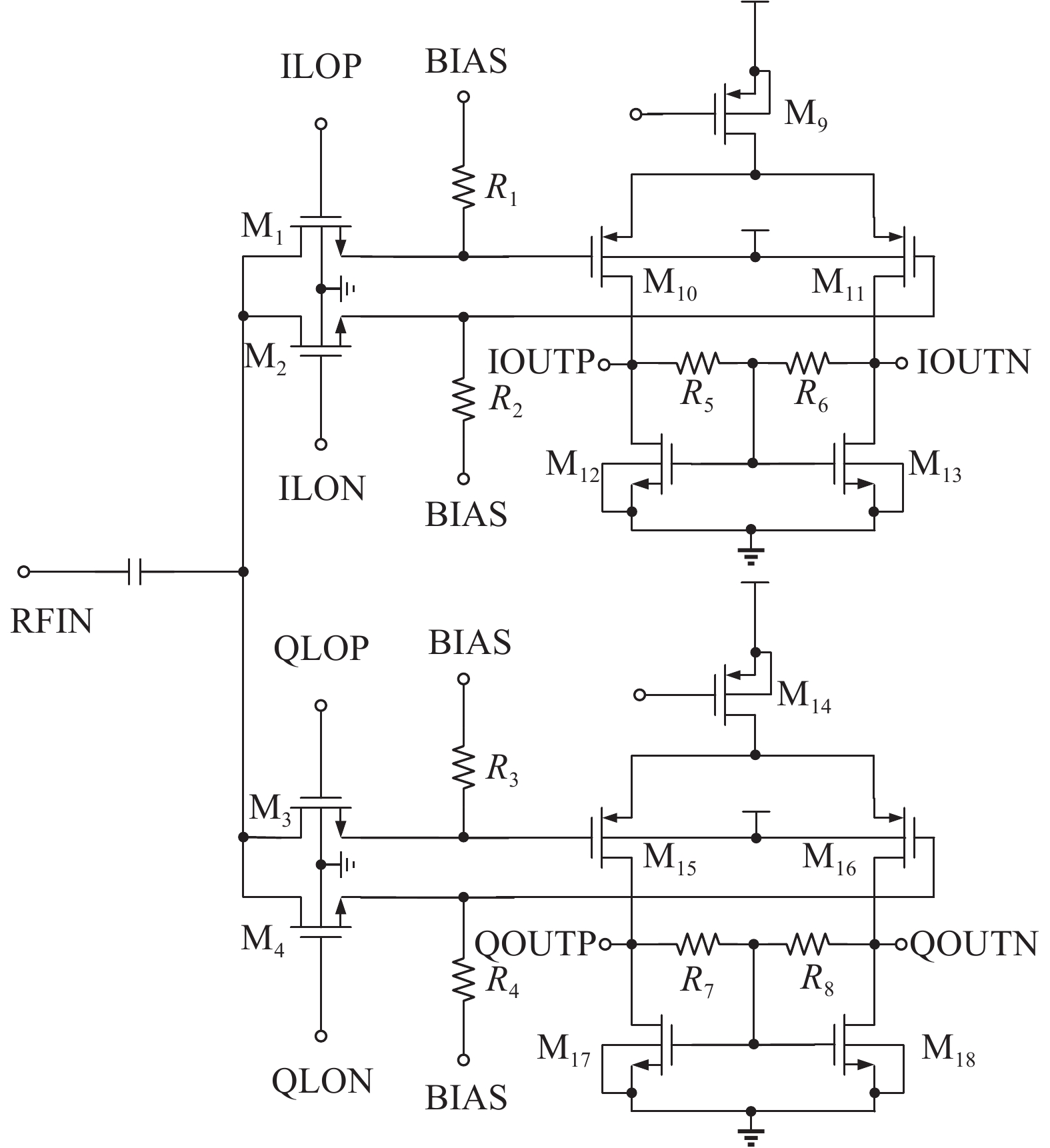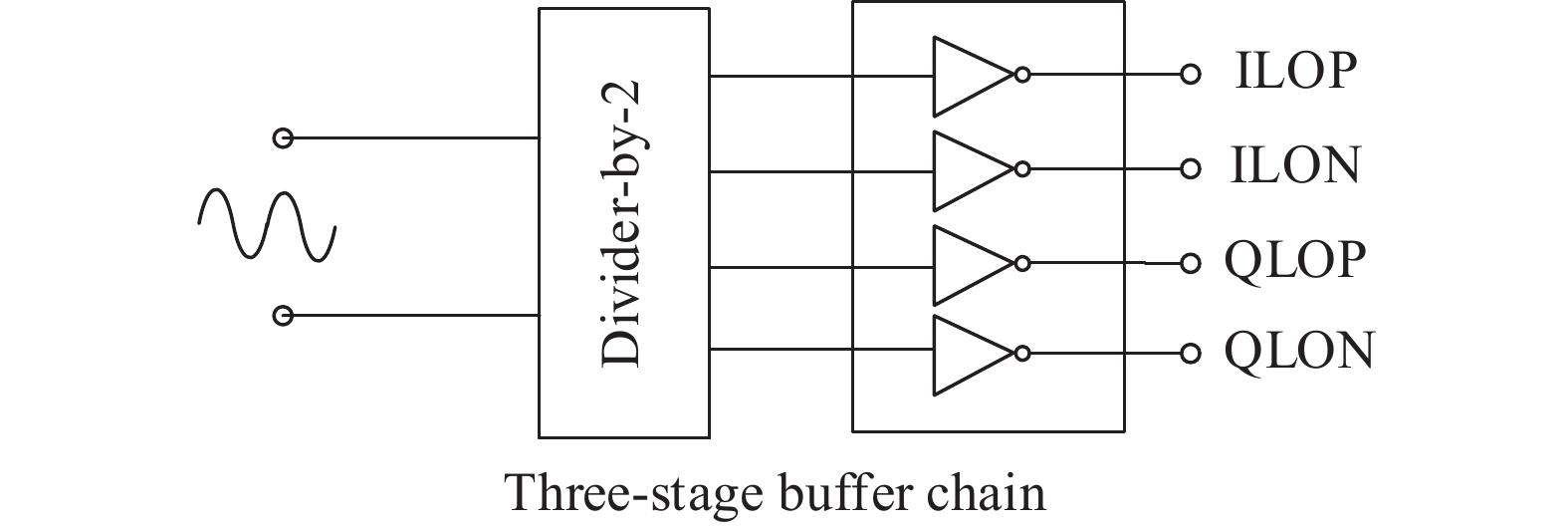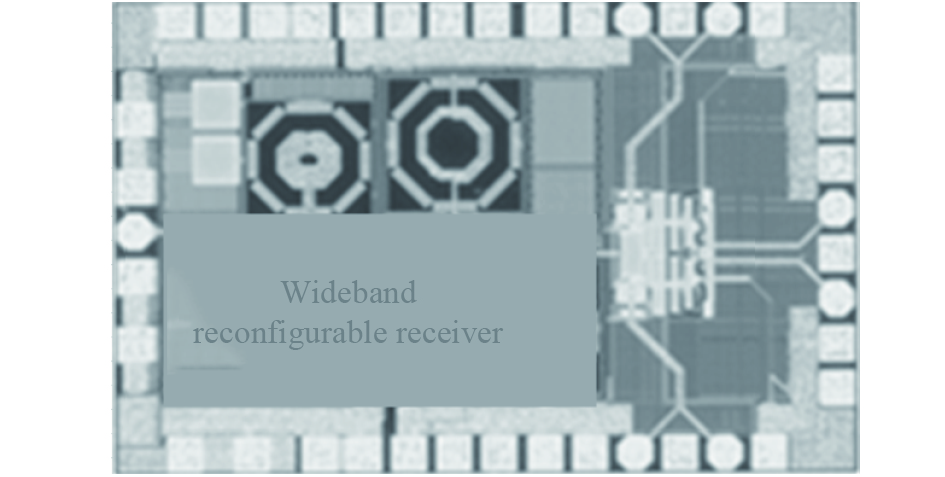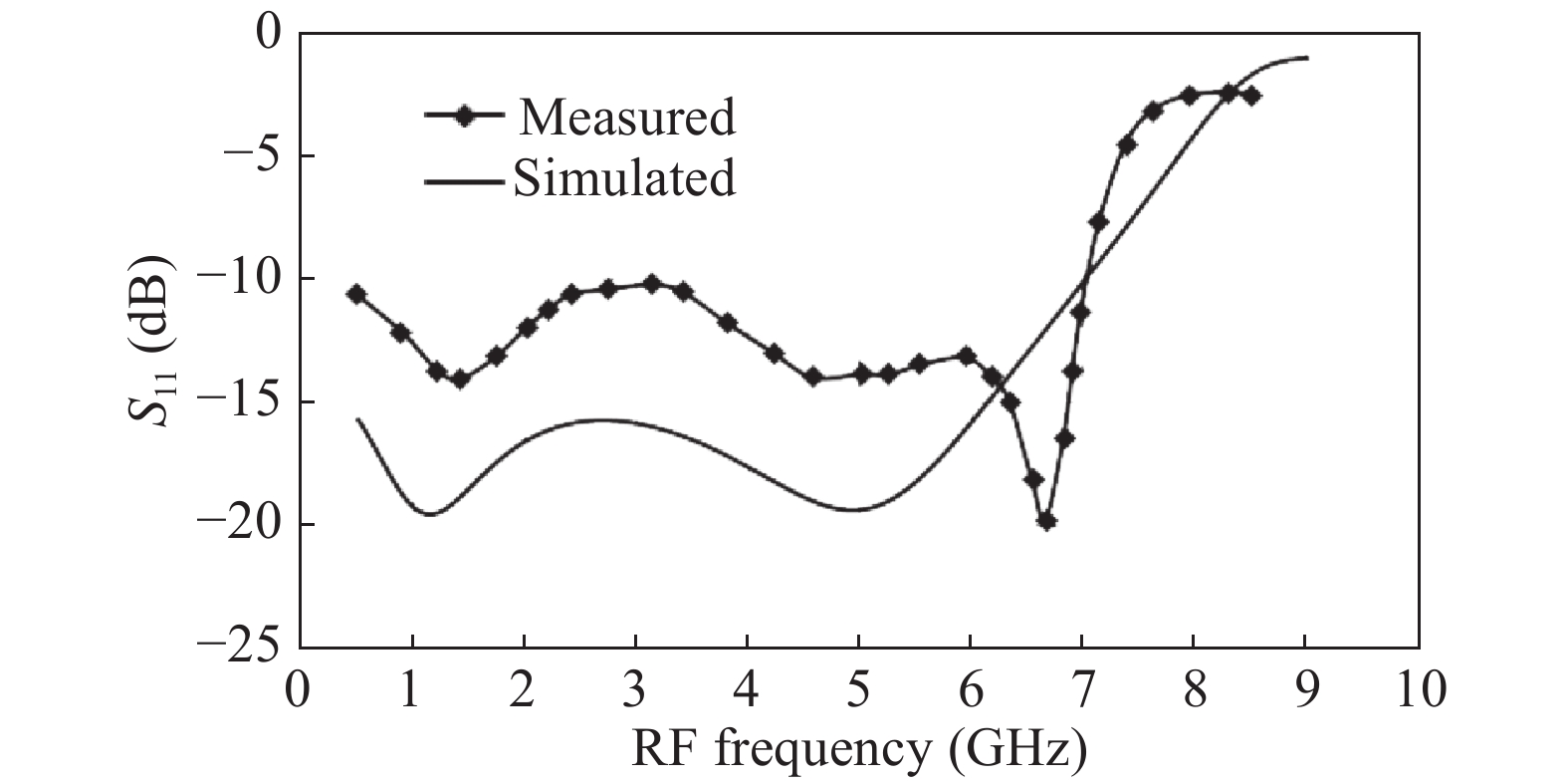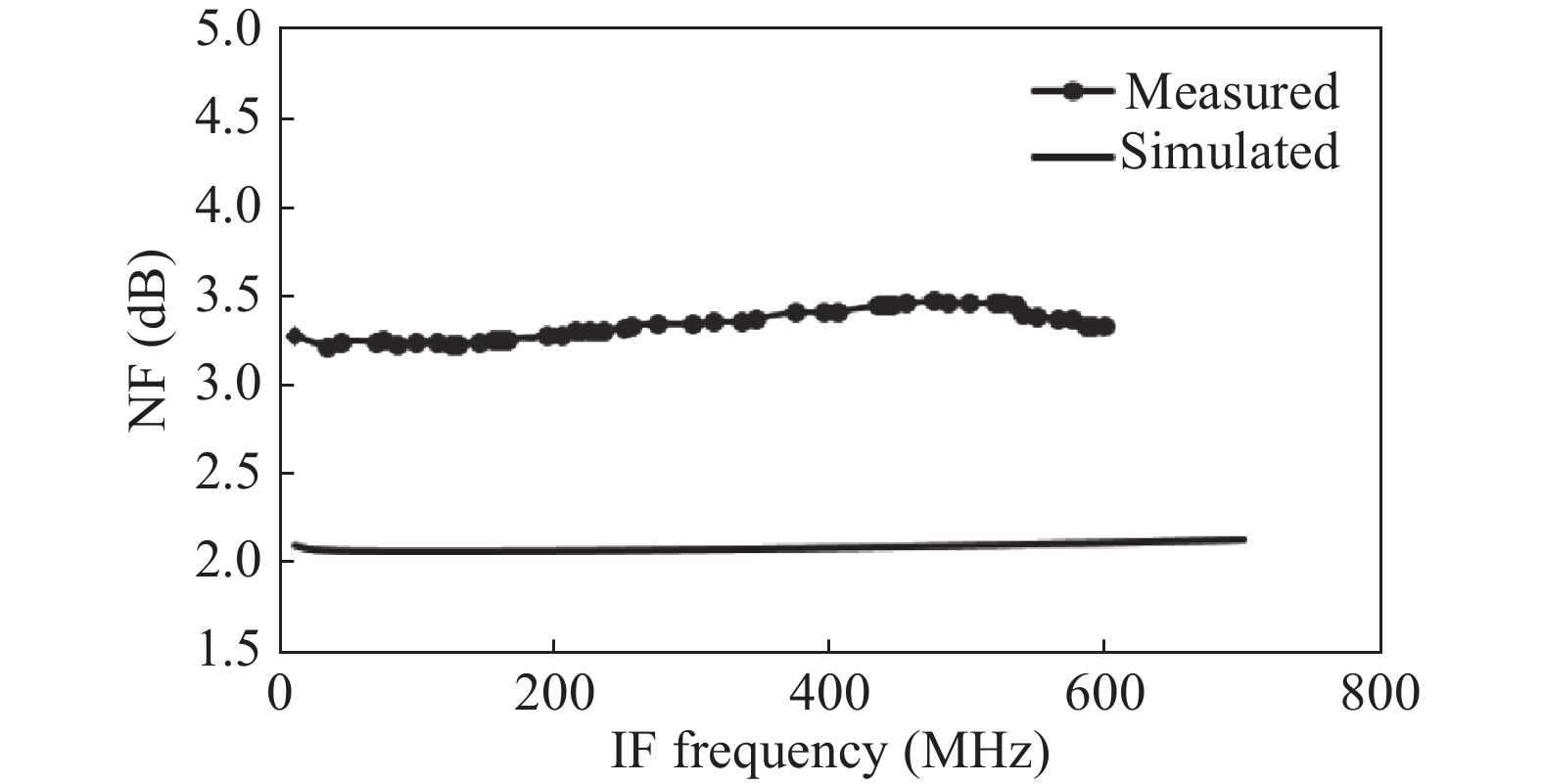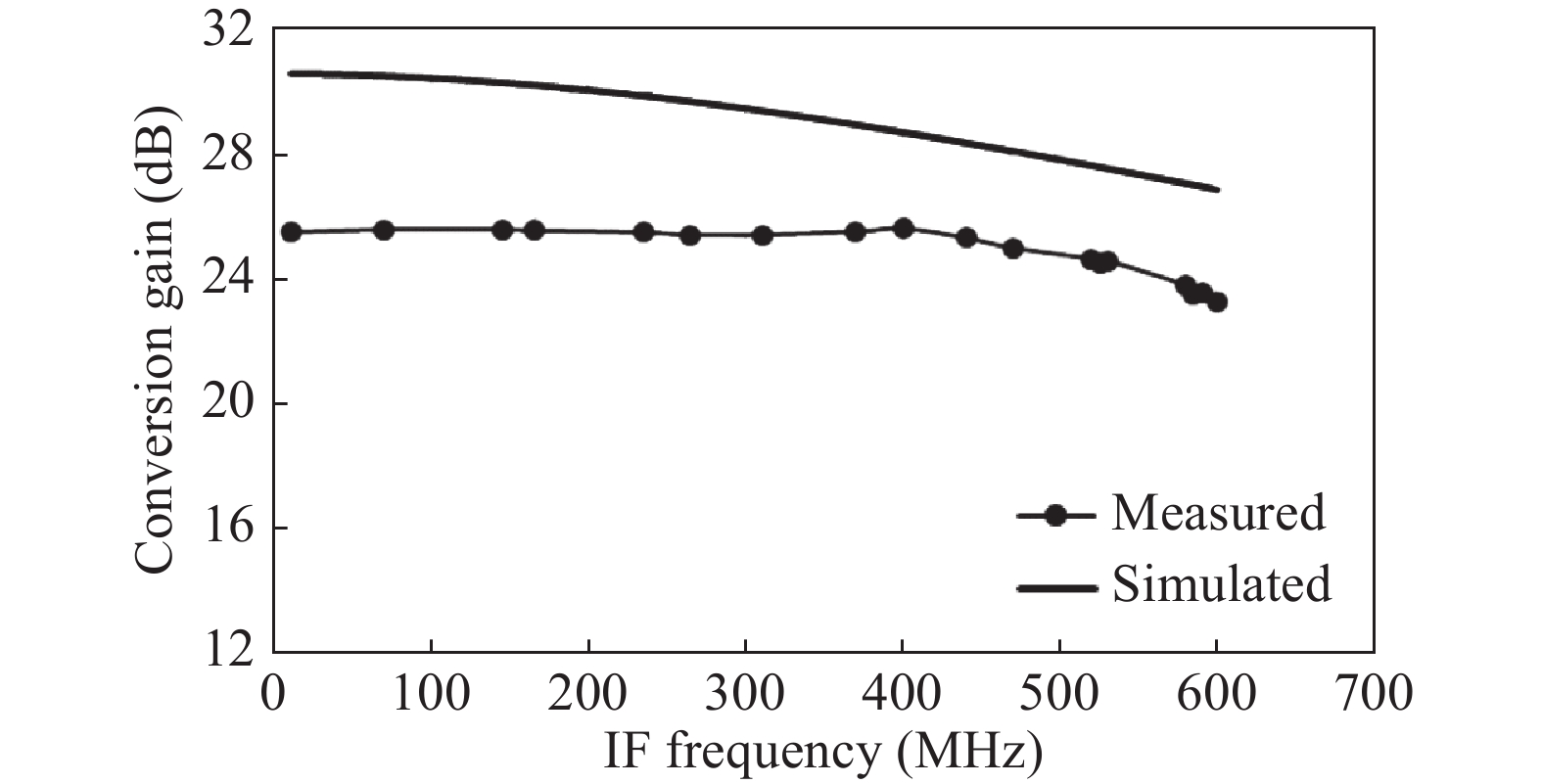


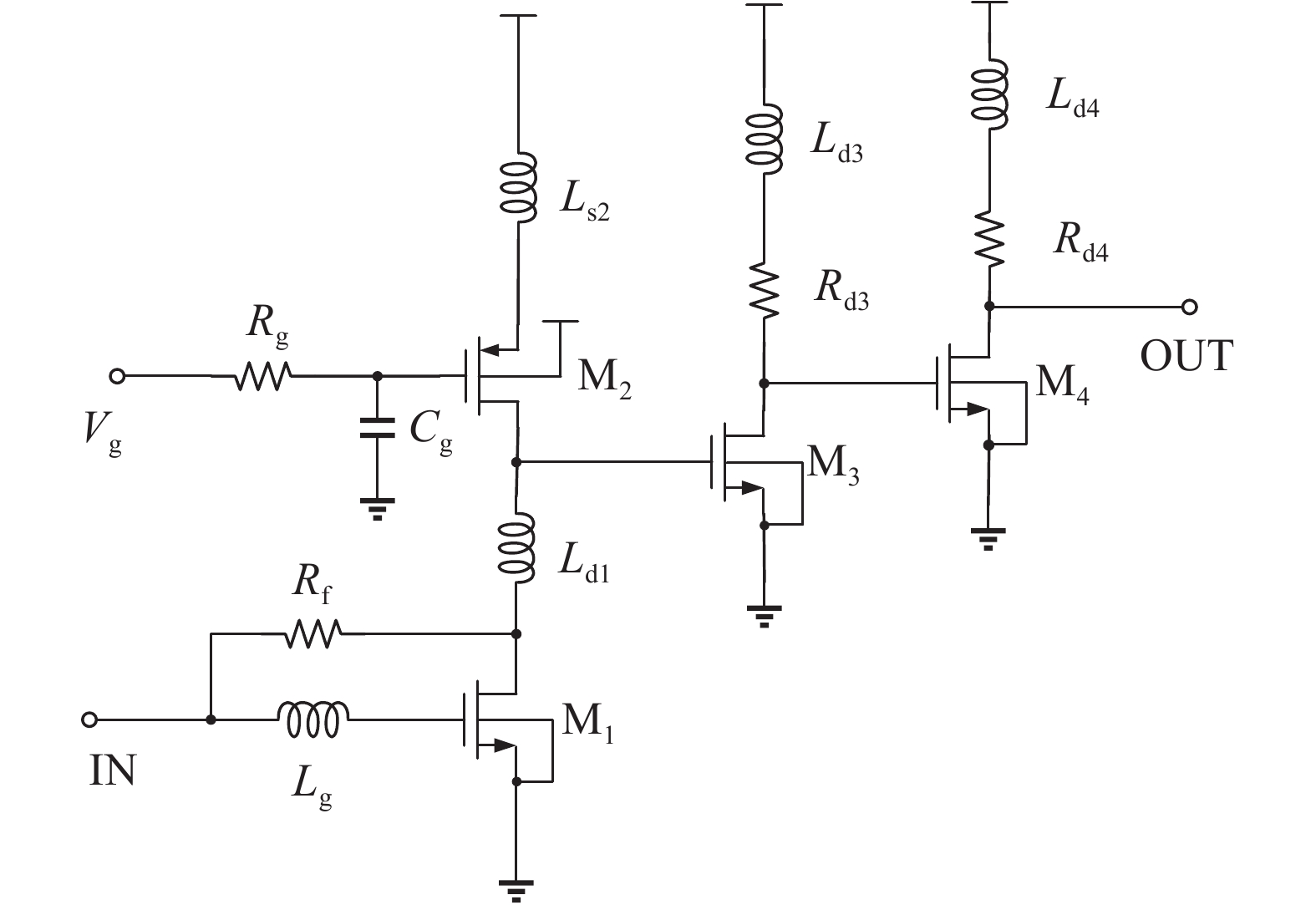
Fig. 1.
Simplified schematic of the proposed wideband LNA.
SEMICONDUCTOR INTEGRATED CIRCUITS
Youming Zhang1, Lijuan Yang1, Fengyi Huang1, 2, , Nan Jiang2 and Xuegang Zhang1
Corresponding author: Fengyi Huang, Email: fyhuang@seu.edu.cn
Abstract: A 0.7–7 GHz wideband RF receiver front-end SoC is designed using the CMOS process. The front-end is composed of two main blocks: a single-ended wideband low noise amplifier (LNA) and an in-phase/quadrature (I/Q) voltage-driven passive mixer with IF amplifiers. Based on a self-biased resistive negative feedback topology, the LNA adopts shunt-peaking inductors and a gate inductor to boost the bandwidth. The passive down-conversion mixer includes two parts: passive switches and IF amplifiers. The measurement results show that the front-end works well at different LO frequencies, and this chip is reconfigurable among 0.7 to 7 GHz by tuning the LO frequency. The measured results under 2.5-GHz LO frequency show that the front-end SoC achieves a maximum conversion gain of 26 dB, a minimum noise figure (NF) of 3.2 dB, with an IF bandwidth of greater than 500 MHz. The chip area is 1.67 × 1.08 mm2.
Key words: wideband LNA, resistive-feedback, CMOS, passive mixer
| [1] |
Wang X, Sturm J, Yan N, et al. 0.6–3-GHz wideband receiver RF front-end with a feedforward noise and distortion cancellation resistive-feedback LNA. IEEE Trans Microwave Theory Tech, 2012, 60(2): 387 doi: 10.1109/TMTT.2011.2176138
|
| [2] |
Zhou H M, Zhang Y, Yu Y, et al. Analysis and design of a 3.1-10.6 GHz wideband low-noise amplifier using resistive feedback. IEEE International Conference on Ubiquitous Wireless Broadband (ICUWB), 2016: 1
|
| [3] |
Cho K F, Wang S. A 0.4–5.3 GHz wideband LNA using resistive feedback topology. IEEE MTT-S International Conference on Numerical Electromagnetic and Multiphysics Modeling and Optimization (NEMO), 2016: 1
|
| [4] |
Zhang X G, Yang L J, Huang F Y. A 0.3–6 GHz broadband noise cancelling low noise amplifier. International Conference on Integrated Circuits and Microsystems (ICICM), 2016: 144
|
| [5] |
Morena-álvarez-Palencia C D L, Burgos-García M. Broadband RF front-end based on the six-port network architecture for software defined radio. 2010 Milcom Military Communications Conference, 2010: 2137
|
| [6] |
Adiseno I, Ismail M, Olsson H. A wide-band RF front-end for multiband multistandard high-linearity low-IF wireless receivers. IEEE J Solid-State Circuits, 2002, 37(9): 1162
|
| [7] |
Wang C, Li Z Q, Li Q, et al. A broadband 47–67 GHz LNA with 17.3 dB gain in 65-nm CMOS. J Semicond, 2015, 36(10): 105010 doi: 10.1088/1674-4926/36/10/105010
|
| [8] |
Chang T, Chen J, Rigge L A, et al. ESD-protected wideband CMOS LNAs using modified resistive feedback techniques with chip-on-board packaging. IEEE Trans Microwave Theory Tech, 2008, 56(8): 1817 doi: 10.1109/TMTT.2008.927301
|
| [9] |
Chen M Q, Lin J S. A 0.1–20 GHz low-power self-biased resistive-feedback LNA in 90 nm digital CMOS. IEEE Microwave Wireless Compon Lett, 2009, 19(5): 323 doi: 10.1109/LMWC.2009.2017608
|
| [10] |
Liu L, Zhang K, Ren Z, et al. 0.05–2.5 GHz wideband RF front-end exploiting noise cancellation and multi-gated transistors. IEEE Asia-Pacific Microwave Conference, 2015: 1
|
| [11] |
Qiu L, Liu S, Zhang Y, et al. A 0.9–2.6 GHz cognitive radio receiver with spread spectrum frequency synthesizer for spectrum sensing. IEEE Sens J, 2017, 17(22): 7569 doi: 10.1109/JSEN.2017.2760339
|
| [12] |
Wu L, Ng A W L, Zheng S, et al. A 0.9–5.8-GHz software-defined receiver RF front-end with transformer-based current-gain boosting and harmonic rejection calibration. IEEE Trans Very Large Scale Integr (VLSI) Syst, 2017, 25(8): 2371 doi: 10.1109/TVLSI.2017.2695719
|
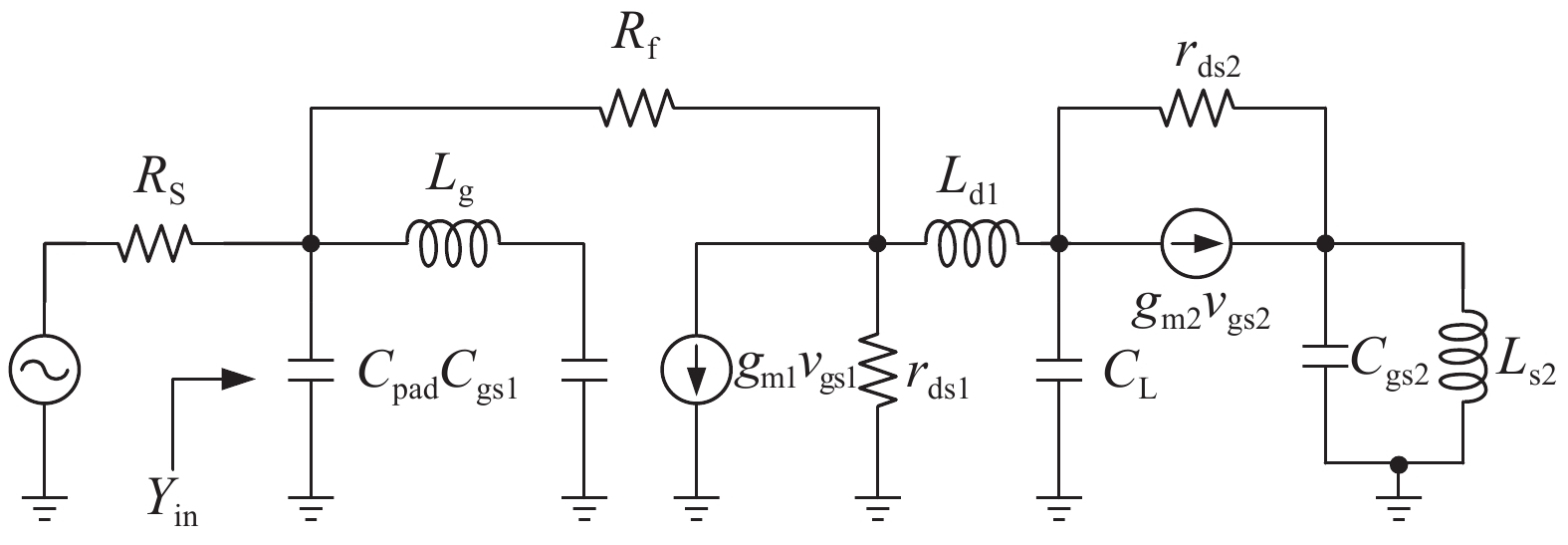
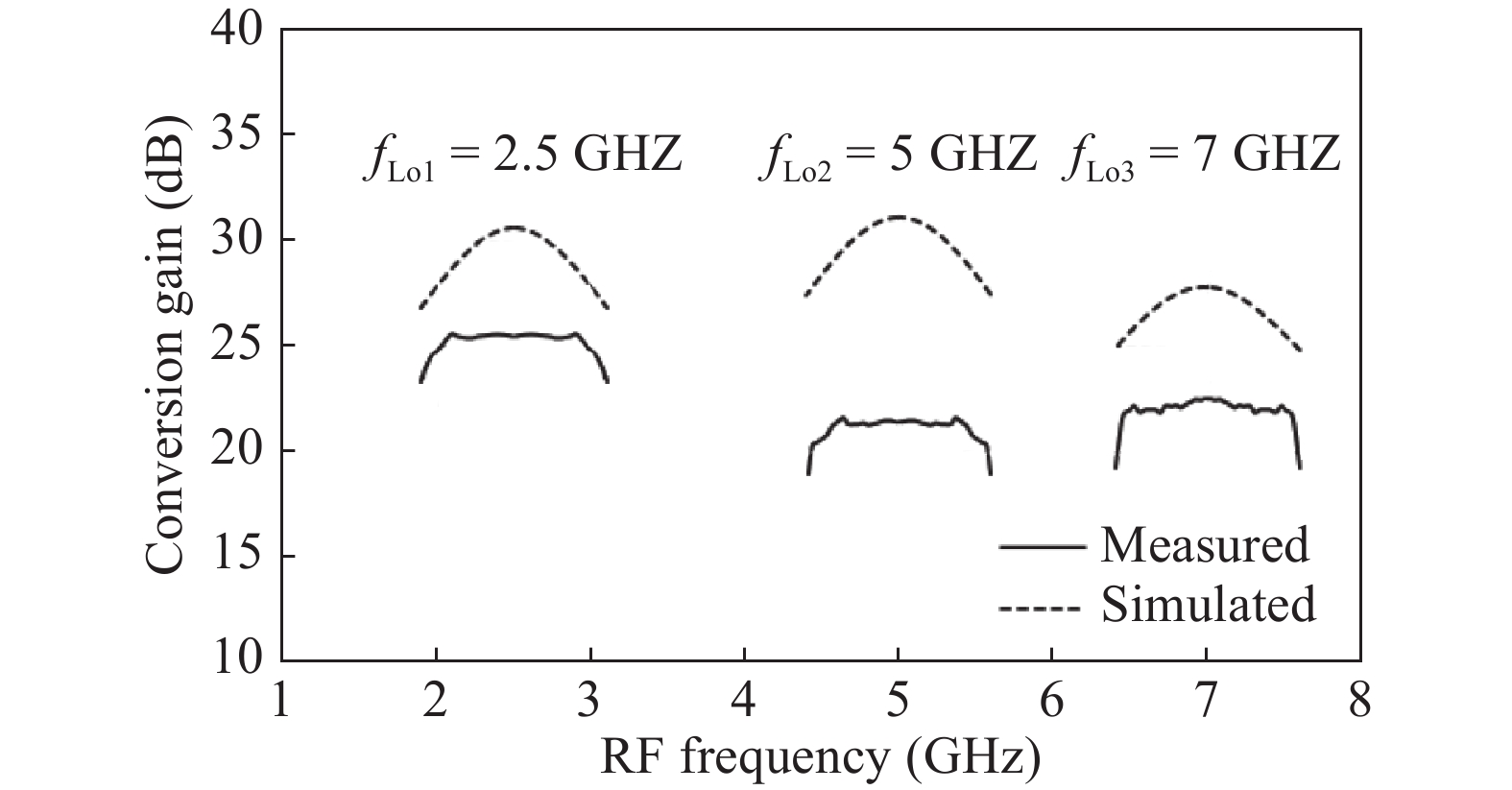
Table 1. Specification of various wireless communication standards and comparisons with this work.
| Parameter | LTE | 802.11g | 802.11ac | This work |
| Frequency (GHz) | 0.9, 1.8, 1.9, 2.0, 2.4, 2.5, 2.6 | 2.4 | 5.8 | 0.7–7 |
| NF (dB) | 5 | 14.8 | 14 | 3.5 |
| IIP3 (dBm) | ?20 | ?22.5 | ?24 | ?19.5 |
| P1dB (dBm) | ?25 | ?26 | ?26 | ?23 |
| Channel BW (MHz) | 20 | 22 | 160 | 600 |
 DownLoad: CSV
Table 2. Performance comparisons with recently published RF receiver front-end.
| Parameter | RF band (GHz) | IF Bandwidth (MHz) | Gain (dB) | NF(DSB) (dB) | S11 (dB) | Area (mm2) | Supply (V) |
| This work | 0.7–7 | 600 | 26 | 3.2–3.5 | < ?10 | 1.8 | 1.2 |
| Ref. [1] | 0.6–3 | 0.8–12 | 48–42 | 3 | < ?8 | 1.5 | 1.2 |
| Ref. [10] | 0.05–2.5 | 0.3–20 | 22–30 | 2.7–4.5 | – | 1.36 | 1.8 |
| Ref. [11] | 0.9–2.6 | 35–70 | 33.5 | 5.3 | < ?10 | 2.75* | 1.8 |
| Ref. [12] | 0.9–5.8 | – | 22–25 | < 4 | < ?10 | 4.2 | 1.2 |
| * The area of whole receiver. | |||||||
DownLoad: CSV
| [1] |
Wang X, Sturm J, Yan N, et al. 0.6–3-GHz wideband receiver RF front-end with a feedforward noise and distortion cancellation resistive-feedback LNA. IEEE Trans Microwave Theory Tech, 2012, 60(2): 387 doi: 10.1109/TMTT.2011.2176138
|
| [2] |
Zhou H M, Zhang Y, Yu Y, et al. Analysis and design of a 3.1-10.6 GHz wideband low-noise amplifier using resistive feedback. IEEE International Conference on Ubiquitous Wireless Broadband (ICUWB), 2016: 1
|
| [3] |
Cho K F, Wang S. A 0.4–5.3 GHz wideband LNA using resistive feedback topology. IEEE MTT-S International Conference on Numerical Electromagnetic and Multiphysics Modeling and Optimization (NEMO), 2016: 1
|
| [4] |
Zhang X G, Yang L J, Huang F Y. A 0.3–6 GHz broadband noise cancelling low noise amplifier. International Conference on Integrated Circuits and Microsystems (ICICM), 2016: 144
|
| [5] |
Morena-álvarez-Palencia C D L, Burgos-García M. Broadband RF front-end based on the six-port network architecture for software defined radio. 2010 Milcom Military Communications Conference, 2010: 2137
|
| [6] |
Adiseno I, Ismail M, Olsson H. A wide-band RF front-end for multiband multistandard high-linearity low-IF wireless receivers. IEEE J Solid-State Circuits, 2002, 37(9): 1162
|
| [7] |
Wang C, Li Z Q, Li Q, et al. A broadband 47–67 GHz LNA with 17.3 dB gain in 65-nm CMOS. J Semicond, 2015, 36(10): 105010 doi: 10.1088/1674-4926/36/10/105010
|
| [8] |
Chang T, Chen J, Rigge L A, et al. ESD-protected wideband CMOS LNAs using modified resistive feedback techniques with chip-on-board packaging. IEEE Trans Microwave Theory Tech, 2008, 56(8): 1817 doi: 10.1109/TMTT.2008.927301
|
| [9] |
Chen M Q, Lin J S. A 0.1–20 GHz low-power self-biased resistive-feedback LNA in 90 nm digital CMOS. IEEE Microwave Wireless Compon Lett, 2009, 19(5): 323 doi: 10.1109/LMWC.2009.2017608
|
| [10] |
Liu L, Zhang K, Ren Z, et al. 0.05–2.5 GHz wideband RF front-end exploiting noise cancellation and multi-gated transistors. IEEE Asia-Pacific Microwave Conference, 2015: 1
|
| [11] |
Qiu L, Liu S, Zhang Y, et al. A 0.9–2.6 GHz cognitive radio receiver with spread spectrum frequency synthesizer for spectrum sensing. IEEE Sens J, 2017, 17(22): 7569 doi: 10.1109/JSEN.2017.2760339
|
| [12] |
Wu L, Ng A W L, Zheng S, et al. A 0.9–5.8-GHz software-defined receiver RF front-end with transformer-based current-gain boosting and harmonic rejection calibration. IEEE Trans Very Large Scale Integr (VLSI) Syst, 2017, 25(8): 2371 doi: 10.1109/TVLSI.2017.2695719
|









Article views: 4979 Times PDF downloads: 112 Times Cited by: 0 Times
Received: 25 July 2017 Revised: 26 March 2018 Online: Uncorrected proof: 16 May 2018Published: 09 August 2018
| Citation: |
Youming Zhang, Lijuan Yang, Fengyi Huang, Nan Jiang, Xuegang Zhang. A 0.7–7 GHz wideband reconfigurable receiver RF front-end in CMOS[J]. Journal of Semiconductors, 2018, 39(8): 085003. doi: 10.1088/1674-4926/39/8/085003
****
Y M Zhang, L J Yang, F Y Huang, N Jiang, X G Zhang, A 0.7–7 GHz wideband reconfigurable receiver RF front-end in CMOS[J]. J. Semicond., 2018, 39(8): 085003. doi: 10.1088/1674-4926/39/8/085003.

|
| [1] |
Wang X, Sturm J, Yan N, et al. 0.6–3-GHz wideband receiver RF front-end with a feedforward noise and distortion cancellation resistive-feedback LNA. IEEE Trans Microwave Theory Tech, 2012, 60(2): 387 doi: 10.1109/TMTT.2011.2176138
|
| [2] |
Zhou H M, Zhang Y, Yu Y, et al. Analysis and design of a 3.1-10.6 GHz wideband low-noise amplifier using resistive feedback. IEEE International Conference on Ubiquitous Wireless Broadband (ICUWB), 2016: 1
|
| [3] |
Cho K F, Wang S. A 0.4–5.3 GHz wideband LNA using resistive feedback topology. IEEE MTT-S International Conference on Numerical Electromagnetic and Multiphysics Modeling and Optimization (NEMO), 2016: 1
|
| [4] |
Zhang X G, Yang L J, Huang F Y. A 0.3–6 GHz broadband noise cancelling low noise amplifier. International Conference on Integrated Circuits and Microsystems (ICICM), 2016: 144
|
| [5] |
Morena-álvarez-Palencia C D L, Burgos-García M. Broadband RF front-end based on the six-port network architecture for software defined radio. 2010 Milcom Military Communications Conference, 2010: 2137
|
| [6] |
Adiseno I, Ismail M, Olsson H. A wide-band RF front-end for multiband multistandard high-linearity low-IF wireless receivers. IEEE J Solid-State Circuits, 2002, 37(9): 1162
|
| [7] |
Wang C, Li Z Q, Li Q, et al. A broadband 47–67 GHz LNA with 17.3 dB gain in 65-nm CMOS. J Semicond, 2015, 36(10): 105010 doi: 10.1088/1674-4926/36/10/105010
|
| [8] |
Chang T, Chen J, Rigge L A, et al. ESD-protected wideband CMOS LNAs using modified resistive feedback techniques with chip-on-board packaging. IEEE Trans Microwave Theory Tech, 2008, 56(8): 1817 doi: 10.1109/TMTT.2008.927301
|
| [9] |
Chen M Q, Lin J S. A 0.1–20 GHz low-power self-biased resistive-feedback LNA in 90 nm digital CMOS. IEEE Microwave Wireless Compon Lett, 2009, 19(5): 323 doi: 10.1109/LMWC.2009.2017608
|
| [10] |
Liu L, Zhang K, Ren Z, et al. 0.05–2.5 GHz wideband RF front-end exploiting noise cancellation and multi-gated transistors. IEEE Asia-Pacific Microwave Conference, 2015: 1
|
| [11] |
Qiu L, Liu S, Zhang Y, et al. A 0.9–2.6 GHz cognitive radio receiver with spread spectrum frequency synthesizer for spectrum sensing. IEEE Sens J, 2017, 17(22): 7569 doi: 10.1109/JSEN.2017.2760339
|
| [12] |
Wu L, Ng A W L, Zheng S, et al. A 0.9–5.8-GHz software-defined receiver RF front-end with transformer-based current-gain boosting and harmonic rejection calibration. IEEE Trans Very Large Scale Integr (VLSI) Syst, 2017, 25(8): 2371 doi: 10.1109/TVLSI.2017.2695719
|

 WeChat ID
Journal of Semiconductors © 2017 All Rights Reserved 京ICP備05085259號-2